
Petritsch on the ban of the dinar: Pristina's decision was not politically smart
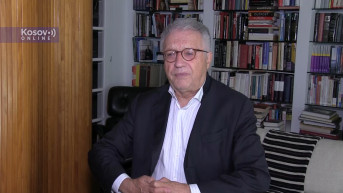
Former EU Envoy for Kosovo, Wolfgang Petritsch, assessed that Pristina's decision to ban the use of the dinar in Kosovo had not been politically wise, as it further deepened the conflict.
In a statement to Kosovo Online, Petritsch pointed out the need to prevent a worsening of the security situation.
Commenting on the decision of the Central Bank of Kosovo to ban the use of the dinar, Petritsch says that the measure is "formally correct" because if Pristina sees itself as a sovereign state, then it can have the currency of its choice on its territory. However, he emphasizes that this decision is not politically wise.
He draws a parallel with the situation in Bosnia and Herzegovina before the introduction of the convertible mark as the currency in that country.
"In Bosnia and Herzegovina, they had the kuna and the dinar, and that's why the convertible mark was introduced. After Kosovo, I was in Bosnia and Herzegovina, and I remember how difficult it was to convince people to accept a single currency... That is the formal side, practically, and the political side is not good. A decision should not be made that is known to deepen the conflict," Petritsch pointed out.
Therefore, he is convinced that negotiations need to progress as quickly as possible and appeals to Brussels, to the EU Special Representative Miroslav Lajcak, and the EU High Representative for Foreign Affairs and Security Policy, Josep Borrell, as it is necessary to inject new dynamics into the talks.
"Will it be possible to conclude the negotiations this year? I doubt it. There are too many elections in Europe, in the EU, Austria, and the US. But I believe that Europe must appeal to both sides not to take impulsive steps. This has now happened with the currency. An attempt will be made to find a transitional solution. So, politically it wasn't wise, but formally, a sovereign state can make such decisions," Petritsch believes.
Regarding the reaction of the international community, the US and the EU have urged Pristina not to implement that decision, which Kosovo has ignored, considering that the Kosovo authorities have invaded and closed Serbian institutions in recent days, such as the clinic in Pristina, which all raises the question of whether Kurti is interested in dialogue and a solution with Serbia, Petritsch says that some of his statements and actions do not contribute to compromise.
"I have known Kurti for many years. He has a strong, excellent political mindset. That doesn't make negotiations with him easier. Since he is smart, he always finds opportunities to show Belgrade who he is and what his politics are. Unfortunately, that's not good when it comes to finding a compromise and when we must not allow new tensions to be fueled. We must prevent any worsening of the security situation at all costs," the President of the Marshal Fund in Austria warned.
Therefore, he notes that Pristina needs to be strongly told not to take impulsive actions because it can be harmful.
When asked whether the reaction of the international community was just a pretense, he says that it seems to him that the international community is not approaching preventing unfavorable things with full determination because, for example, it is known that the EU does not implement decisions with determination when elections are looming.
"At the international level, especially in the EU, just before the elections, after which we will also get a new European Commission, a high representative for foreign and security policy, and perhaps a new negotiator instead of Miroslav Lajcak, I have the impression that the approach is not with full determination to prevent unfavorable things. It is known in the EU that before elections, policies are no longer implemented with such determination. Unfortunately," Petritsch stated.
He believes that restraint should be demanded from both sides to avoid a political deadlock that could lead to military escalation.
"This must be prevented at all costs. I appeal to the responsibility of the politicians involved," Petritsch warned.
When asked what could be expected in the Balkans from the EU elections, given the rise in the popularity of the right, he expresses concern about the outcome of the EU elections, as well as after the US elections in November.
"This could bring the whole thing into a new situation, which I hope will not be a burden on the Western Balkans, Serbia, Kosovo, Bosnia and Herzegovina. It should be understood that nationalist politics, as well as Trump's 'America First' policy, imply things that may look good at first glance but ultimately harm. Especially in the Western Balkans, where work is being done on the integration of the region into the EU, on strengthening the Union by consolidating the territory... It is not an enlargement because the Western Balkans is surrounded by EU countries, and that must not be forgotten," Petritsch said.
He appeals to Pristina to pursue a policy of compromise, and to Belgrade - to have the courage to realize that, in the long run, Serbia and the Serbs in other countries can be united only in Europe, not somewhere else.
"That would make the problem of Republika Srpska and the problem of Kosovo easier. The problem won't be automatically solved, but if you are in the same community, it is easier to regulate problems," Petritsch said.

0 comments