
Petritsch: I share Petkovic's stance; I don't believe that any attacks on Kosovo are being prepared in Belgrade
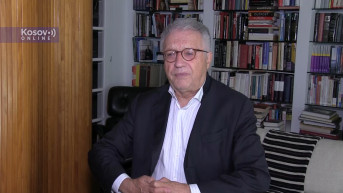
Former EU Special Representative for Kosovo, Wolfgang Petritsch, stated today for Kosovo Online that he did not believe that any attacks or military actions on Kosovo were being prepared in Belgrade. He emphasizes that he does not expect any significant progress in the normalization of relations between Serbia and Kosovo in the coming year, primarily due to the elections in the EU and the US.
Following the claims of Kosovo's Prime Minister Albin Kurti that Serbia is preparing a new attack on Kosovo and the response of the Director of the Office for Kosovo and Metohija, Petar Petkovic, calling it a fabrication, Petritsch says he shares Petkovic's stance.
"I am on Petkovic's side. I cannot imagine that attacks or military actions are being prepared in Belgrade. Banjska created a difficult situation because it created the impression that Belgrade does not have full control over the situation at the border", Petritsch said.
When asked whether Kurti was using the situation in Serbia, after the elections, to impose sanctions on Belgrade, he responds that he is very skeptical about that and, as a diplomat who always insists on dialogue, believes that sanctions are always the last solution.
"Especially in the dialogue process, one should try to prevent the situation from escalating with sanctions. It brings nothing. I believe it is important to show that the EU is ready for it. Now, I would expect the Union to take steps towards negotiating at the technical level on the details of the CSM. Citizens should be more actively involved in this, as the Serbs who will be affected by this should have a voice", Petritsch says, adding that it is important that the EU is trying to increase citizen participation in more and more countries, a principle that is increasingly taken into account in diplomatic processes and mediation.
It is important to involve those to whom this concerns, primarily the Serbs, but also Kosovo Albanians.
Therefore, he emphasizes, there is a particular responsibility on Pristina.
"We should assess what works in southern Kosovo, where the majority of Serbs live in Kosovo. We hear too little about the Serbs from the south, how they are, how they live, whether something can be learned from that or if their fate and life can be improved, and whether this can be taken into account in the drafting of the CSM", Petritsch says.
Regarding the incidents in Rajska Banja, in Banjska, and the confiscation of Serbian property, he appeals to both sides, especially to Pristina, not to take provocative steps but to try to act in agreement with the people living there.
"This is an appeal to Pristina, and it is important that this happens. If Kosovo claims to be a state - then it must act like a state; otherwise, the international community will say what is happening and that it is not working. It is crucial to try there, and the EU and Lajcak should emphasize more, to talk to people on the ground and not do anything against the local population", Petritsch pointed out.
Regarding expectations regarding the Kosovo issue in the coming year, Petritsch notes that 2024 will be challenging because two important election processes are coming up, which decisively influence the development of the situation in Kosovo - the elections for the European Parliament and in the United States.
This means that the two main actors in the Western Balkans, especially regarding Kosovo, will not be able to make political decisions for several months, so everyone will have to be careful not to change the security situation next year, he explains.
The only thing that can be done, and both sides have reacted, especially Belgrade, is to reinforce KFOR personnel, Petritsch added, believing that this is the right path.
"We must ensure that the northern part of Kosovo, the border between Kosovo and Serbia, is effectively monitored by international forces", he believes.
In political negotiations, he does not see significant possibilities for progress during 2024, until the establishment of the new European Commission and the appointment of a new head of EU foreign policy.
However, he sees possibilities for progress in technical negotiations.
"Experts can further negotiate the issue of the CSM. There has been no progress on this issue for 10 years, and it should not be like that. Progress needs to be made at the technical level", Petritsch is clear.
Decisive, he says, is what will happen in the US elections.
"Whether Joseph Biden will be re-elected, or whether Donald Trump will return. Both things are difficult to assess now, there are big question marks. I am convinced that the international community must be careful not to lead to a military conflict", Petritsch added.
Regarding the message from the EU Special Representative for the Dialogue, Miroslav Lajcak, that the end of January 2024 is the deadline for formalizing an agreement between Belgrade and Pristina, Petritsch believes that it is an ambitious announcement.
"I understand Lajcak insisting on that as the one responsible for the dialogue. This year has not been a great success for EU mediation. That's why I completely understand and support that. Realistically, I am a bit skeptical. I don't know if it can succeed, considering that there was almost no progress last year. If it is reduced to the technical level, if they deal more strongly with technical issues, something can be achieved at that expert level. Of course, it is clear that Chapter 35 contains the Kosovo issue, and its resolution is a prerequisite for concluding accession negotiations. It is certain that Belgrade and Pristina should make progress", Petritsch said, adding that, for example, the Middle East showed how a problem that had not been resolved for many years led to a dangerous development of events.
In response to Kurti's reply to Lajcak, stating that the Constitutional Court should analyze the draft of the CSM Statute and that he could create his proposal, and the question of whether Pristina's goal is actually further delaying the fulfillment of that obligation, Petritsch responds that the delay is politically motivated and that Kurti is now in a difficult position because he previously said that the CSM would not happen.
"That can't be the case. His predecessors signed it ten years ago, and the signatures of governments are valid for the following governments. This is an important principle in international law. Pristina must also respect that", Petritsch is clear.
In a recently published comment on the conflict in the Middle East in the Viennese newspaper Die Presse, Petritsch warned of Austria's one-sidedness on the issue. When asked whether there is one-sidedness in the EU towards Serbia regarding Kosovo, he notes that the EU, as seen in the voting in the United Nations, does not speak with a unified voice.
"My impression is that a unified stance is more strongly present in the Western Balkans, but countries like Austria have a greater interest in a solution than countries further north on the European continent. We are neighbors; we have a strong connection, and that should never be forgotten. We Austrians, together with Serbs, the Albanians from Kosovo, with the peoples of the former Yugoslavia, have a centuries-old connection. This connection is important, and it leads to Austria having great respect for the region's enormous cultural contributions. It is necessary to bring this into the EU. The EU creates ideal conditions for Serbs spread across multiple countries. I believe that Serbs need to understand more strongly than before that the future is in the EU, where they will be united. As was the case with Austria and South Tyrol. There were conflicts during the 1960s, escalations, and terrorism between Austria and Italy. An agreement was reached that resolved it, and now people live together in Central Europe in the EU. I expect the same for the region between Kosovo, northern Kosovo, and Serbia. That borders will be abolished", Petritsch says.
He notes that in the Union, it is clear that in such situations, reconciliation in border regions strongly contributes to increased prosperity.
"It was the case between Germany and France. These are real bonds in the EU between different peoples", he added.
In response to the question of whether such a solution is possible for northern Kosovo under the leadership of Albin Kurti, he replied:
"Kurti is an intelligent, principled politician who still has problems because, during Slobodan Milosevic's time, he was a political prisoner in Serbia. This limits his tolerance threshold. I told him personally that it is very important and that the Serbs and the Albanians can function together when they get closer to each other. Moral principles cannot be applied when there is no readiness for compromise".
0 comments