
Petritsch: Verdicts must be accepted, protests mean a return to the past
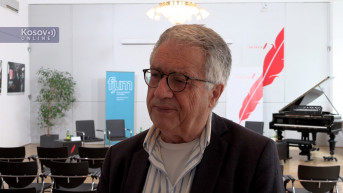
Former European Union envoy for Kosovo Wolfgang Petritsch said that court decisions must be accepted because the rule of law requires crimes to be punished, and pointed out that protests over the verdict against KLA leaders mean a return to the past, while assessing that they will not last long.
“It is always difficult to accept the verdicts of an international court, primarily because of the image of people in their countries of origin, and this applies not only to Kosovo, but also to Bosnia and Herzegovina and Serbia. These courts make decisions based on certain criteria, and when the evidence is clear, a verdict follows,” Petritsch explained in a statement to Kosovo Online.
He said that one can disagree with a verdict or feel disappointed and protest, but that the verdict must be accepted.
“Court verdicts must be accepted. And that is lacking not only in Kosovo at the moment, but also in Serbia, where a state funeral was recently organized, which was a sign that the past, from 30 years ago, still shapes the present,” Petritsch said.
He expressed his belief that the protests over the guilty verdict against the KLA leaders would not last long.
He stressed that the verdict is “certainly tragic for those convicted”, but if they committed war crimes and criminal offenses against civilians, then it is clear that the verdict must be accepted.
“This applies to the entire region, including Kosovo. Of course, the verdict does not mean collective guilt. There is no collective guilt, either in Serbia or in Kosovo. What exists is individual guilt, which must be punished. The rule of law requires that crimes that have been committed be punished,” Petritsch stressed.
He noted that protests and denial of the verdict represent a return to the past.
He observes that Kosovo attaches importance to the “great narrative of the liberation struggle”, but also adds that it is “a fact that ethnic Albanians were oppressed by Belgrade, against which they defended themselves”.
“Unfortunately, and I see this as a fundamental failure of the international community, the peaceful alternative offered by Ibrahim Rugova was not seriously considered in the capitals of Europe and the United States. For that reason, there is a certain degree of shared responsibility for the military conflicts that took place in 1998 and 1999,” the former EU special envoy for Kosovo stressed.
He also said that this issue could not be resolved at the Rambouillet talks, which he himself attended, because the military escalation had already gone too far.
“The war returned to where the conflict and the breakup of Yugoslavia had begun, and that was Kosovo,” Petritsch said, adding that this was, unfortunately, the final point.
He believes that what has now, many years later, been legally elaborated is an important contribution that will help reconciliation in the long term.
“At this moment, that is not the case, but I am convinced that it will contribute to reconciliation if responsible politicians do not now return to the past, to the time of the war that tore Yugoslavia apart,” Petritsch added.

0 comments