
Radicevic: Regrouping within right-wing movements in EU parties underway
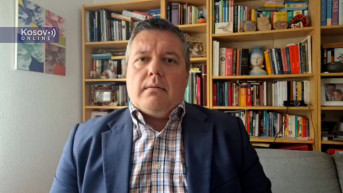
Journalist Nenad Radicevic notes that the attacks on Slovak Prime Minister Robert Fico and other European politicians reflect the polarization of society influenced by the wars in Ukraine and Gaza, as well as the economic conflict between the US and China. He assesses that the attack will have significant effects on Slovakia but not on the upcoming European elections, where realignment within right-wing movements is currently taking place.
"These attacks are a sign of this polarization, which is not only characteristic of the EU but is also widespread in America and parts of Asia. It is conditioned, on the one hand, by wars that cause considerable anxiety, both in Ukraine and Gaza, and on the other hand by the economic conflict between the US and China, forcing many countries to choose sides. In this choosing, there are many decisions without consensus in many societies, which causes great polarization. Additionally, the cultural war between globalist, left-wing liberals and the so-called patriotic-identity forces further exacerbates the situation, leading to attacks such as this one on a current EU leader after many years," Radicevic explains.
He points out that Slovak society is quite divided and that this tension has lasted for several years, particularly intensified since the pandemic and the energy and financial crises that followed the start of the war in Ukraine.
"Two poles are essentially at war – one represented by Robert Fico and several parties close to him, and the other moderately conservative, pro-European one, favored by official Brussels. Fico included an extreme right-wing party in the government he formed last year, leading to their suspension from the group of European socialists and progressive parties in the European Parliament, indicating sanctions even at that level, not to mention recent moves causing concern in the Brussels administration," our interlocutor explains.
He notes an increase in incidents involving attacks on politicians but does not believe it could lead to broader eruptions because the European elections are not seen as dramatically important by the general public, despite many significant decisions being made in the European Parliament.
In Germany, he adds, the public is not very interested in European elections, but it was deliberately decided to hold local government elections on the same day, so turnout is not expected to be low. Regarding incidents, the media mainly reported on the attack on one politician, but there were actually several.
"Sometimes these were verbal attacks, sometimes physical, while on posters, it seems, there is a campaign war between parties like never before, with election campaigns in Germany also involving posters on poles, not just billboards. Since the rise of Alternative for Germany, there has been a considerable 'poster war,' where parties draw mustaches or otherwise deface each other's posters. The tension is much more noticeable than before, but there is no indication it could lead to significant outpourings of dissatisfaction or greater aggression," Radicevic says.
On the other hand, he assesses that the attack on Fico, except in the Slovak context, should not impact European right-wingers since his party is ideologically left-leaning, despite having many positions that could be classified as right-wing. The real earthquake, he says, is Marine Le Pen's decision that her MPs will not sit in the same parliamentary group in the European Parliament as Alternative for Germany (AfD).
"This is partly because the main figure, the top candidate on AfD's list for the upcoming European elections, said that not everyone who wore SS uniforms in World War II were necessarily criminals. This statement, among others, led Marine Le Pen to openly say she did not want to cooperate with them. She also wants to distance herself from her main competitor on the European right, Eric Zemmour and his movement. So, behind the scenes, there is a possible new realignment within right-wing or populist movements in the EU," Radicevic says.
He believes there is a possibility of forming a strong bloc of European conservatives, which could include Viktor Orban and his Fidesz, practically expelled from the European Parliament, as well as Marine Le Pen, the Dutch Freedom Party expected to perform very well in the European elections, and Giorgia Meloni and her party.
"This would lead to European conservatives, for the first time since the UK left, being a significant force in the EU, with their voices being much more strongly heard than those of right-wingers have been so far. Recall that just over a month ago, the current President of the European Commission, Ursula von der Leyen, who is running for re-election, unexpectedly said in a debate that under certain circumstances, there might be a possibility of cooperation between European conservatives and the European People's Party. In this sense, another event might actually change the picture that is now somewhat clear before the European elections," he notes.
Regarding the Balkans, specifically Serbia, he assesses that the situation in Europe after the elections could reflect on the region.
"If European conservatives join the ruling majority in the European Parliament, it would be a significant change, likely including Orban, Marine Le Pen, Giorgia Meloni... This might bring changes in the stance towards the Balkans, perhaps with stricter positions on migration on the one hand and more readiness for compromises on EU membership on the other. This is currently very difficult to predict, as the European path of most Balkan states is largely set, and much depends on major influential members like France and Germany," Radicevic says.



0 comments