
Sainovic: In Rambouillet, the West devised warfare through agreements
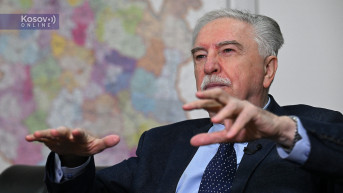
The negotiations in Rambouillet, which began 25 years ago on February 6th, can also be seen as a prelude to later agreements between Belgrade and Pristina, says Nikola Sainovic, who was one of the representatives of the Serbian delegation in the negotiations in 1999.
Sainovic adds that at that time, FR Yugoslavia was offered to accept, with one signature, the occupation of the entire country and the mechanism for declaring independent Kosovo, and he points out that at that moment, the collective West devised a new method of warfare – warfare through agreements.
Sainovic points out for Kosovo Online that the negotiations in Rambouillet were not a singular event and that things started happening before that. In that sense, he mentions that the negotiations in Rambouillet followed negotiations with Ibrahim Rugova regarding education in 1998, as well as negotiations with Rugova mediated by Christopher Hill on the drafting of a self-governance document in Kosovo.
All of that, he says, lasted until the autumn of 1998, and then suddenly 'America changes sides'.
"America abandons Rugova, abandons Vatican mediation on education, and Christopher Hill, along with Holbrooke, sits down with that bearded member of the KLA in Junik with Kalashnikovs and demonstrates that America has switched to the armed side within the Albanian corpus. Then battles ensue, the pacification of the KLA, Walker arrives, who was initially cooperative but then works to bring back the KLA and prepare a new conflict for us. Meanwhile, NATO is preparing for the conflict, and in those preparations, formal negotiations are made. Why formal – because we never sat down to talk with the other side. Rugova and their academic, Rexhep Qosja, came as leaders. They were left out in the rain, and Madeleine Albright declared Hashim Thaci as the leader of the Albanian side. There were no negotiations," Sainovic narrates.
He emphasizes that the content of the negotiations was the surrender of the sovereignty of FR Yugoslavia, not Kosovo but the entire country, to a group of countries.
"They gave us a treaty with 'NATO Political Council' written on it, signed by foreign ministers, supposed to represent the NATO government. We give them the entire territory; they come with weapons and have the right to arrest whoever they want. It's a classic occupation, valid for three years, and after those three years, the Kosovo problem will be resolved according to the will of the people. Initially, it said 'referendum,' and we said, 'What referendum?' and then the will of the people was left. We were supposed to accept, with that one signature, both the occupation and the mechanism for declaring independent Kosovo. We refused," he said.
As he emphasizes, even today, if someone proposed something like that to him, he would not be able to sign it.
After those negotiations, as Sainovic recounted, other agreements followed, such as Resolution 1244, then the Brussels Agreement, the Ohrid Agreement...
In that regard, he explains that the collective West devised a new method of warfare, which was warfare through agreements.
"I give you an agreement, you fulfill yours, I don't fulfill mine, and when you object, I offer you a new agreement in which it's the same again. And here we are today, with the ban on the dinar, the arrest of a group of doctors and medical workers because, as they say, they provided medical services without authorization, and that's how we came to violate everything that has been until now. Rambouillet was just one segment of that process," Sainovic points out.
He states that back then, the Serbian side managed, through resistance, to compel the great power to return us to the UN and adopt Resolution 1244.
"We managed to get Resolution 1244 adopted, stating in it that sovereignty over Kosovo of FR Yugoslavia and Serbia is undisputed, it is written in the resolution proposed by America, while Russia was weak at the time. It remains a question for history why they didn't give us Resolution 1244 in Rambouillet. We would have accepted it reluctantly, but we would have had to accept it because sovereignty would have remained, because part of our forces would have remained in Kosovo, and there was also the disarmament of the KLA," he notes.
Sainovic also highlights that in Resolution 1244, they gave what the Serbian side said in Rambouillet as its red lines, without which it couldn't accept anything.
"After 78 days of war, they gave us that; we accepted it. They violated it on the first day, and the violation of agreements continues, and injustice grows," he adds.
He says Rambouillet is only part of the strategy usually referred to as a conspiracy theory, emphasizing that it's not a conspiracy theory because a theory is on paper, and this is realized, and it's not a conspiracy but a plan. That plan, he says, is being implemented in phases, pointing out that there was first the Rugova phase, then the phase of the KLA leaders, and now it's the Kurti phase, which, in quotes, is democratic.
"In fact, it's been the same goal the whole time," Sainovic says, pointing out that the ideological basis of the KLA is the Marxist-Leninist Party of Albania, while the ideological basis of Kurti is Adem Demaci.
"It is the same strategy rooted in 'Greater Albania' and it is still on the scene. When we older ones said that Kurti was the political grandson of Adem Demaci, many said, 'Ah, you're telling the same stories now,' and he came to Skopje and made Adem Demaci Street instead of Brigades Street, which liberated Skopje," Sainovic notes.
On the question of whether there is any connection between the events then and the present, given that the US Ambassador to Serbia Christopher Hill and Assistant Secretary of State for European Affairs James O'Brien participated in the Rambouillet talks, Sainovic says there is and that they are part of the Biden administration, which is the continuation of the plan.
"At that time, Hill was at a mid-level, he was the ambassador to Macedonia, O'Brien was a young advisor, ambitious. I saw him in Rambouillet, dealing with legal issues. The Biden administration is a continuation, Hill was brought back from retirement, and O'Brien was brought back toward the end of his career to the same job. There's no doubt, there's no conspiracy theory, everything is a process and a plan," Sainovic concludes.


0 comments