
Stasi: We must not forget the past; we are building relations with the Serbian Armed Forces on trust
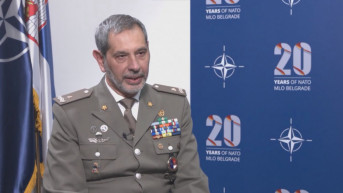
The partnership between Serbia and NATO rests on political dialogue, practical cooperation and full respect for Serbia’s military neutrality, Brigadier General Antonio Stasi, Head of the NATO Military Liaison Office in Belgrade, said. Speaking to Euronews Serbia on the occasion of the Office’s 20th anniversary, Stasi described relations with the Serbian Armed Forces as highly professional and focused on the stability of the entire region.
Reflecting on the work of the Office, which was established in late 2006, the Italian general said that cooperation through the Partnership for Peace program had developed across numerous areas—from military training and modernization of the defense system to scientific projects and emergency response.
As the highlight of the Office’s work in its anniversary year, Stasi singled out the first joint military exercise, “NATO-Serbia 2026,” held in Serbia in May, during which around 600 troops from Serbia and eight Allied countries trained in peace-support operations over a two-week period.
He also recalled the major civilian exercise “Serbia 2018,” held in Mladenovac, which brought together 2,000 participants from 40 countries, as well as the fact that the Alliance had invested more than EUR 5 million to help Serbia destroy more than 800 tons of obsolete ammunition.
Speaking about building trust between the Serbian Armed Forces and NATO in light of the difficult historical legacy of 1999, the Brigadier General stressed the importance of open dialogue and professionalism.
“We must never forget the past, nor the objective historical context in which certain events took place. But we can move forward, and that is what NATO and Serbia are doing through this long-term partnership,” Stasi told Euronews Serbia, adding that joint activities directly raised the operational standards of Serbian forces for participation in UN and EU peacekeeping missions.
As a key factor for security on the ground, he highlighted the regular communication between the until-recently Chief of the General Staff of the Serbian Armed Forces, General Milan Mojsilovic, and KFOR Commander Major General Roberto Vergori, who met twice in Belgrade, as well as joint synchronized patrols along the administrative boundary line.
“KFOR remains fully focused on continuing to implement its longstanding UN mandate, based on United Nations Security Council Resolution 1244 of 1999, by contributing to the maintenance of a safe and secure environment for all communities in Kosovo and freedom of movement, at all times and impartially, in close coordination with the Kosovo Police and the EULEX Mission,” the Head of the NATO Office stressed, noting that the Alliance strongly supported the EU-facilitated dialogue between Belgrade and Pristina.
Asked how cooperation functioned with a militarily neutral country that is almost entirely surrounded by Alliance members, Stasi replied that NATO respected Serbia’s sovereign right to choose its own path, just as it respected the decisions of countries that had chosen to join the Alliance.
In addressing skepticism among the Serbian public, the General pointed to lesser-known but highly important scientific projects implemented through the Science for Peace and Security Programme.
Among them, he particularly highlighted the work of scientists from the Vinca Institute on the DEXTER project, which focuses on detecting weapons and explosives in crowds in order to prevent terrorist attacks. He also cited projects involving the production of biofuels from algae, the development of seismic maps of the Western Balkans, protection of the Sava River and the development of demining robots.
Looking ahead to the next five to ten years, Stasi said that relations needed to be built on mutual trust.
“For the NATO-Serbia partnership to develop further, it should be a two-way street based on mutual trust and respect and a genuine commitment to regional stability. This means providing the support we have requested from the Serbian authorities to ensure that those responsible for the unjustified attacks in Kosovo in 2023, including those that affected more than 90 of our peacekeepers, are held accountable and brought to justice,” Stasi stressed, adding that it was also important for the Serbian authorities to provide citizens with objective information about the benefits of cooperation with NATO.
In conclusion, he said that he would like to be remembered in Serbia for his sincere efforts to advance dialogue and cooperation between NATO and Serbia.
0 comments