
Twenty-five years since the NATO aggression on FR Yugoslavia - tons of depleted uranium and one historic apology
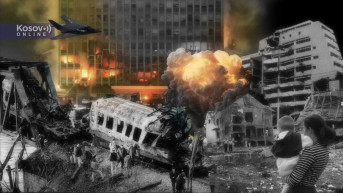
Twenty-five years ago today, the NATO alliance began its aggression against the then-Federal Republic of Yugoslavia. The attacks lasted for 78 days, during which, according to the Serbian Ministry of Defense data, 2,500 civilians were killed, including 89 children, and 1,031 members of the army and police. Around 6,000 civilians were injured, including 2,700 children, as well as 5,173 soldiers and policemen, with 25 people listed as missing.
Despite the lack of approval from the United Nations Security Council for this intervention, the order for the attack was given by Javier Solana, the then Secretary-General of NATO, to the commander of the Allied Forces, US General Wesley Clark.
The immediate trigger for the aggression was the events in Racak on January 15, as well as the unsuccessful conclusion of negotiations on the crisis in Kosovo in Rambouillet and Paris.
NATO's website states that the "air campaign, Operation Allied Force, was launched in March 1999 to stop the humanitarian catastrophe that was occurring in Kosovo."
"The decision to intervene followed more than a year of fighting within the province and the failure of international efforts to resolve the conflict diplomatically," the Alliance's website says.
According to NATO data, during the 78 days of air strikes, more than 38,000 sorties were flown - of which 10,484 involved the use of weapons.
Nineteen NATO countries began bombing from ships in the Adriatic Sea and from four airbases in Italy. Initially, the targets were air defense and other objects of the Yugoslav Army. The first missiles hit the Communications Center building in the Prokuplje barracks, killing soldier Boban Nedeljkovic. The bombing severely damaged industrial facilities, schools, healthcare institutions, infrastructure, media houses, cultural monuments... It is estimated that 10-15 tons of depleted uranium were dropped during the 78 days.
In Kosovo, military targets in Pristina were the first to be hit, struck on the evening of March 24. During the 78 days, areas such as Gracanica, Leposavic, Kosovska Mitrovica, Kosovska Vitina, Pec, Podujevo, Gnjilane, Prizren, and Urosevac were targeted. The final projectiles fell in the area of the village of Kololec near Kosovska Kamenica.
On May 1, NATO bombed the bridge in Luzane near Podujevo, over which the Nis-Ekspres bus was passing, killing 44 people. The "Djakovica prevoz" bus was hit on May 3 near Savina Voda, on the road from Psć to Kula-Rozaje, resulting in the deaths of 20 people and injuries to 43 others. Near the village of Korisa, not far from Prizren, on May 14, a column of people was bombed, resulting in 87 deaths and 70 injuries. The Dubrava prison in Istok was hit on May 21, where at least 20 prisoners were killed.
From April 9 to June 14, the Battle of Kosare was fought. The goal of the KLA was a ground invasion of Kosovo and the cutting off of communication between the Yugoslav Army units in Djakovica and Prizren. With artillery support from the Albanian Army and NATO aviation, the border posts were captured, but the Yugoslav Army managed to prevent further penetration. In these battles, 108 Yugoslav Army members were killed.
In the battle of Pastrik, which began on May 26, 26 Yugoslav Army members were killed, with more than half of the victims being due to NATO aviation actions.
The bombs that fell on Serbia did not discriminate by age, so the youngest victim of the aggression was eleven-month-old Bojana Tosovic, killed on April 11, 1999, during the bombing of the village of Merdare near Kursumlija. Two-year-old Marko Simic was a victim of bombs that fell on the center of Novi Pazar. In Varvarin, fifteen-year-old Sanja Milenkovic, a student of the Mathematical Gymnasium in Belgrade, was killed during the shelling of a bridge over the Velika Morava. Three-year-old Milica Rakic, a girl killed in her home during the bombing of Batajnica, became a symbol of the suffering of children in the NATO bombing.
The aggression was halted by the signing of the Military-Technical Agreement in Kumanovo on June 9, 1999, which specified the withdrawal of Yugoslav Army forces from Kosovo and the entry of international military troops into Kosovo, and the adoption of United Nations Security Council Resolution 1244.
On June 10, 1999, the Secretary-General of NATO issued an order to cease the bombing. The first KFOR troops entered Kosovo on June 12.
The only official from a NATO member country to apologize for the bombing of FR Yugoslavia is former Czech President Milos Zeman, who was Prime Minister in 1999.
"I would like to apologize for the bombing of Yugoslavia at the time. I would like to ask the Serbs for forgiveness. It troubled me all along. When the decision was made to bomb, we had only been in NATO for a few weeks. We were the last to agree," Zeman said in 2021 from the position of President of the Czech Republic.

0 comments