
Vucic: I am not here to please Russians, Ukrainians or anyone else; I work in Serbia's interests
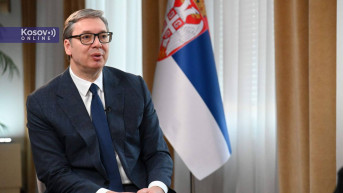
Serbian President Aleksandar Vucic said today, commenting on Ukrainian President Volodymyr Zelensky's visit to Belgrade, that he makes decisions in Serbia's interests, not in the interests of any other country, adding that nothing he discussed with Zelensky was detrimental to either Serbia or Ukraine, RTV reported.
"I am not here to please Russians, Ukrainians or anyone else, but to work in Serbia's interests. I see that there are many misunderstandings in Serbia. Now they consider me the greatest traitor because I met with President Zelensky, as if that were not my job," Vucic said on a podcast hosted by Axel Springer CEO Mathias Dopfner, RTV reported.
He stressed that nothing they discussed was detrimental to either Serbia or Ukraine, adding that they also discussed the participation of a Ukrainian company in major infrastructure projects in Serbia and that those talks were very serious.
"I think it was a very useful meeting for both of us. I know that nobody, absolutely nobody, likes or appreciates this kind of policy. Everyone said: 'You are sitting on many different chairs; you have to choose one, and that's it.' Yes, we have chosen one. It is the Serbian chair. Why do I say that? Because we have our own strategic objective, and that is full membership in the European Union," Vucic stressed.
Asked why he had invited Zelensky, given that he is regarded as the European leader closest to Russia, Vucic said that both Russians and Ukrainians have traditionally been friends of Serbia, that Ukraine is an important partner, and that trade between the two countries has increased.
"I can tell you that Western media always exaggerate and portray and describe Serbia as a Russian puppet state or whatever else, which is not true, because we have always been a sovereign nation," Vucic said.
Asked whether Zelensky's visit was primarily connected with economic interests or the EU, or whether he believed Russia would lose the war in Ukraine and that this was therefore, in some way, the time to forge new alliances, Vucic said that the main topic of his talks with Zelensky was the path toward the EU.
"I explained what I had written about and signed together with Edi Rama—the issue of a single market and open borders within Europe—because I believe that, realistically speaking, we cannot expect to become part of the European Union before 2030, and perhaps not even then. Bearing that in mind, I wanted to discuss it with Ukraine because I am less optimistic than President Zelensky regarding Ukraine's European path, and I did not hide that. I told him what I thought, and that was it. I wanted to hear his opinion, and I learned a great deal from him—about his experiences, his thinking and his expectations," Vucic said.
He stressed that he considered it very important to establish better cooperation between Serbia and Ukraine regarding their paths toward the EU—how they could, not necessarily fully coordinate, but at least cooperate along that path, and how they could better understand their future, whether outside or inside the EU.
Asked whether defense plans had been discussed, given claims by some that joint drone production with Ukraine and the UAE was being planned, Vucic said that they had not discussed that, but had spoken about the current situation and other issues.
"But that factory—the drone factory—we are building with the Israelis, and the facility will be opened by the end of September. And yes, that was something he knew about. I believe these are fairly sophisticated drones that until now have been produced only by the Israelis, and now those drones will also be produced in Serbia. We discussed a free trade agreement, and we discussed the overall situation, which is very important, because it is easy for you—you have your sides, whereas Serbia does not take sides. We are a militarily neutral country. We are on the path toward the EU, we will remain on that path, and we will see," Vucic added.
He stressed that Serbia wants to preserve its traditional ties not only with Russia but also with China, India and all other countries, including African states.
"We believe that this has served Serbia's interests best. I also have evidence that I am right. In the first half of this year, Serbia ranked first in terms of its growth rate—3.5 percent. For next year, the IMF and the World Bank, not me, forecast that we will reach 4.5 percent. We expect 4.3 percent, but in any case, we will rank first again next year. You cannot separate global and international politics from the economic situation because everything is interconnected," Vucic said.
He added that elections are due to be held in Serbia in 70 or 80 days, but said that what matters to him is what people tell him personally and that he does not care about criticism concerning moves that he firmly believes were made in the best interests of the Serbian people.
"There was nothing bad about Zelensky's visit. On the contrary, quite the opposite, and we believe that this will become evident in the future. On the other hand, I have to speak with Putin, whether in seven days or in a month, about the Petroleum Industry of Serbia, because, as you know, we have problems with companies under sanctions and similar issues," the Serbian president said.
He reiterated that Serbia had not supplied ammunition to Ukraine and said that what had happened was that ammunition had been sold to numerous Western partners, as well as to some African countries, and that those weapons and ammunition ultimately, in one way or another, ended up in Ukraine.
He said that they had also discussed financial support from Serbia and ways of revitalizing or rebuilding some smaller Ukrainian towns.
Vucic said that he had not spoken with Russian President Vladimir Putin before Ukrainian President Volodymyr Zelensky's visit to Belgrade, stressing that Serbia is nobody's "puppet" but an independent country that conducts its own foreign policy. He also said that he saw no possibility of the war in Ukraine ending this year or before next spring.
Asked by Dopfner whether anything had surprised him during his conversation with Zelensky, Vucic said that the two had known each other for years and had always maintained good contacts and good relations because, as he said, he understands the Ukrainian president's position and believes Zelensky understands his.
"We had a very thorough and substantive discussion on many issues. Yes, that is all I can say," Vucic said.
Asked about the Russian perspective and criticism that had allegedly come from "Russian propaganda" over Zelensky's visit to Serbia, as well as whether he had discussed the visit with Putin beforehand, Vucic said that he had not "announced his political agenda" to Russian President Vladimir Putin.
"I did not speak with him because I do not announce my political agenda to anyone, because Serbia is not a puppet of any other country in the world. We have our own agenda and we conduct our own foreign policy. That's it," Vucic stressed.
He said the same applied to Putin's meetings with U.S. President Donald Trump, U.S. envoy Steve Witkoff, Jared Kushner, European officials or anyone else.
"We are an independent country, and we will remain so in the future," Vucic said.
Asked whether he had seen any indirect attempts by the Russian side to prevent Zelensky's visit to Serbia, Vucic said that he had seen a great deal of criticism directed at him, but assessed that it had largely come without any real arguments.
He added that those people were, as he put it, "against him once again," saying that apparently even the Autonomous Province of Kosovo and Metohija was not important because "some people simply have to side exclusively with Russia."
"I side exclusively with Serbia's interests, not Russia's interests," Vucic said.
He added that he had been criticized for this and would continue to be criticized, just as, he said, he had also been criticized by many in the West.
"I maintain my position, and I will always believe that it is the best position for Serbia. If you ask me whether in the future I will ask anyone else whom I should meet and what I should discuss, I will never do that. Otherwise, I would never have been in the position of president or prime minister, or any other position," Vucic said.
Speaking about his relationship with Russian President Vladimir Putin, Vucic said that they had previously met not once but several times a year.
"We had mutual respect, so to speak. I spoke with him, I do not know exactly, 21 or 22 times, and I visited Russia many times. He also visited Serbia," Vucic said.
He noted that Serbia and Russia have traditional ties and always will, adding that the two countries traditionally commemorated Victory Day on May 9 together because, as he said, the Russian army played a major role in the liberation of Serbia.
"We also had major economic interests. We still receive most of our gas from Russia. At the same time, they still own our oil industry, which the previous government sold to them in 2008," Vucic said.
According to him, Serbia and Russia have many common denominators and shared interests, and it was "very regular and very normal" to discuss those issues with a friendly country such as Russia was and, as he said, remains today.
"But what was not true, and what was always being imposed on everyone in Europe, was that we were portrayed as 'Russian puppets,' as 'little Russians,' or whatever else. That was never the case. We are proud Serbs, and we have always looked after our own country and our own people," Vucic said.
Speaking about Putin, Vucic described the Russian president as an intelligent and strong man who, he said, was also willing to listen to differing opinions on various issues.
"I do not know whether he likes hearing them or not, but he was capable of listening to other people's differing views on various issues. At least he was willing to listen to me when I thought differently," Vucic said.
Asked how Putin had changed over the previous decades, particularly during the war in Ukraine, Vucic said that even if he had noticed or sensed something, he could not speak about it.
"Without a doubt, I have changed too. It is normal and natural for people to change, and I cannot define it. I would be overestimating my knowledge and even my own intuition if I began speaking about that," Vucic said.
He added that he genuinely expected that a peace settlement for the war in Ukraine would eventually be found.
Asked whether Putin might be becoming "increasingly nervous" about the outcome of the war, given alleged growing domestic pressure, and whether that could lead to a change in strategy, Vucic said that the leaderships of both countries were under enormous pressure.
"You have the leaderships of both countries under tremendous pressure, both in Russia and in Ukraine. It is not easy for anyone who loses hundreds or dozens of soldiers every day. Nor is the economic situation during wartime easy, and it cannot be easy in either country," Vucic said.
He added that he could not imagine how difficult the situation must be for both the Russian and Ukrainian leaders.
"If you ask me for my forecast, I do not see the war ending this year, and I do not see it ending before next spring," Vucic said.
He explained that, in his view, one side would have to become stronger and, in one way or another, prevail in order for the war to be brought to an end.
"Otherwise, in the current stalemate, I do not see any possibility of compromise solutions," Vucic said.
Asked what Putin's actual ultimate objective is today and what he wants to achieve through the war, Vucic said that he could not speak on his behalf.
"I may have my own predictions, but it would be irresponsible to discuss them publicly," Vucic said.
Vucic nevertheless said that he believed Putin wanted to take control of the entire Donbas region and that, after that, he believed the Russian president would be prepared to end the war in Ukraine.
Discussing developments in the war in Ukraine and the possibility of the conflict spreading to Europe, Dopfner said that Ukraine had proved much stronger than expected and was no longer viewed globally merely as a weak victim, but as a highly significant actor in modern warfare and the technologies associated with it, an assessment with which the Serbian president agreed.
Dopfner also cited examples of various attacks, including cyberattacks, attacks targeting executives of defense companies and the case of an explosive-laden drone at Leipzig Airport, arguing that Germany and Europe could therefore already be described as being under attack, although there was currently no evidence establishing who was behind those incidents, only suspicions and assessments regarding their possible origin.
Asked whether Putin might therefore have changed his priorities and, if unable to achieve his objectives in Ukraine because Ukraine had proved much stronger than expected, might shift direction and act more aggressively against Europe and Germany using all the instruments of hybrid warfare—ultimately failing to win the war in Ukraine but winning a hybrid war in Europe—Vucic said that Russia had, in his view, launched or conducted a hybrid war against Germany and certain other European countries, but stressed that Europe had done the same against Russia, or even more.
"You have been arming yourselves, you have imposed sanctions on Russia, and at the same time you have financially supported Ukraine. What is that if not hybrid warfare against Russia? They have largely been doing the same," Vucic said.
Vucic said that he believes the world is at the "beginning of a larger war" and that a much greater global conflict could follow.
"If you ask me what I personally think, and I will not explain why I think this, I believe we are at the beginning of a larger war. That is why I had hoped that someone else would have done something by now to create peace. That has not happened, and it will not happen soon. This means that we are on the brink of a much, much larger war. I hate to say this," Vucic said, responding to a question on whether he believed the world was at the beginning of a "much larger conflict" or a "war between Europe and autocrats such as Russia."
Vucic said that in the future people in different countries would "seek greater independence for themselves and less dependence on external actors."
"People in different countries will seek greater independence for themselves and less dependence on the outside world. On the other hand, you have two great powers, the United States and China. You have a third, which is, or should be, the EU. I am not sure whether Europe will be able—and I hope it will—to establish itself as a third pillar. Fourth, you will have Russia, India and other enormous continental or regional powers," the Serbian president said.
He assessed that a new alliance between Türkiye, Pakistan and Saudi Arabia would create completely different divisions and a different global atmosphere.
"And if you ask me what this will look like in five years, I would say that we will still be in a process of 'defining things through more destructive means' than is the case today. It is good that everything is digitalized and someone will be able to assess my words six years from now," Vucic said in response to Mathias Dopfner's question about the roles Europe, China and the United States would play in the world five years from now.
0 comments