
Vucic: The international community should take action against those responsible for the escalation of the situation in Kosovo
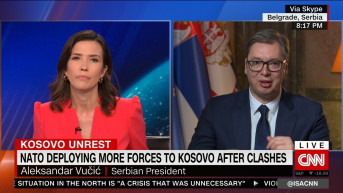
The President of Serbia, Aleksandar Vucic, called on the international community tonight to take decisive action against, as he said, those who were stubborn and responsible for the escalation of the situation in Kosovo, thereby endangering the peace and security of the entire region.
Vucic, in a statement to American CNN, appealed to the Serbs to protest peacefully and maintain sobriety.
"I know that these people are determined to fight, in a peaceful way, for their basic rights. They want to survive, to preserve their name and surname, their religion, and to have the right to live where they have always lived. My advice and request is to always do it calmly and to remain sober. And I call on the international community to take decisive action against those who are stubborn and who escalate the situation on the ground, thereby endangering the peace and security of the entire region," Vucic emphasized when asked what his message was for people who were protesting in the north of Kosovo.
He pointed out that there were two key things - which Serbia had implemented all its obligations from the first agreement, from April 2013, and Pristina had not implemented its only one - the formation of the CSM.
"They didn't do it, nor do they want to do it," Vucic emphasized.
He also stated that local elections were held in the north of Kosovo with a turnout of 3.4 percent, which was why they were not legitimate, that is, he said, they were sham elections.
"Would elections with such a low turnout be called legitimate anywhere else?" he asked.
He also pointed out that 97 percent of citizens in the north, Albin Kurti called fascists, ultranationalists, criminals...
"You cannot work without 97 percent of the people, and with only three percent. The Serbs want safety and security for themselves and their families," he stressed.
He reminded that since Kurti had come to power, 353 ethnically motivated attacks had been recorded, which was the highest number of attacks on the Serbs since Kosovo's independence had been declared in 2008.
He also stated that since the beginning of the year, there had been as many as five gunshot wounds of Serbian civilians, including two children.
When asked if he had asked the Serbs to boycott those elections, Vucic replied that he had not done so and that it had been their decision.
"That's why I wanted to explain the facts. Prior to 2013, Serbs never participated in the elections organized by Pristina. And then they accepted and participated four times in the Kosovo elections, and there were never any problems. Since Kurti came to power, he banned the Serbs to participate in the referendum, as well as in the Serbian parliamentary elections, and the most important thing is that he did not form the CSM, which is a prerequisite for the Serbs to participate in the Kosovo elections," Vucic explained.
When asked how to de-escalate the situation, he emphasized that Serbia had been and remained committed to calls for the Serbs to remain calm and to do everything to stabilize the situation, which had been destabilized by Pristina, after two days ago a Serb had been shot with two bullets in the back.
"We regret that members of KFOR were injured and we said so immediately. We are faced with peaceful protests, attended by teachers, nurses, doctors... Were they blackmailed to leave - they were not. They want the special units of the Kosovo Police to leave buildings that never belonged to them," Vucic said.
When asked if he had control over the protesters, he said that he did not, but that he believed that the majority of people would show respect for Serbia.
"The only thing we can do with international partners, the EU, the US, and everyone else from around the world, is to work on a stable region. Serbia accounts for 50 percent of the economy of the Western Balkans, 63 percent of attracted foreign direct investments in the region, and we do not need any escalation but peace. That's why we proposed 'Open Balkan'. We need freedom of movement," the President of Serbia added.
When asked what was needed for Serbia to recognize the independence of Kosovo, Vucic answered - that this question should not be asked.
"The Franco-German plan envisages the process of normalization of relations. It is a prerequisite for the progress of Serbia, but also Kosovo on the European path. We recognize the UN Charter and the UN resolution, and we are always ready to discuss compromise solutions. We have always been ready for that. The real question is why someone wants to escalate the situation," he added.
He pointed out that it had been heard in many media that Serbia intended to attack the countries of the region on Vladimir Putin's instructions, but that had not happened.
Recalling the criticism directed at the Kosovo authorities by the US ambassador in Pristina, and asked what the "red line" of Serbia was, he said that he was satisfied with the recent statements of the US Secretary of State Antony Blinken, as well as that the statement of the President of France Emmanuel Macron, who had presented how things were on the ground.
"Speaking of Serbian obligations, we act 100 percent in accordance with the Kumanovo Agreement concluded with NATO. We did not enter the territory of Kosovo with any soldiers, we did not break any international rules. We have professional cooperation with KFOR and NATO on the ground. I think we will be able to maintain that professional cooperation with NATO. Even today, we had a statement from the Visoki Decani Monastery, in which the most beautiful words are expressed for the Italian soldiers in the KFOR, who from the beginning protected the monastery from attacks," he concluded.
Before President Vucic went live in the program, the CNN analyst, explaining the causes of the new tensions in Kosovo, reminded that the Brussels Agreement had been signed in 2013, which, he added, had not been implemented, as well as the Ohrid Agreement, which had been signed recently.
He also reported that in the local elections in the north, the turnout had been 3.4 percent and that the mayors had been elected with 141 votes.
He also reported that the American ambassador in Pristina, Jeffrey Hovenier, said that this crisis had been unnecessary and that the police action had not been coordinated with the US, and that Washington wanted the new mayors to work from alternative locations, and for the police to withdraw from municipal buildings.
0 comments