
Vucic: It is clear some are forming military alliances against Serbia, EU and NATO’s silence is concerning

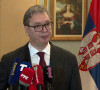
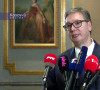
President of Serbia Aleksandar Vucic, commenting today on the declaration of military cooperation between Slovenia and Croatia, and bearing in mind the earlier agreement signed by Pristina, Tirana, and Zagreb, stressed that it is clear some are creating military alliances against Serbia. He expressed concern over the silence of the EU and NATO, noting that he will try to discuss the issue with NATO Secretary General Mark Rutte. He underlined that the Serbian Army is ready to defend the country if attacked, while emphasizing that Serbia has no intention of attacking anyone.
“This is not an easy matter for us. We have very negative experiences from the 1990s, when the same groups united against the Serbs and Serbia. Unfortunately, they were more successful and stronger—not because of their great strength or wisdom, but because of stronger external support. They were more cunning, and in the end they prevailed, because for them victory meant expelling Serbs from their centuries-old homes in Krajina, Kosovo and Metohija, and much of Bosnia and Herzegovina—though in some places it was the other way around, with expulsions of the Bosniak population. But when you look at everything, it is clear that someone is preparing something,” Vucic told TV Pink.
He noted that during his recent visit to China, he also observed that everyone—even if not the Chinese most of all—is preparing for something in the future.
“You can see it in all European countries: they are arming to the maximum. And in the region, this kind of multi-layered axis forming against Serbia is significant, because Serbia is seen as a factor that is not obedient enough, that refuses to serve others’ interests and insists on serving its own. They want the Serbian question not to be dominant, never to be fundamentally raised,” Vucic remarked.
He stressed that Serbia must not respond hysterically, but with patience and restraint.
Reminding that four NATO countries still do not recognize Pristina, he underlined that no one has spoken out against the military cooperation with Zagreb and Tirana. He pointed to yesterday’s declaration signed by Slovenia and Croatia, which, he said, clearly revealed its purpose—linked to the situation in Bosnia and Herzegovina and in Kosovo.
“When you form a military alliance with Croatia, it is clear against whom it is directed. It’s not against Austria, a supposedly neutral country—it is against Serbia,” he warned.
Vucic emphasized that Serbia must strengthen its military capacities but also its political position in the world.
“This is directly against the Serbian people and Serbia, and we must take note of it. We must strengthen our position and ensure our army is strong,” he said.
He announced that the military parade on 20 September will show a vast difference compared to how the Serbian Army once looked, highlighting its current role as a true deterrent.
“We want to strengthen our army. People must know that we are ready to defend the country if attacked in any way. But we do not want conflicts or wars, nor does it ever cross our mind to attack anyone. It is clear some are creating military alliances against us. The silence of the EU and NATO is worrying. I will try to speak with Mark Rutte. It is hard to believe he can again say he does not know what it’s about, as he did with the agreement of Zagreb, Pristina, and Tirana—not accidentally named the ‘Tripartite Pact,’” Vucic said.
When asked whether some are trying to create a new hotspot in Kosovo or in the Republic of Srpska, Vucic replied that information had been received that during a meeting of delegates in Belgrade—while protesters attacked police in Novi Sad—an instruction, as if coming directly from Albin Kurti, was adopted: to organize demonstrations on 19 September against the Office for Kosovo and Metohija.
“And now, as if Kurti himself ordered what they should do, they will demonstrate against the Office for Kosovo and Metohija. Do you really think that’s a coincidence?” the Serbian President asked.
He also questioned whether anyone believes that Croatia, Slovenia, Pristina, Tirana, and Zagreb thought of all this on their own.
“Someone else is behind it—someone who wants to control the geopolitical map, just as they did after the Congress of Berlin, the Balkan wars, the First World War. When Pašić sought an outlet for Serbia to the sea, they told him no, but gave Djakovica. It is the same people who said that then who today are telling others how to act against Serbia and the Serbian people,” Vucic underlined.
He insisted that Serbia must now be wiser than in the 1990s—not rushing into conflicts, avoiding wars, preserving children, stability, and security, while strengthening itself daily through a capable army as a deterrent.
Although all these acts are clearly hostile toward Serbia, Vucic concluded that “we must keep the ball down.”
He reassured citizens not to worry, noting that those who, with Western support, achieved their goals in the past—even by committing grave crimes such as Operation Storm (Oluja) and Operation Flash (Bljesak)—are not strong enough today to endanger Serbia.
On the Republic of Srpska, Vucic said that the world is well aware of what has happened with Milorad Dodik, and how an “occupational Gauleiter” made decisions contrary to basic democratic principles, legitimacy, and legality.
“But this is the era we live in. Those who most often speak of the rule of law and democracy are precisely those who care the least about it, guided only by their own political interests,” President Vucic concluded.

0 comments