
Vucic: We will work on the implementation of the agreement up to our red lines
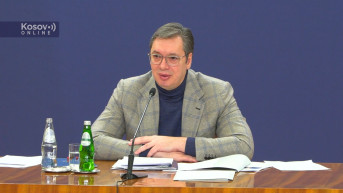
In his address to the public, the President of Serbia, Aleksandar Vucic, spoke about the Annex to the Agreement, which had been agreed upon yesterday in Ohrid with the EU mediators in the dialogue and the Prime Minister of Kosovo, Albin Kurti.
"Discussions are never simple because we are dealing with parties that have different interests," Vucic said.
Vucic stated that the Annex was an integral part of the agreement, where Kosovo and Serbia agreed to respect it and implement all obligations.
"The parties acknowledge that the agreement and annex for implementation will become an integral part of the process of Serbia's accession to the EU and Kosovo's accession to the EU. The parties acknowledge that after the adoption of the annex, the EU will begin changes to Chapter 35 for Serbia, which will reflect Serbia's obligations. The agenda of the special group of Kosovo will also reflect the new obligations of Kosovo arising from the annex. The parties agree to confirm the declaration of missing persons as agreed in the agreement," Vucic said.
As he said, according to the Annex, in order to implement Article 7 of the European proposal, Kosovo initiated negotiations with the mediation of the EU on the establishment of concrete agreements and guarantees in order to ensure an adequate level of governance for the Serbian community in Kosovo in accordance with the relevant previous agreements from the dialogue.
"The parties agree to establish within 30 days a Joint Monitoring Committee chaired by the EU. The implementation of all provisions will be ensured and monitored by the Joint Monitoring Committee. To implement Article 9, the EU will organize a donor conference within 150 days to establish an investment and financial aid package for Kosovo and Serbia. Aid will not be granted until the EU determines that all provisions of the Agreement have been fully implemented. Kosovo and Serbia agree that all articles will be implemented independently of each other. The order of the positions of this Annex does not call into question the order of their implementation. Kosovo and Serbia agree that they will not block the implementation of any article or item," Vucic said.
As he stated in the Annex, it was also stated that all discussions regarding the implementation of the Agreement would take place within the dialogue led by the EU.
"Kosovo and Serbia have taken note that any non-compliance with their obligations from the Agreement, this Annex, or previous dialogue agreements can have direct negative consequences for their processes of accession to the EU and for the financial aid they receive from the EU," Vucic said and added that was it for Serbia, in conditions where there was nothing easy, nothing particularly difficult.
"There will be much more difficult things in the future, in six months or a year. It is important for us not to depend only on the goodwill of Pristina, which is a positive change, but also on how ready we are to do certain things. I am talking about the European path," Vucic says.
I did not sign anything, because I am not negotiating with the "Republic of Kosovo"
He pointed out that he had not signed anything, primarily because Serbia was a recognized state, while, he stated, Kosovo was not.
"I don't want to make international legal agreements with the Republic of Kosovo. As president, even my statements are binding, and that's why I choose my words carefully. After every summit and meeting, I speak unequivocally about the red lines, which concern the opposition to the recognition of Kosovo, and the reception in the UN. I say this even today so that no one could think of imposing a legal obligation on Serbia," Vucic added.
He pointed out that this was why neither the agreement nor the annex had been signed, but Serbia was ready to work on implementation up to its red lines.
"So, the article of the Vienna Convention says the following, “An additional problem is that Article 7 of the Vienna Convention establishes that the verbal consent of the head of state is binding." Of course, always less than a signature, but it has value. That's why I refused to accept verbal nouns like acceptance," he said.
Vucic also pointed out that Serbia accepted the concept, that it would work on its implementation, and that he wanted people in Serbia to know how the country's interests were taken care of.
"I'm not repeating things because I'm stupid or I don't know what I'm doing, but because I know what I'm doing. Now we come to the one article that is important to everyone, and that's the missing persons," he said.
Until now, Pristina has used the issue of the missing as pressure on Serbia in order to receive war reparations
"We accepted everything, except for one request. They were doing whatever they wanted with the requests and added to them. And we accepted, we have no problem with that, in a humanitarian and humane sense. The problem was that we could accept one term, about how they have been forcibly disappeared, but you cannot accept the term enforced disappearance, because that term is part of a special international convention, and then we would have the obligation to pay war reparations and be directly responsible for the conflict in Kosovo," Vucic says.
He adds that it is extremely important that the annex clearly mentions the agreements reached in the dialogue process.
comments