
Washington Times: Trump’s “smart shift” toward Serbia and the Balkans
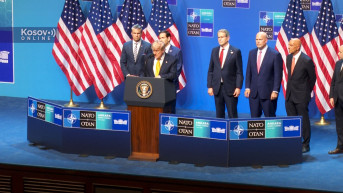
US President Donald Trump has made a “smart shift” in policy toward Serbia and the Balkans, steering relations between Washington and Belgrade toward diplomacy, cooperation, and economic development rather than a policy rooted in the legacy of the 1990s, the Washington Times writes.
Nearly 30 years ago, the United States, together with its NATO allies, bombed Serbia during the Kosovo war. At the time of the bombing, then-US President Bill Clinton first stretched and subsequently violated the provisions of the War Powers Resolution, which limited a president’s ability to conduct military action against a foreign country without congressional authorization to 60 days, the Washington Times article states.
It adds that Clinton continued the bombing for 78 days despite opposition from foreign policy analysts and members of Congress who described the war as illegal, while the US administration also spoke at the time of the accidental bombing of the Chinese Embassy.
The article’s author, Cheryl K. Chumley, recalls Serbian President Aleksandar Vucic’s statement in an interview with Fox News that support for the United States had increased significantly in Serbia.
“If you ask people in Serbia to compare the Clinton administration with the Trump administration, or Democrats with Republicans, you wouldn’t believe it. It would be 90 to 10 or 95 to five,” Vucic said.
That, the author adds, is also important for the United States.
The Washington Times recalls that on July 17, during the first US-Serbia Strategic Dialogue in Washington, US Secretary of State Marco Rubio and Serbian Foreign Minister Marko Djuric announced a new memorandum of understanding on cooperation in energy and infrastructure, science and technology, including space exploration, as well as the continuation of the Fulbright Program, which connects leading American and Serbian academics.
Given China’s and Russia’s interest in the region, these commitments are not merely an economic matter, the article stresses.
It recalls that several months before the meeting with Rubio in Washington, Vucic traveled to China to conclude bilateral agreements with Beijing.
“In September 2025, while in Beijing for events marking the 80th anniversary of the end of World War II, Vucic also met with Russian President Vladimir Putin, who spoke of the two countries’ ‘mutually beneficial’ partnership and the need to further ‘strengthen’ it in the future,” the Washington Times notes.
The question, according to the US outlet, is therefore whose influence will dominate in Serbia in the future.
Geographically, the Washington Times assesses, Serbia occupies an important crossroads between Eastern and Western Europe.
“Even the Joseph Biden administration recognized this. In June 2021, the State Department stated that Serbia occupies a key strategic position in the Balkans, at the social, political, and geographic crossroads of Eastern and Western Europe, and that the United States wants Serbia to be part of a stable Balkan region,” the article adds.
Furthermore, Serbia’s population is predominantly Christian and pro-Israel, meaning that Serbia is more closely aligned with American principles than with China or Russia, the Washington Times states.
“As defense ties deepen, Serbia is emerging as one of Israel’s closest allies in Europe,” the Jerusalem Post wrote earlier this month, the article adds.
For Israel, a country that, according to the author, is frequently criticized by European politicians and governments, friendship with Serbia is significant. Close relations between Israel and Serbia further strengthen the US interest in cooperation with Belgrade.
The Washington Times states that Serbia’s experiences during the wars of the 1990s make it a potential US partner in combating radical Islamism.
“During the wars of the 1990s, foreign mujahideen and members of radical Islamist movements linked to the broader network of international jihadism that later attacked America also fought against the Serbian people,” the Republic of Srpska Memorial Center Director Denis Bojic said in a statement provided to the Washington Times.
He added that Serbs, as a Christian people, had been targeted by radical Islamist structures for decades.
The Washington Times then links the US domestic political landscape with issues of antisemitism, attitudes toward Israel, and Islamism, arguing that it would be beneficial for the United States to have as many Christian countries as possible on its side in the fight against Islamist insurgent movements.
In the author’s assessment, Trump does not receive enough credit for the changes he is making in foreign policy, partly because he is neither Barack Obama nor a Democrat.
The Atlantic Council, according to the article, has assessed the significance of the shift in US policy toward the Western Balkans as “enormous.” According to that interpretation, the focus is on “hard geopolitical interests”—liquefied natural gas terminals, gas interconnectors, transport corridors, cybersecurity, defense capabilities, and limiting Russian and Chinese influence.
The issue, the Washington Times concludes, is therefore one of energy and technology, but also of efforts to curb the influence of Russia and China.
Trump’s shift in Balkan policy will probably not earn him a Nobel Peace Prize or favorable headlines, the author assesses, but his administration is taking steps that will safeguard US interests over the long term, and history may one day demonstrate the strategic foresight of his policy.
0 comments