
The abbot of the Devine Vode Monastery deported from Kosovo without explanation
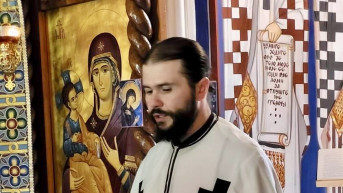
The abbot of the Devine Vode Monastery, near Zvecan, protosyncellus Fotije, was deported today from Kosovo to North Macedonia by the Kosovo Police through an urgent procedure without explanation, the Serbian Orthodox Eparchy of Raska and Prizren stated, and strongly condemned this action, emphasizing that it represented a brutal and arbitrary expulsion of a church figure, effectively initiating the open persecution of the clergy and monks of the SOC in Kosovo.
Father Fotije, born in 1981 in Skopje, has been serving in the Eparchy of Raska and Prizren of the SOC since 2004. Until 2009, he served in the Sopocani Monastery and Gracanica, where he spent most of his time. In 2009, he was appointed as the superior of the Devine Vode Monastery near Zvecan, where he had been continuously residing for 13 years while performing his monastic duties.
According to the Eparchy's statement, in accordance with Kosovo's laws, as a citizen of North Macedonia, and like other clergy members without Kosovo documents, he applied for a residence permit every year for the past five years.
They note that he regularly received extensions of his residence permit without any problems. Just ten days ago, he successfully passed the immigration test organized by the Ministry of Internal Affairs of Kosovo. Therefore, he was supposed to receive a temporary Kosovo ID card with a residence permit for the next five years today.
"Father Fotije, like other church figures in our Eparchy applying for Kosovo documents, goes through this procedure under the coordination of the OSCE monitoring team, whose representatives were present during today's events. He is permanently residing in the Devine Vode Monastery, although he has a registered address with the Eparchy in Prizren. He was informed that 'Northern Kosovo is not in the system' and that he cannot apply for Kosovo documents from his address where he resides," the Eparchy stated.
However, today, when he was supposed to pick up a new permit with his ID card, he was informed without explanation that his request had been denied.
"Moreover, although he had an approved residence permit until November 11, he was told that he had to go to prison immediately and that he would be deported from Kosovo. They also told him that all his previous applications and residence permits in Kosovo were annulled, and his further stay in Kosovo would be illegal. The document given to him quoted the sections of the law related to 'national security reasons' without specifying any criminal or other responsibility, as Father Fotije had no such problems," the statement adds.
The Eparchy emphasizes that in an extremely uncomfortable situation of pressure, he was forced to sign documents handed to him (a rejection document and a document nullifying his right to further stay).
"The documents were given to him in Albanian and were later translated for him. After that, he was searched with his hands against the wall and was told that if he wanted to avoid imprisonment, after which he would be without the right to stay, he could be deported without formal arrest. At the request of the Eparchy, a representative of the OSCE arrived at the scene, and an EULEX representative came to photograph the documents and tried to get an explanation of the real reasons for deportation, but, like Father Fotije, he was told that it was 'national security reasons' without any details," the Eparchy points out.
After practically being forced to accept deportation, Father Fotije's North Macedonian passport and mobile phone were temporarily taken away, and his vehicle parked in front of the building was thoroughly searched, witnessed by an EULEX representative. He was then escorted by the police to the border with North Macedonia, where his passport and phone were returned to him.
He was prevented from going to his monastery to collect personal belongings, and he was deported within a few hours of being informed that his further stay in Kosovo was not approved.
The Eparchy of Raska and Prizren expressed its strongest protest against this unprecedented event, where a longtime clergyman of the Eparchy, who had been in Kosovo for over 13 years, had been deported with a ban on returning to Kosovo for the next five years, along with the annulment of all previous residence permits, without any clear explanation.
"This is a case of brutal, arbitrary, and extrajudicial expulsion of a church official from Kosovo, which has prevented him from performing his church mission. It is an open example of the violation of human and religious rights, especially considering the law on religious freedoms in Kosovo, Article 7A.3, which states that 'there shall be no arbitrary prohibition on entry into Kosovo or residence in Kosovo for priests, candidates, and clergy, monks, nuns, and visitors'. This part of the law deals with certain aspects of the SOC activities in Kosovo," the Eparchy said.
They recall a similar attempt to expel a monk a few years ago, which was resolved through the intervention of the Kosovo Ministry of Internal Affairs.
The Eparchy also stated that they would officially inform the EU, EULEX, ambassadors of the Quint countries, and international organizations that deal with the protection of religious and human rights about this case of open persecution based on religious and national grounds, with a blatant violation of religious rights.
"With this brutal act, the Kosovo institutions, without citing any specific reason, have prevented the functioning of a monastery where Father Fotije served, and have practically initiated an open persecution of the clergy and monks of the Serbian Orthodox Church in Kosovo and Metohija. This is unacceptable and worsens the interethnic and interreligious situation in Kosovo and Metohija on multiple levels," the statement from the Eparchy of Raska and Prizren concludes.
0 comments