
Deutsche Welle: Conservative Islam is spreading in Kosovo
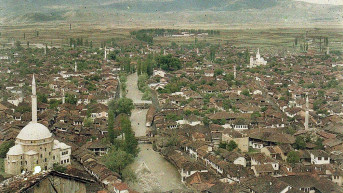
In Prizren, a campaign has been going on for days against the newspaper "Nacionale" and its journalist Vullnet Krasniqi, through huge billboards that have been placed all over the city, calling for a boycott of that Kosovo portal, with a picture of the journalist Krasniqi and the message "Freedom of opinion ends where the insults begin," Deutsche Welle writes.
According to that media, the case of journalist Krasniqi is not an isolated case, and Prizren, which, they say, is known for its diversity, is now becoming the scene of an incitement campaign that is completely contrary to its spirit.
In mid-August, journalist Krasniqi reported on a protest by members of the Muslim community in Prizren, who opposed the performance of feminist Canadian musician Peaches, who is also an idol of the LGBT community.
Peaches performed with her band at the film festival "DokuFest" in Prizren on August 4, 2023, in clothes that showed more than they hid, and calling for a protest, it was said that her performance had been incompatible with tradition and culture, that it had endangered children and led to "degeneration", Deutsche Welle writes.
The protest was held on August 11 in front of the most famous mosque in Prizren, right after Friday prayers, and about 200 people gathered.
When Vullnet Krasniqi asked some of them what exactly was the harm of the performance of the Canadian artist and what "degeneration" meant, as stated by Deutsche Welle, the crowd quickly had turned against him.
"Violent protesters approached me, insulted me, and pushed me. They asked me not to ask questions and not to report on the protest," Krasniqi said.
His cameraman, Arber Arifi, was also harassed and pushed, and the video shows the officers just watching without intervening.
For the second time this summer, Deutsche Welle points out, small groups of conservative Muslims have found themselves in the news due to violence against journalists, and one journalist was recently beaten in the hospital because he ironically reported that an ultra-conservative imam from Prizren had received a "Mercedes" from members of the community. as a retirement gift.
In recent years, numerous journalists have received threats or been physically attacked, and in addition to attacks for reporting on political corruption, the reason was often that, according to conservative Muslims, they allegedly violated religious values or traditions.
Radical Islam is currently not a relevant political threat in Kosovo, which is explicitly declared secular, and the vast majority of residents see themselves as moderate Muslims, according to the text of the German media.
Traditionally, women do not wear hijab or niqab, but if they wear anything at all, only scarves tied around the back of their necks.
Alcohol consumption is not condemned, and many go to the mosque only rarely or not at all.
Political scientist, journalist, and winner of several journalism awards in the USA, Arbana Xharra, investigates Islamic radicalization in the Balkans.
"Islam in Kosovo is liberal and, so to speak, pro-Western. Even in such a mild form, few people in the country practice it, and religion is not placed above people's identity. This is in clear contrast to some countries in the Middle East, where religion it's not a culture, but an ideology," Xharra says.
Despite this, Arbana Xharra senses a dangerous phenomenon behind the campaign against Krasniqi.
"Since the end of the 1999 war, radical Islamic movements have been penetrating Kosovo. They want to change the geopolitical and cultural orientation of the country and oppose the multicultural and liberal atmosphere and pro-Western heritage. It turns into a threat when the state starts tolerating those tendencies," Xharra said.
As a journalist, Xharra was exposed to hate campaigns and threats for years because of her reports on radical Islamists in Kosovo. In addition, she was insulted, among other things, as a "Jewish whore", and in May 2017 she was brutally attacked and beaten in front of her house in Pristina, according to Deutsche Welle.
A few months later, she left Kosovo after learning that her assassination was being planned.
It is still not clear who attacked her in 2017.
"Even after six years, the police did not take any action, neither did the Prosecution," Arbana Xharra says resignedly.
The attitude of the authorities is essentially contradictory on this issue - on the one hand, they have been very harsh in recent years towards a certain part of the spectrum of radical Islamism.
Namely, it is estimated that 400 citizens of Kosovo joined the "Islamic State" in the Middle East.
In some cases, returnees were sentenced to long prison terms or placed under supervision.
On the other hand, the authorities often remain inactive, according to the text of the German media.
For example, in the case of attacks on undesirable journalists, the authorities often investigate listlessly or do not conduct investigations at all.
Politicians are often silent on such unpopular topics, as is the case with the LGBT topic, which conservative Muslims are increasingly revealing to themselves in order to agitate.
Officially, queer people are protected by the Kosovo constitution, but in reality, they hardly have any protection.
Not only are many people in Kosovo prejudiced against that part of the population, but Muslim communities and most politicians, regardless of their orientation, reject homosexuality as "immoral", Deutsche Welle writes.
Kosovo Prime Minister Albin Kurti has long been in favor of recognizing same-sex marriages.
Kosovo would be the first Muslim-majority country in the world with such a law, but the initiative failed infamously in the spring of 2022.
Even many members and MPs of Kurti's Self-Determination Party objected, even though the party nominally represents leftist and social democratic values and was originally founded as a civil rights movement.
At the protests in Prizren, Vullnet Krasniqi did not confront moderate Islam.
Attacks on him can also be connected to the fact that he is a declared homosexual and that he publicly supports LGBT rights.
Either way, he's still shocked by the action and reactions.
"The images of the attack caused thousands of reactions and comments on Facebook, most of which welcomed the attack. Although I received a lot of support, I did not expect such a large amount of hate in the comments on Facebook," Krasniqi said.
In his case too, the Kosovo Government is silent, and the spokesperson of the Government of Kosovo left Deutsche Welle's inquiry about the hate campaign against journalists and the "Nacionale" portal unanswered until the publication of this article.
Krasniqi himself says that he is not afraid.
"Giving up is not an option. The only way to show the attackers that I'm not afraid of them is to keep working," Krasniqi added.

0 comments