
Elek: Due to the ban on the dinar, employees at the Clinical Hospital Center in Kosovska Mitrovica are at risk, and there is also a shortage of food for patients
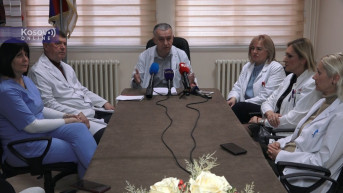
The board of the Clinical Hospital Center in Kosovska Mitrovica, headed by Dr. Zlatan Elek, the director of this institution, presented at today's press conference the problems the hospital is facing after the regulation of the Central Bank of Kosovo banning the dinar came into effect on February 1st.
Elek highlighted the most affected categories suffering from the dinar ban.
The first category comprises the employees of this clinical hospital center, totaling around 1,700 workers, whose families depend on these earnings.
"You know that our salaries have been coming regularly from Serbia since 2013 and have been increased on several occasions. Now all workers are at risk because they cannot withdraw money. You can see huge lines in front of the only bank where we can withdraw money - the Postal Savings Bank. This directly endangers doctors, nurses, staff, technicians, drivers, and cleaners. We are condemned again to go to central Serbia to withdraw our personal incomes, to Raska, Novi Pazar, and Kraljevo," Elek said.
He emphasized that this was the second time workers had had to leave Kosovo, the first time being for vaccination purposes.
Patients are the second endangered category because there is a shortage of food in the Clinical Hospital Center Kosovska Mitrovica. There are over 500 beds in the center.
"Our suppliers are from these areas, and payment is made solely in dinars. We are obstructed in two ways because there is some kind of ban that we have not seen in written form, and that is a ban on importing food from Serbia. Our procurers are unable to procure the food prescribed by the tender documentation. The other way is that we cannot pay for this food in dinars, and they are in trouble, and therefore the patients," Elek said, adding that the most vulnerable were diabetics, operated patients, and those suffering from malignant diseases.
The third problem is fuel, and Elek mentions that soon ambulances will run out of fuel because fuel is paid for in dinars.
"Not because Serbia is not transferring money, but because we cannot pay," he adds.
The fourth problem is heating because the hospital is heated with fuel oil, which is also paid in dinars.
"For the hospital to function normally, we rely on maintenance services for instruments such as X-rays, provided by companies from Serbia. We are unable to pay even these service providers because we are obliged to pay them in one currency - dinars," Elek says.
The same applies to the technicians who maintain this institution, and Elek adds that there is also a problem with services such as medical examinations for driver's licenses, routine check-ups, and participation fees for analyses paid in dinars.
"This press conference is also an appeal to the international community and all political actors who can influence Pristina to postpone this decision. We are supporters of dialogue, a peaceful resolution of this decision, rather than the sudden adoption of unilateral decisions that aim to escalate problems on the ground, affecting healthcare workers and sending a signal to ordinary people to leave these areas because they will not have their own currency. We are encouraged by the statements of President Aleksandar Vucic, who said that there was enough money. All contributions coming from Serbia are completely regular and have been until the moment when the dinar was abolished. We also have an endangered category, and that is our medical trainees because their education is funded by the Clinical Hospital Center Kosovska Mitrovica in dinars. I think everyone understands the situation in which the Clinical Hospital Center finds itself. We all wonder what Albin Kurti's next step will be to make our lives more difficult in these areas," Elek said.
He also stated that he would discuss with the relevant ministry and with the Government of Serbia, that common sense would prevail, and that a compromise solution would be found to the satisfaction of both parties, primarily a compromise for the Serbian community.
"These are all facts and arguments that support the fact that this decision was made unilaterally, that it was hasty, and that it does not benefit the Serbs. There are several such decisions, but that is not today's topic, I would not delve into politics. Today, I am addressing you as the Director of the Clinical Hospital Center, and I am here to explain the problems we are facing and the obstructions by the Government in Pristina that affect normal functioning. You know that the right to treatment is one of the basic rights, and when you take that away, you take away the right to life. The right to life is a guaranteed right under the UN Charter, but unfortunately, that charter is not in force here," Elek stated.


comments