
Hasani: Serbian lawyers are right about the abolition of the dinar issue, but the Constitutional Court is not the place for such an appeal
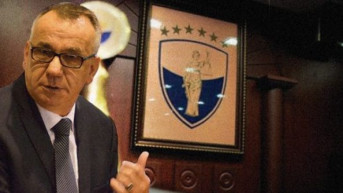
Former President of the Constitutional Court Enver Hasani assessed that Serbian lawyers were right and that the currency issue could not be regulated by a Regulation, but also pointed out that the Constitutional Court was not the right place for the appeal filed seeking a review of the constitutionality of the Central Bank's decision, but rather that it should be the subject of regular court proceedings before the administrative departments of the Basic Court in Pristina.
Commenting on the explanation of lawyer Vasilije Arsic that the currency issue could not be regulated by regulations but by a law that did not exist, Hasani said that the Serbian lawyer was correct.
"The Serbian lawyer is right regarding the fact that the implementing norm of Article 11.1 of the Constitution of Kosovo can never be a sub-legal act, such as the CBK Regulation," Hasani stated.
He said, however, that it was unlikely that the Constitutional Court would declare the CBK decision unconstitutional.
"A Serbian lawyer cannot be a party to the proceedings before the Constitutional Court on this issue. It lacks active legitimacy, so it does not fall into any of the categories of authorized parties under Article 113 of the Constitution of Kosovo. This regulation cannot be challenged before the Constitutional Court because it does not have constitutional authority under Article 113 of the Constitution. The legal act in question, i.e., the CBK Regulation, is neither a government regulation nor its legal act. Acts of independent institutions and agencies can only be challenged regarding their legality under the applicable law on administrative disputes. These cases are resolved by regular courts, or the administrative departments of the Basic Court in Pristina," Hasani said.
He reminded that the introduction of the euro as a means of payment in Kosovo had been decided by UNMIK.
"Kosovo unilaterally assumed the application of UNMIK's legal structures with Ahtisaari's plan and the Constitution in force, including this one regarding the designation of the euro as a means of payment. In a narrower and fully legal sense, it is not disputed that the euro is a means of payment. However, in UNMIK's decision, it was not stated that the euro is the only means of payment, as the Serbian dinar is also described as such. This has resulted in the tolerance of the Serbian dinar as a means of payment for a long time. Therefore, this is not a constitutional guarantee: the euro does not have such status. Article 11.1 of the Constitution specifies that a single currency is used in Kosovo, so the euro is not defined as such," Hasani states.
When asked whether the UNMIK decision could then be taken as a kind of legal solution on which the Constitutional Court would decide, Hasani says that this is impossible.
"The time when UNMIK's rules and Ahtisaari's plan were valid has passed. Kosovo had a deadline to harmonize its legal-constitutional order after independence on February 17, 2008, and that period has expired. For the purposes of direct action in Kosovo's legal order, UNMIK's rules or Ahtisaari's plan can never be applied. In September 2012, supervised independence was closed, and such provisions were removed from the Constitution of Kosovo, which is now the highest legal act in the country," Hasani says.
According to his words, the issue regarding the abolition of the dinar, as well as the regulation of the official currency in Kosovo, can only be resolved by enacting appropriate laws.
"It is never allowed anywhere in any state to define the national currency by a sub-law act. This is done by the constitution or by law based on explicit constitutional authority. In our case, such a thing would have to be established by law, based on the authorization from Article 11.1 of the Constitution. Unfortunately, the Law on the CBK currently in force has not provided for such a thing, as stated in Articles 16 and 17 of that Law. Moreover, Article 16.1 provides that 'The currency of Kosovo shall be determined by law in accordance with Art. 11 of the Constitution.' The wording of this law is strange because it speaks as if it were the mouth of the Kosovo constitution-maker. There is no need for the Law on the CBK to indicate that the currency is determined by law because Article 11.1 of the Constitution says so. In short, the CBK has neither legal nor constitutional authority to designate the national currency as a means of payment," Hasani concludes.


0 comments