
Mandic: The EES system makes it impossible for professional drivers to work; we will block the borders until they let us through
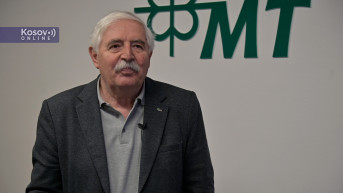
The President of the Serbian Transporters’ Association, Nedjo Mandic, who together with colleagues from Montenegro and Bosnia and Herzegovina has announced a blockade of border crossings toward the EU on Monday, 26 January, told Kosovo Online that the implementation of the EU Entry/Exit System (EES) in practice does not merely make the work of professional drivers from the Western Balkans more difficult, but effectively renders it impossible, with potentially catastrophic consequences for both the economy and citizens.
Mandic stated that such a working regime would first lead to the collapse of employees and their employers.
“It does not make the work more difficult; it makes it impossible, because the little we are able to work means nothing either for the company owner or for the driver. That is collapse. The driver will not earn a salary sufficient for a decent life, nor will the employer be able to meet his obligations, including paying that same salary,” Mandic said.
According to him, transport companies must operate at full capacity, and the shutdown of firms would have serious consequences for the economy.
“We either have to work at full capacity or stop altogether, given that our employers have invested significant funds and have obligations toward other employees, not only drivers. There is a huge number of other costs that are so high that without serious work there can be no positive business results, and without positive results a company must close. We do not want that, because it would have negative consequences for our economy,” he noted.
Mandic also pointed to lengthy delays at border crossings.
“When we set off, we wait in queues—sometimes 24 hours, sometimes 48, even 72 hours. The same happens on the return journey, and this prevents us from covering a sufficient number of kilometers and completing assignments due to the enormous loss of time at external customs offices, internal customs offices, and various delays that could be avoided,” he said.
He added that the introduction of the electronic system would further restrict work.
“Previously we were not checked, but this is a system of electronic registration. Once you reach 90 days, there is no entry, and that limit is reached in just three to four months, which means that for the following two months there is no work,” he emphasized.
Speaking about the consequences, he warned that they would be “catastrophic.”
“First, no foreign investor will be able to meet their obligations anymore because they will not have reliable transport. We are relatively inexpensive, very efficient, and well organized. Foreign companies cannot do this because they have no interest. They operate in an area without borders and customs, cover 15,000 kilometers, and can charge for transport, settle all obligations, and still make a profit, while we can cover only 8,000 to 9,000 kilometers. If they start operating here, they too will cover only 8,000 kilometers, which means a price twice as high. That affects employers, and when employers are affected, so are citizens, because every cost is ultimately passed on to the end user,” he said.
Commenting on messages from the European Union, Mandic said that responses have been lacking.
“It is the same response we have been receiving for two years. That response is meaningless. They say there will be no change, yet the Schengen Agreement states that it can be amended and supplemented. Obviously, someone has grown comfortable in an easy life without any obligation to work. They do not want to launch the initiative we are proposing; instead, it is easier for them to offer solutions that are unworkable and lack the necessary interpretation that drivers are not civilian travelers, but people at work. Their job is to drive from Serbia or another Balkan country to Europe and back, and this rule should not apply to them,” our interlocutor said.
Speaking about a possible solution, he noted that one does exist.
“There are a hundred solutions, starting with the simplest: reintroduce a driver visa for professional drivers—a long-term visa, for three or five years—that would allow an unlimited number of entries and exits, and then there would be no problem. We have proposals, but it is best to talk and for each side to propose what suits it best, so that in the end we find a compromise solution, resolve the problem, and eliminate the need for protests,” he stressed.
He emphasized that blockades are not the goal, but that they will not abandon them.
“At a meeting with von Beckerath, I said there would be no blockades—just send us a letter and invite us to a meeting, with a joint commitment to reach a compromise and find a solution within 60 days. If that does not happen, we will wait until they let us into the EU. We will bring loaded trucks to the border, but the driver knows that entering entails the risk of being checked, deported, arrested, and facing consequences, and we have no right to force him to take that risk. He certainly will not do so on his own, because what has been happening recently—only in Rostock—is truly more than catastrophic,” Mandic said, pointing to the arrest of eight drivers from Serbia for exceeding the permitted period of stay.

0 comments