
Metropolitan Teodosije expresses concern over latest developments in Kosovo during meeting with Senator Ernst
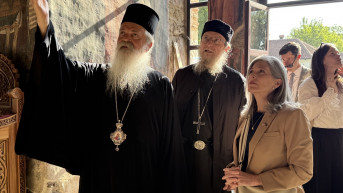
Metropolitan Teodosije met with U.S. Senator Joni Ernst in Gracanica today and expressed concern over the latest developments in Kosovo, according to a statement issued by the Raska-Prizren Diocese.
Following a tour of the Gracanica Monastery and a presentation of its spiritual, historical, and cultural significance, discussions were held on the current position of the Serbian Orthodox Church and the Serbian people in Kosovo, as well as the challenges faced by the Church and the faithful in their daily lives, the Raska-Prizren Diocese stated.
Metropolitan Teodosije pointed to the Diocese's serious concern over the visible deterioration of the security and institutional situation and the growing sense of insecurity among the Serbian population, which is perceived as persecution and open discrimination by the Kosovo authorities.
"He particularly emphasized that we have witnessed a series of deeply concerning developments recently. In this context, the Bishop mentioned problems during recent Serbian Orthodox Church religious gatherings at Gazimestan and the Holy Archangels, various forms of institutional and administrative pressure, such as the recent demolition of a number of Serbian houses at Lake Gazivode, and several arrests of Serbs without clear evidence of criminal responsibility. The lack of response by institutions in cases affecting the Serbian Orthodox Church and the Serbian community was also mentioned, as demonstrated by the latest violation of the Law on Special Protective Zones around the Decani Monastery during new works on the disputed road, as well as earlier violations of the protected-zone regime around the Hermitage of St. Peter and the Church of the Mother of God of Hvosno. It was emphasized that all of this creates a cumulative effect of pressure and further deepens the already extremely low level of trust and security in which our people and the Church live," the Raska-Prizren Diocese stated.
The Metropolitan pointed out that all of this is taking place amid prolonged institutional and political uncertainty in Pristina, as well as the failure to fulfil previously undertaken obligations. Under such circumstances, he stressed, preserving clear and unequivocal international security guarantees is particularly important, especially at the most sensitive locations.
In this context, the talks also addressed today's announcement of the gradual integration of Kosovo Police personnel into KFOR's security architecture around the Visoki Decani Monastery.
Metropolitan Teodosije stressed that the Diocese is following this process with particular concern, given the existing low level of institutional trust and the broader security situation.
At the same time, he emphasized the importance of KFOR's clear assurances that this process does not represent a transfer of primary responsibility for the monastery's security, but merely coordinated work within KFOR's existing security protection system.
Of particular importance to the Diocese was KFOR's unequivocal confirmation today that its commitment to the security of the Visoki Decani Monastery and the safety of all local communities remains firm, and that KFOR continues to bear primary responsibility for the monastery's security.
"These assurances are consistent with the messages received by the Abbot of the Decani Monastery, Archimandrite Sava, during the recent visit of the Commander of NATO's Allied Joint Force Command Naples, Admiral George M. Wikoff, when NATO's enduring commitment to protecting Visoki Decani and preserving stability in Kosovo was particularly emphasized. Metropolitan Teodosije also specifically addressed the situation in North Mitrovica, stressing that the Ibar Bridge, as a location that has repeatedly been associated with serious security incidents and interethnic tensions in the past, remains a highly sensitive point. Under the current circumstances, when trust between communities and institutions is at an exceptionally low level, the Metropolitan believes that KFOR's visible presence in this area remains an indispensable factor in deterring incidents, preventing escalation, and preserving the population's sense of security. Therefore, any change to the existing security arrangements at such a sensitive location could have serious consequences for stability," the statement reads.
Metropolitan Teodosije stressed that the Diocese does not question the need for professional cooperation among all security actors, but believes that, under the current circumstances, any transfer of primary security responsibility from KFOR at Visoki Decani and the bridge in Mitrovica would be premature. It is therefore essential that every further step remain gradual, based on actual and verifiable conditions on the ground and on building trust through concrete results.
Metropolitan Teodosije also specifically highlighted administrative problems and the selective application of the law by Kosovo institutions, which make life more difficult for the Church and undermine the self-sustainability of Serbian monasteries.
"At the conclusion of the meeting, Metropolitan Teodosije expressed gratitude to the United States, NATO, and KFOR for their engagement to date in preserving peace and security and protecting the holy sites of the Serbian Orthodox Church. He particularly expressed confidence that the United States and NATO will continue to make all security decisions with full awareness of the complexity of the current circumstances, the low level of interethnic and institutional trust, and the need to avoid any step that could create a security vacuum or additional uncertainty among the local population. The discussion also emphasized the importance of continuing the dialogue and fully implementing previously reached agreements, particularly those concerning the position and rights of the Serbian community and the Serbian Orthodox Church in Kosovo and Metohija," the statement reads.
Finally, Metropolitan Teodosije stressed that the Church remains firmly committed to peace, dialogue, and building trust with all communities, but that lasting stability can rest only on the rule of law, consistent respect for acquired rights, and concrete guarantees that will enable the Serbian people and the Serbian Orthodox Church to live safely and with dignity and to remain in Kosovo and Metohija.

0 comments