
More than childcare: How kindergartens in North Mitrovica and Leposavic support children’s development
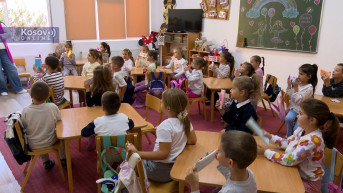
The “Danica Jaramaz” Preschool Institution in North Mitrovica and “Nasa Radost” in Leposavic have begun the new school year with a total of 1,075 enrolled children, with a particular focus on their development, socialization and safety. While North Mitrovica has seen an increase in enrollment and the renovation of part of its main facility, the institution in Leposavic operates 22 groups, with staff working to provide children with opportunities for play, learning and social interaction despite limited space.
A total of 720 children began the 2026/2027 school year at the “Danica Jaramaz” Preschool Institution in North Mitrovica. In addition to the higher number of enrolled children, this year has also been marked by improved conditions for children and staff. During the institution-wide annual break, the older section of the main facility was renovated, while a new younger preschool group was opened at the facility in Bosniak Mahala.
Ivana Todorovic, a pedagogue at the preschool institution, said they were proud of the number of children enrolled, noting that attendance had been increasing from year to year.
“In the new 2026/2027 school year, a total of 720 children have been enrolled, a figure we are truly proud of, showing that every year we have an increasing number of children attending our institution. The groups are organized across three facilities—our main facility, the facility in Bosniak Mahala and the facility where the four-hour preparatory program is implemented. This year, we opened a new group in Bosniak Mahala, a younger preschool group. Previously, the preschool groups were mixed-age, so this year in Bosniak Mahala we have a mixed nursery group for children aged one to three, as well as younger, middle and older preschool groups,” Todorovic said.
Speaking about the organization of activities, she said that the main facility had six nursery groups, four younger, four middle and four older preschool groups, as well as three groups within the preparatory preschool program. Another four preparatory preschool groups have been formed at the facility offering the four-hour program.
“This year there are slightly fewer preschoolers, with a total of 134 children divided into seven preparatory groups,” Todorovic said.
She stressed that the older section of the facility had been renovated during the collective annual break, enabling both children and staff to begin the new school year in significantly improved conditions.
“We are making an effort, and of course it shows. This year we had a collective annual break, and I would like to thank the parents for their understanding. Most of them do not have a month-long vacation, but on behalf of the entire institution, I thank them for their understanding, patience and willingness to accommodate us. That one-month period was used to renovate the older part of the facility, so we started September with much better working conditions. Every room in the older section now has its own sanitary facilities, which was not previously the case, and that makes the educators’ work much easier. The windows and floors have also been replaced, while the corridors are much nicer and more spacious. Naturally, the children feel the difference, the work of the educators and nurses has been made easier, and we hope the parents are satisfied as well,” Todorovic said.
Children’s adaptation tailored to individual needs
Professional associate and psychologist Ana Garic spoke about the process of helping children adapt to preschool, emphasizing that the transition was introduced gradually, while monitoring each child’s individual needs and working closely with parents and educators.
She explained that the plan was for a child to spend two hours a day at the kindergarten during the first week, after which the length of stay would gradually be extended.
“The new school year has begun. We are happy and pleased that we are able to accommodate such a large number of children. Our adaptation plan, which we agreed on in previous years, is to carry out the adaptation during the first days of the child’s attendance, within what is legally permissible and practically feasible. Our plan is for a child, when first starting kindergarten, to stay for two hours during the first week, from 8 a.m. to 10 a.m. After that, we extend the stay from 8 a.m. until noon, before nap time, and from around the third week onward, we observe the child and, if they are ready, allow them to stay for the nap as well,” Garic said.
She stressed that the adaptation process differed from child to child, and that the initial plan was therefore adjusted where necessary to make the transition from the family environment to the new setting easier.
“The adaptation process may go very smoothly, while in some cases there may be minor difficulties, which we of course take into account. We then adjust the initial plan that generally applies to every child. One child may adapt within a month, another within a week, while for some even two months may not be enough. That is why, in cooperation with parents and educators, we monitor how the process is progressing, observe the child and consult with one another to determine how much we can extend the child’s stay or whether we should continue following our initial plan,” Garic explained.
There is no universal rule for when a child should start kindergarten
Garic also pointed out that there was no single rule as to the best age for a child to begin attending preschool, and that the decision should be based on the child’s individual needs and development.
“There are certain beliefs and an unwritten rule that around the age of three is the best time for a child to enter a different environment, an expanded family-type environment. However, in recent years we have realized that there is no fixed rule because we follow the child’s needs. Once a child has acquired certain skills within the primary family and environment, learned how the social environment functions and shown the first signs of being ready to enter a different, broader setting, kindergarten attendance can begin even earlier,” she said.
According to her, parents should pay attention to their child’s interests and behavior, particularly when the child begins to show a desire to socialize, play cooperatively and gain new experiences.
“It varies from child to child, and it is best for parents to follow the needs of their own child. As soon as a child begins to show interest in other children, cooperative play, sharing, gaining new experiences and developing new habits, that is the first sign that the child should be included in a preschool setting,” Garic said.
Early socialization important for child development
Speaking about the importance of attending kindergarten, Garic stressed that early socialization contributed to the development of social and emotional skills, familiarization with the rules of group life and the acquisition of experiences that children could not always gain exclusively within the family environment.
“Early socialization is very important for learning new habits and group rules, meeting other people, coming into contact with a different environment and various stimuli. It simply enriches a child’s world. We can look at it this way: when a child remains within the family environment, as people commonly say, they are somewhat sheltered. They do not have as many experiences or as much contact with the outside world. Once they begin attending kindergarten or another organized form of childcare, the child gains new experiences,” Garic explained.
She added that through various organized activities children encountered new topics, came into contact with their peers and developed empathy, the ability to share and other emotional qualities.
“It is good to organize different activities because children learn about new things and subjects, come into contact with other children—which is the most important thing—and learn from one another. This is horizontal learning among peers, the development of emotional qualities, empathy and the ability to share. All of that truly means a great deal. From experience, we have seen that there is a significant difference between children who have attended kindergarten from an early age, for example from after their first or second year of life, and children who encounter this type of environment for the first time at the age of four or five,” Garic concluded.
A clearly structured day
The “Nasa Radost” Preschool Institution in Leposavic is currently attended by 355 children divided into 22 groups, ranging from nursery age to the preparatory preschool level.
Institution Director Zorica Jovanovic said that the kindergarten’s activities were organized so that children had a clearly structured day, adapted to their age and individual needs.
“The preschool institution is open from 6 a.m. to 4 p.m. Children arrive between 6 a.m. and 8 a.m., after which they have breakfast, free and guided activities, lunch, an afternoon rest, followed by a snack and departure,” Jovanovic said.
She stressed that particular attention was devoted to safety, care and children’s overall development.
“This institution provides care, nutrition, preventive healthcare and educational work. We make every effort to ensure that all children who come to us are safe above all, and that parents can feel secure when entrusting us with what is most precious to them—their child,” Jovanovic said.
According to her, kindergarten attendance was not merely about childcare, but also represented an important part of children’s development.
“Every child needs structure. Here, depending on their age, children have time for play, guided activities, socializing, rest and everything else that is important for their development,” Jovanovic stressed.
The period between ages two and three is particularly suitable for starting kindergarten
Speaking about the age at which children should start kindergarten, Jovanovic said that the period between the ages of two and three was one of the most suitable times for a child to enter a group setting.
“When we talk about the psychological aspect of the child and their readiness to separate from the family, the ideal period is between the ages of two and three. At that age, the child is more independent, hygiene habits are better developed, their vocabulary is broader and they can express their needs more easily,” Jovanovic said.
However, she added that family circumstances often determined when a child would begin attending kindergarten.
“Life often does not ask when the best time is. Many parents have to return to work after only six months or a year. We are open to working with those children and try, in accordance with their age, to help the child first and foremost, and thereby the parents as well,” Jovanovic added.
Preparatory preschool teacher Milica Savic stressed that attending kindergarten greatly benefited children’s socialization.
“Children socialize, learn tolerance and fair play, gain new experiences and knowledge through play, and develop their imagination and creativity,” Savic said.
According to her, children who start kindergarten earlier generally adapt more easily to group settings and establish contact with their peers more readily.
Lack of space makes implementation of modern programs more difficult
When it comes to working conditions, staff members say that limited space is one of the main constraints, particularly in implementing modern educational programs. There is also a need for more space for children and additional toys.
“We try, as far as the available space allows, to meet the children’s needs and follow modern programs,” Savic said, also emphasizing the good cooperation with parents, who assist with activities whenever necessary.

0 comments