
“Tradition through the Centuries” Association preserves the customs of central Kosovo
At a time when many old customs are gradually disappearing, the women gathered in the “Tradition through the Centuries” Association are determined not to let the legacy preserved by generations fall into oblivion—from traditional costumes and ritual breads to songs, wedding customs and traditional recipes from central Kosovo.
The idea of establishing the Women’s Association “Tradition through the Centuries” came from Danijela Simonovic of Batusa near Kosovo Polje, who in 2020 decided that she wanted to preserve the customs of central Kosovo and what she describes as part of her people’s identity. Other women soon joined her, and their shared desire grew into an association that today brings together members of different generations.
At first, Simonovic attended ethno fairs on her own, presenting traditional specialties characteristic of the area.
“What we are known for are Kosovo pies, pogaca, Slava bread, Christmas cesnica and so on. Then, in 2022, I saw that I was achieving good results, that doors were opening and that there was a need to establish an association. That is when I decided that our focus should be central Kosovo, our region, authentic folk creativity, and the traditions and customs of our people. We want to save from oblivion whatever we can and continue preserving whatever we can—our tradition and this part of the cultural heritage of our entire people,” Simonovic said.
She added that during that period she received considerable support from the “Voice of Metohija” Association.
The “Tradition through the Centuries” Association officially began its activities in 2022 at the “Gracanica Prelo” event in Gracanica.
“At first, there were around 20 women—about ten active members and another ten who wanted to help us obtain old objects and other items. Year after year, we continued our activities, made friends, and every fair, event or gathering held in our area or in central Serbia opened a new door for us,” Simonovic said.
From traditional costumes to forgotten customs
The “Tradition through the Centuries” Association seeks to save the traditional customs characteristic of the area from oblivion and preserve authentic folk traditions.
“Our activities cover a broad spectrum. They encompass authentic folk creativity, from traditional costumes and ritual breads to our traditional songs, recipes characteristic of our region, preserved family objects, family heritage—everything that belongs to us and all our customs. The customs are the most important, particularly the ritual customs. A great deal has been forgotten, but we are working to preserve whatever we can still learn from our people and our surroundings. These include wedding customs, Slava customs, customs associated with St. George’s Day and Easter, as well as the Lazarke tradition, which we rescued from oblivion after 75 years,” she stressed.
She added that the results were being achieved thanks to a well-organized team of women.
“The road is not easy at all. We chose one of the most difficult paths—to stand up for our Serbian community in these difficult times by preserving our traditions and customs. It is one of the hardest things to do, but also one of the most beautiful,” Simonovic said.
She explained that one of the driving forces behind the entire initiative was the traditional Kosovo strugana pogaca, which, thanks to her work, has been presented throughout Serbia and across the region.
“Kosovke” preserve the songs of their region
The Association also includes the singing group “Kosovke,” of which Simonovic is particularly proud.
“Kosovke are younger and older women who preserve and nurture the songs of their region. I am proudest of Kosovke. That is who we are. In this entire story of ours, that is us—Kosovo women, children, young married women, all united in this spirit of togetherness, with one single goal: to preserve our beautiful tradition,” Simonovic said.
She is particularly pleased that an increasing number of young women are joining the Association.
“In these difficult times, when, as I say, the modern and the old come together, it was very difficult to raise awareness among the younger generation about knowing their roots, to bring back that beauty of ours and, through our customs and ritual practices, encourage young people to continue the tradition. That is why our Association includes many young girls and women, young married women, brides and young women who are encountering all of this for the first time. We also have members and associates, women from Serbia who married and moved to Kosovo, who are an integral part of our team and who have perhaps shown even greater love for our Association and greatly helped us in our work,” Simonovic said.
Wedding customs as a living memory of times gone by
The Association is currently devoting particular attention to preserving wedding customs, including songs and rituals that have been passed down orally for generations.
“There is the song ‘Oj, ljubavo’ [Oh, Love], which has been passed down orally and had somehow started to be forgotten. It is a wedding song, one of the most joyful songs associated with an important ritual involving the newlyweds, in a way bestowing God’s blessing upon them so that they may be happy,” Simonovic explained.
She said that other elements of traditional wedding rituals were also being preserved—from the bride’s arrival at the family home and dancing in the courtyard to customs involving the father-in-law and mother-in-law, breaking pogaca over the bride’s head and bringing prosperity into her new home.
“There is also the ritual with the mother-in-law, around the stove, where the mother-in-law and daughter-in-law meet for the first time,” she said.
According to the old custom, Simonovic added, the mother-in-law does not go to collect the bride but waits for her at home beside the hearth.
“While everything else is being completed outside, the mother-in-law waits inside the house beside the hearth, because everything is centered around that hearth and all the blessings of the home are connected with it. The mother-in-law waits for her daughter-in-law there, and then comes their first meeting, when she shows her how to stir the food and bake pogaca, and finally presents her with a gift. In this way, that ritual continues into their life together,” she explained.
Simonovic said that another custom that had begun to disappear in central Kosovo was the Lazarke tradition, but the Association had made an effort to preserve it as well.
“It is a children’s holiday through which children announce the resurrection of Lazarus. It is the most joyful children’s holiday, when children set out to announce it throughout the village, singing and dancing and heralding joy and blessings for every family they visit—whether for marriage, the fields or whatever is appropriate in each household,” Simonovic said.
At various events, the Association also performs the “Gracanica Prelo” choreography, which depicts the life cycle of a traditional Serbian family.
“The choreography itself features a Kosovo woman rocking a cradle, because that is an integral part of the cycle of life at a prelo. Pogaca is prepared, and there are handicrafts—one woman knits, another embroiders, another crochets, another unwinds yarn and prepares what is needed for knitting, or someone sorts beans—but the cradle is always there, accompanied by our traditional song. We show how women once lived and raised their children. They did not waste time; they prepared food, ground coffee and rocked their children. That is ‘Gracanica Prelo,’ the choreography of the ‘Kosovke’ singing group, where our collective team brings together women from all communities who want to be part of this story,” Simonovic said.
Traditional costume as the “identity card” of a Kosovo woman
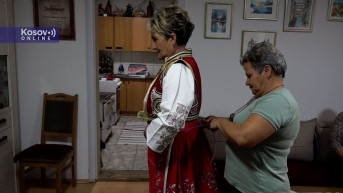
As she speaks about these customs, Simonovic is wearing a traditional costume from Nerodimlje, which she says represents a kind of “identity card” for a woman from Kosovo.
“Our costume consists of a dress, a long shirt and a bojca—women always wore a bojca. Then, depending on the color and their age, they wear aprons. There is also jewelry, a vest, a headscarf, socks and opanci. That is what a Kosovo woman should look like,” Simonovic said.
At fairs, she said, the “Tradition through the Centuries” Association’s stand attracts considerable attention from both visitors and exhibitors.
“Wherever we participate, we attract a great deal of attention because the Association itself has a large team. There has never been a place we were invited to that we did not attend. As a gift from Kosovo and Metohija, we always bring Kosovo strugana pogaca. The pogaca is always present at the opening of a fair or as a symbol of friendship and twinning, so it has always accompanied us,” Simonovic said.
She added that various elements of cultural heritage are presented at the stand.
“There are handicrafts and Kosovo embroidery. We are always dressed in traditional costume. There are Kosovo pies, dough-based products—the things our Kosovo women used to make. We strictly preserve our own recipes; we do not interfere with anyone else’s, but we do not give up our own. Preserves, liqueurs, various traditional fruit preserves, homemade honey and handicrafts are always present at our stand, so we invariably attract the attention of visitors as well as other exhibitors,” she said.
“Tradition preserves a people”
Simonovic urged younger generations to preserve tradition because, as she put it, tradition preserves a people.
“They should live in accordance with their possibilities in this modern age, but they should not forget their homeland, their tradition or their roots, because that is their identity card. The time will come when their children ask them who they are. If they do not know their own history and their roots, how will they be of use to society or to their community?”
0 comments