
Raska-Prizren Diocese: Road works in the Special Protective Zone of Visoki Decani Monastery resumed without the consent of the Serbian Orthodox Church
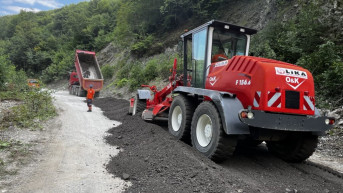
The Raska-Prizren Diocese announced that road works have once again commenced within the legally designated Special Protective Zone of the Visoki Decani Monastery, approximately two kilometers west of the monastery, along the existing route connected to the long-disputed Decani–Plav international transit road project.
"The monks of Visoki Decani Monastery visited the construction site. They observed heavy trucks delivering large quantities of crushed stone, as well as construction machinery spreading and leveling the material along the existing road. Based on the nature and scale of the activities observed, the works go beyond routine and limited road maintenance and display the characteristics of construction, reconstruction, or significant upgrading of road infrastructure within the protected area," the Diocese said in a statement.
The Diocese added that neither Visoki Decani Monastery nor the Raska-Prizren Diocese had been notified in advance about the works, nor had they received any project documentation or explanation regarding their purpose, scope, or legal basis.
"The consent of the Serbian Orthodox Church, as required by the Law on Special Protective Zones, was not requested. Nor are we aware that the legally prescribed procedure has been initiated before the Implementation Monitoring Council, which includes two Kosovo ministers, Metropolitan Teodosije, and the Heads of the EU and OSCE Missions in Kosovo and Metohija. Law No. 03/L-039 on Special Protective Zones constitutes a specific and binding legal framework for the protection of Visoki Decani Monastery. Article 7 of the Law explicitly establishes the monastery's Special Protective Zone. Article 5 expressly prohibits the construction of transit roads through rural Special Protective Zones, such as the zone surrounding Visoki Decani Monastery, while Article 6 provides that any road construction or reconstruction constitutes a restricted activity for which the competent authorities must first obtain the consent of the Serbian Orthodox Church. If such consent cannot be reached, the matter must be considered through the legally established implementation and monitoring mechanism," the statement said.
The Diocese stressed that the legal situation is therefore clear, regardless of how the works may be formally presented.
"If their purpose is to continue the construction of the Decani–Plav transit route through the Special Protective Zone, then the activity is prohibited by law. If the works are presented as repairs or improvements to the existing local road, they are still subject to the obligation of prior consultation with and consent from the Church, as well as consideration by the competent joint mechanism if such consent is not obtained. Based on the facts currently available, none of these procedures has been followed, while the scope of the works exceeds ordinary seasonal road maintenance," the Diocese said.
It also expressed particular concern that this is not the first attempt to carry out works along the same or a related route without full compliance with the law.
"Similar works within the Special Protective Zone were initiated in 2018 and again in 2020, only to be suspended following a firm response from international representatives. The agreement reached within the Implementation Monitoring Council in November 2020 provided for the construction of an international bypass outside the Special Protective Zone, together with strictly limited and parallel improvements to the local road within the zone. That agreement did not authorize unilateral works or the gradual transformation of the local road into a prohibited transit route. Unfortunately, although the agreement was signed by two Kosovo ministers and the Mayor of Decani, and guaranteed and endorsed by the then Heads of the EU and OSCE offices, it has not been respected for the past six years," the Diocese stated.
The Diocese emphasized that neither it nor Visoki Decani Monastery opposes improved transport links, lawful economic development, or the needs of the local population.
"For years, the monastery has supported a lawful compromise solution involving the construction of a bypass outside the Special Protective Zone and limited improvements to the local road in accordance with the law and previously reached agreements. Our concern is not development as such, but the renewed commencement of works within a legally protected area without a legal basis, consultation, or the prescribed procedures. Such actions call into question the effectiveness of the Law on Special Protective Zones, undermine confidence in institutions, and risk creating irreversible facts on the ground. This is particularly serious in the case of Visoki Decani Monastery, a shrine of the Serbian Orthodox Church and a UNESCO World Heritage Site, whose protection requires the highest level of legal and institutional responsibility," the statement said.
The Diocese expressed hope that the Kosovo Police and other competent authorities would, without delay, determine who ordered and authorized the works, verify their legal basis, and take all measures within their competence to ensure compliance with the law, the legal order, and the Special Protective Zone regime, and to halt the ongoing works.
"The rule of law must be demonstrated in practice, especially when it is necessary to prevent the creation of a fait accompli in violation of clear legal restrictions. At the same time, we expect the international representatives in Kosovo and Metohija, including the European Union, the OSCE, and KFOR, within the scope of its mandate, to give this case serious consideration and help preserve the legal mechanisms and agreements established for the protection of Visoki Decani Monastery. The Raska-Prizren Diocese remains committed to peaceful and constructive dialogue, but emphasizes that the monastery's special legal protection must not be reduced to a mere formal declaration. It must be applied consistently in practice, without exceptions or unilateral interpretations, because only in this way can the rule of law, mutual trust, and peace be preserved," the statement concluded.


0 comments