
Sretenovic on Armistice Day: Not all Serbs and Albanians have been enemies throughout history
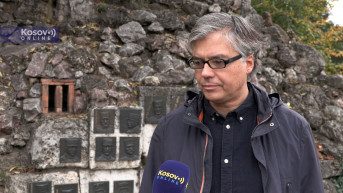
Historian Stanislav Sretenovic states that the relations between the Serbian and Albanian people throughout history have been marked by ups and downs, and he emphasizes that during World War I, Serbs had a friend in one of the Albanian leaders, Essad Pasha Toptani, who protected and assisted them during their withdrawal through Albania.
Sretenovic, speaking on Armistice Day, discussed the Serbian-Albanian relations throughout history.
"Serbian-Albanian relations over the centuries have been marked by ups and downs. Hostile relations have prevailed, but this stance should be nuanced because there were periods when relations were good. We can glance over several centuries and say that they were very good during the Middle Ages, during Skanderbeg's rule. Then they entered a period of crisis when Albanian nobles supported the Ottoman occupation and the system of pressure on the Christian and Serbian population. Later, during the Balkan Wars and World War I, these relations became even more strained, as Serbs and Albanians found themselves on different sides," Sretenovic explains for Kosovo Online.
He emphasizes that not all Serbs and all Albanians have been constant enemies.
"There were, of course, political games and alliances. For World War I, we should mention a friendship created with a minority group of Albanians gathered around Essad Pasha Toptani, who is even remembered by many Serbs as the 'Serbian mother' supported by the Serbian Government during World War I. During the withdrawal of the Serbian army through Albania, he called on the population to help them. Of course, some Albanians responded to this call, but they were a minority. Many rebelled, attacking Serbs at that difficult moment, and many Albanians looked indifferently at Serbian suffering during World War I. Essad Pasha Toptani was killed by an Albanian extremist in Paris after World War I and was buried in a Serbian military cemetery in Thiais near Paris," Sretenovic says.
He notes that at the signing of the armistice in World War I, Serbian and French troops liberating Serbia were already on the territory of the former Austro-Hungarian Empire, in the Pannonian Plain, in southern Hungary, i.e., Vojvodina.
"Serbian-Albanian relations are tied to an earlier period, especially to October 1918, when French troops with General Tranie, together with Serbian insurgents led by Duke Kosta Pecanac, entered Pristina on October 10. At that moment, the arrival of the French and Serbs was perceived by the Serbian population as liberation. It was Serbian territory being liberated, while the Albanian population viewed this act more as an opposing arrival in parts where they were the majority. During World War I, Albanians predominantly supported the Austro-Hungarian occupation of the northern part of Kosovo and the Bulgarian occupation of the southern part, which were very difficult occupations for the Serbian population in Kosovo and Metohija," Sretenovic explains.
Speaking about the symbol of Armistice Day in World War I - the flower Natalie's Ramonda, Sretenovic says it was well chosen and actually restores hope to the Serbian people.
"Natalie's Ramonda means a lot to all Serbs, wherever they are. Not only for Serbs in Kosovo and Metohija but also for the Serbian people anywhere in the world. Natalie's Ramonda is a symbol that was very well chosen, relatively recently, in 2012, as a symbol of the rebirth and revival of Serbian identity and prosperity wherever Serbs are located. It is a soothing Christian symbol that speaks of the suffering of our ancestors and the desire for us, in today's time, and our descendants to live in peace and prosperity," Sretenovic says.
He reminded that similar symbols exist in French and Anglo-Saxon culture, and such flowers play a role in awakening hope for relationships based on mutual respect among nations.
"Natalie's Ramonda is significant for our culture and should be present in our everyday lives, especially every November 11, whose symbol it is," Sretenovic concludes.


0 comments