
Tanasic: All 'neighboring Serbian nationalisms' are based solely on the negation of Serbian identity
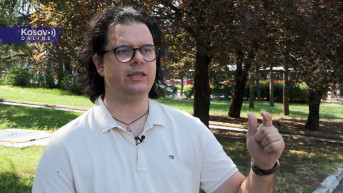
All 'neighboring Serbian nationalisms' are based solely on the negation of Serbian identity," philosopher Nikola Tanasic stated in an interview with Kosovo Online, discussing the destruction of Serbian cultural heritage in Kosovo. He added that these groups are interested in certain cultural heritage only to the extent that it can be proven that it is not Serbian.
Speaking about the recent comments by the U.S. Ambassador to Kosovo, Jeffrey Hovenier, who referred to Ulpiana as 'Kosovo's cultural heritage,' Tanasic emphasized that 'no one in their right mind in the last twenty years expects any kind of restraint or objectivity from Western officials.'
He added that it would be surprising if the U.S. ambassador behaved differently. However, he stressed that every available opportunity should be taken, and every kind of political pressure should be applied to international institutions.
"But expecting that Serbian cultural heritage, not to mention other, perhaps more significant, perhaps less important, but vital Serbian national interests in Kosovo, will be protected by convincing some well-meaning foreigner with our strong arguments to change their policy—that is highly illusory," Tanasic cautions.
According to him, "this hypocritical position towards Kosovo's identity, heritage, and culture is not new."
"This was inserted into American political jargon as far back as during the bombing. It's because their public also found it difficult to understand how a sovereign state could attack itself, so it became very important to talk about Kosovars, about Kosovo identity, about some kind of Kosovo space," he explains. He adds that this can be clearly seen in the case of Ukraine, where Ukrainian identity is spoken of as millennial and exclusive to Russian, "which we all more or less know has no basis in reality."
Tanasic believes that the broader public in the U.S. and the West "doesn't really care what kind of justification is used to protect imperial interests in Kosovo and Metohija, but they like to hear some argument."
"On the other hand, we have their core political elite, their industrial cabal, the famous military-industrial complex. As far as they're concerned, they absolutely don't care whether Kosovo's culture was invented yesterday or not, they don't care whether there will be some monastery standing for a thousand years or if it will be erased tomorrow. These are people with strong economic interests in the colonial and military occupation of Kosovo and Metohija. And those interests have nothing to do with what they think about Albanians, about us, our cultural relations, or who Kosovo's cultural heritage belongs to," our interlocutor explains.
In his view, the application of Solomonic solutions regarding cultural heritage is not just a problem of Kosovo Albanians, "but of all so-called neighboring Serbian nationalisms.
"We can see the exact same pattern, with varying degrees of intensity, in Croatia, in the Federation of Bosnia and Herzegovina, and in Montenegro, where there is a completely distorted approach to national identity that is based solely on the negation of Serbian identity. In other words, certain cultural heritage interests us only to the extent that we can prove it is not Serbian. If we can prove it is not Serbian, we will appropriate it, but we will not care for it. If we cannot prove it, then our goal is to destroy it, obliterate it, and erase any trace that Serbs once existed there and, heaven forbid, left behind something that is part of UNESCO's heritage or the cultural heritage of the entire world," says Tanasic.
He emphasizes that the actions of Kosovo Albanians are "schizophrenic" because they want to destroy some monasteries while seeking to appropriate others.
"They do not come there to pray, they do not come to venerate icons, they do not sing songs about it, they do not have folk songs that are hundreds of years old. This is not something that mobilizes them. It only mobilizes them insofar as they see it as an outpost of the Serbian colonial aggressor, which they then feel compelled to destroy because it hangs over them like the Sword of Damocles. What interests them in all of this is, therefore, only how to eliminate the Serbian factor. If they think they can eliminate it by seizing ownership of monuments, by taking control of those monuments, because they see, of course, the Serbian Orthodox Church as an enemy, then in their eyes, by taking away that property, they believe they are removing a lever of influence," he believes.
He also adds that in the event of any geopolitical complication, monasteries and other Serbian cultural heritage sites in Kosovo and Metohija will again suffer.
"These individual incidents, this low-intensity terror that is carried out against Serbs in Kosovo and Metohija every day—whether it is hay, livestock in barns, garages, broken windows, or the parading of heavily armed terrorists through the main streets of Serbian towns, just to show that they can, not to mention the killing of people, which we have also seen in the recent period—all of this is part of a policy aimed solely at intimidating and ultimately expelling the Serbian people from these areas, which I sincerely hope we, as a people, culture, and state, have the strength to oppose," Tanasic asserts.
In the struggle to preserve this heritage, "there are no bad tools," but it is important, he believes, to remain rational.
"Let's not allow anyone to sell us a pig in a poke, and let’s not sacrifice vital national interests to appease people who, in any scenario, will never be favorable to us and from whom we cannot expect understanding on this issue. UNESCO is fine; UNESCO helps us, can provide some funds, and can assist in maintaining these sites and similar activities," says Tanasic.
He also points out that Kosovo remains a relevant topic in our culture at all levels, but the key issue is legislative.
"If we want to take serious steps towards protecting our property, we must start enacting laws that prescribe specific measures for its protection. Because as long as this isn't legally defined, as long as it hasn't passed through parliament, as long as it hasn't been signed by the president, and as long as it isn't elevated to the level of state policy that is documented on paper, it can be manipulated, and people can refer to verbal agreements, private promises, and the like. So, the sooner this issue is institutionalized, the sooner the state begins to approach it as a state matter rather than a personal relationship between this or that politician and this or that foreign diplomat, the sooner we will be in a position to do something genuinely useful that will improve the situation on the ground," Tanasic concludes.



comments