
Celic: I believe the defense tactic of former KLA leaders is to have certain witnesses “overshadow facts with their titles”
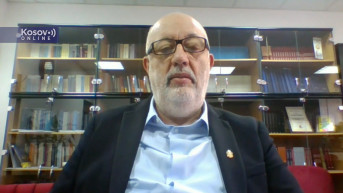
Assistant Professor at the Faculty of Law in North Mitrovica, Dusko Celic, told Kosovo Online that he does not expect a large number of defense witnesses in the trial against Hashim Thaçi and three other former KLA leaders in The Hague—certainly not as many as appeared for the prosecution—because the defense is in a hurry.
Since the accused have been in detention for years, Celic believes the defense’s interest is to have the case concluded as soon as possible.
“I also assume that they, from their perspective, believe the verdict will be acquittal. Therefore, I don’t expect many witnesses for the defense, but rather that a number of international, former, active, or retired officials will appear as defense witnesses who would, so to speak, overshadow the facts and reality with their titles. I assume that is the defense’s tactic in this case, not bringing in a larger number of witnesses,” Celic explained.
The presentation of defense evidence in this case begins tomorrow. As Wesley Clark, Bernard Kouchner, and William Walker have previously been mentioned as possible defense witnesses, Celic says he does not see what procedural value their participation would have, other than perhaps offering general statements in favor of the accused.
He added that he is not sure how suitable they are to be credible witnesses for several reasons.
“With their actions—first during the NATO aggression, and even before it—they positioned themselves on one side, namely with the so-called Kosovo Liberation Army and the Albanian separatists. Particularly, their activities after the NATO aggression, and here I especially highlight William Walker, his regular visits to so-called Kosovo and his highly biased statements about various events, show that if the court were to accept the defense’s request for them to testify, they would not be credible witnesses, because they have openly taken one side. Their statements are not statements of fact, but rather extremely subjective value judgments in favor of one side,” Celic noted.
He specified that the first procedural obstacle to them being witnesses is that their past conduct has already shown they are not credible.
“Secondly, from the positions they held at that time, they certainly could not have had insight into what the accused in this case were doing, nor what the KLA forces were doing at the time—which crimes they committed, where the camps were, who was held in them, what crimes were committed systematically and on a large scale at that time. So, from that perspective as well, I don’t see what procedural value their participation in this trial could possibly have, apart from giving general statements in favor of the accused,” Celic said.
According to him, the trial before what he calls a “quasi-judicial body in The Hague” has been contaminated from the very beginning, “because it is not an international court but formally part of the quasi-legal system in Pristina.”
“Even the indictment itself is incomplete because it largely covers internal Albanian disputes, while it does not cover Serbian victims—especially not during the NATO aggression and certainly not afterward. Only a relatively small number of Serbian victims is included, and all this shows us that politics has greatly influenced this trial. On top of that, we have the repeated scenario from the Hague Tribunal, where witnesses are being pressured, so in that respect too, this quasi-judicial process is contaminated,” Celic said.
He pointed out that the Coordination of Serbian Associations of Families of the Missing and Murdered from the Former Yugoslavia had previously expressed doubts about the outcome of this trial. As the deputy president of this organization, Celic said he does not believe justice will be served for the majority of Serbian victims in Kosovo and Metohija.
0 comments