
Why do we fail to normalize relations?
At the same time as the unsuccessful attempts of the representatives of the West to enable the normalization of relations between the Serbs and Albanians in Kosovo, and then those on the Belgrade-Pristina line, there are many indicators that say that things are going in the opposite direction and that the process of creating new hostility is heating up on both sides, which in the near future leads to inflaming of hatred, conflicts, and continued bloodshed.
How is it possible?
After 24 years since the military conflict and the arrival of international missions in Kosovo and 10 years since the conclusion of the Brussels Agreement, the situation on the ground, above all in the areas where the majority of the Serbs live, is catastrophic to the extent that it is hard to believe that such a thing is possible in the 21st century. Especially in Europe, which prides itself on the guarantee of various freedoms, respect for the principles of legality, human and civil rights, international conventions, agreements, and other modern achievements?
The causes of the current situation in Kosovo are numerous and stem from the very core of the Serbian-Albanian conflict, which has been going on for at least two centuries blame can be sought on both sides, but the responsibility for what is happening now lies primarily with the Western mediators. Washington, Berlin, Brussels, and others are doing something wrong, and it is becoming more and more visible every day.
Because, taking into account the number and presence of special representatives of the US, EU, Germany, France, and Great Britain, in addition to ambassadors already engaged daily in Pristina, the absence of real effects on some important obligations that the Kosovo government has, and which it persistently does not comply with, is surprising.
And, this is further reflected in everyday life, in which the government in Kosovo makes and implements decisions outside of democratic practice, often contrary to legal provisions, abusing institutions, especially the police. Of course, such a situation is fertile ground for tensions, incidents, and the possibility of large-scale conflicts, which we witness day after day.
How many times in the last few years have people from the West, through various announcements, conclusions, and declarations, without any effect, asserted that the Community of Serb-majority Municipalities should be formed? As if it is a job that requires the greatest intelligence and technology of Silicon Valley engineers. And, all it takes is goodwill and for some people to nod their heads in the affirmative, for things to move towards normalization.
Or, the case with the return of part of the stolen land to the Decani Monastery. The Quint ambassadors periodically mention that decision of the Constitutional Court, which the Kosovo government has been blocking for eight years. People from the Quint come forward on this occasion, mostly, in the moments when the Kosovo authorities carry out some new provocation, which they often made possible by their silence or even open approval. And also, as a rule, their admonition does not produce any consequence.
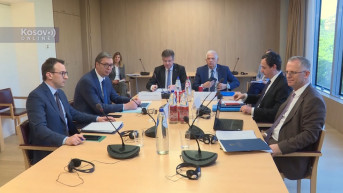
Miroslav Lajcak says that he is afraid of escalation in the north, and at the table in Brussels, he fails to get anything more from the representatives of Pristina except for a new mockery of the obligation to form the CSM.
So something is fundamentally wrong. What?
Perhaps the problem is that the Albanian side has no motive to change its approach. Why would official Pristina give up on maximalist demands when they are doing just fine like this?
Kosovo has entered the procedure for the Council of Europe, the EU has approved a visa-free regime, and it is said that Germany will push Kosovo's candidacy for the EU, entry into NATO has been in preparation for a long time. At the same time, the Kosovo government is building special police bases in the north, usurping Serbian land, holding elections with three percent of voters, arresting and holding people without evidence, and releasing others after shootings and attempted murders.
And that is why "normalization of relations" has two completely different meanings for the Serbs and Albanians. Some demand respect for basic rights, above all the right to a free life,
others an exclusive right to another state in which the opposite party is only expected to be obedient, even when its back is broken. And therein lies the key problem.
If it weren't for the tension in which people live every day in areas where the Serbs are the majority in Kosovo, that show in which the special mediators "convince Kurti to give in" would perhaps be fun to watch. In this way, not only is there no room for laughter, but the drama reaches its maximum.
And many logically ask questions. What is the purpose of stretching and haggling over the CSM? Do they even intend for us to get out of the labyrinth together?
If the Albanian majority in Kosovo does not accept the Serbs as their equal neighbors in the near future, and if this is not established as a principle in everyday life, and then translated into some sustainable Serbian-Albanian agreement in Kosovo, then this is not going well for either of us.
Pulling only on one side, trying to humiliate the other, and completely neglecting its interests and rights, will not be able to bring anything other than a boomerang that returns "to the forehead". New generations are growing up, it is not good that frustration with injustice grows with them. A sustainable solution for both parties can therefore only prevent a new accident in the future.
Written by: Milos Garic, editor of the Kosovo Online portal



0 comments