
Can "shuttle" diplomacy solve the Kosovo issue? The key, however, is always in Washington
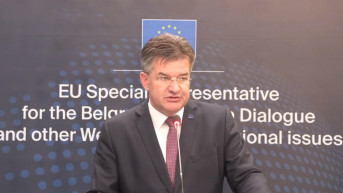
Yesterday's visit of the special representative of the European Union for dialogue between Belgrade and Pristina, Miroslav Lajcak, is the sixth visit of a European diplomat in just four months. Sometimes alone, and sometimes with the US Special Envoy for the Western Balkans Gabriel Escobar; Lajcak on behalf of the EU tries to reduce tensions between Belgrade and Pristina and to move the talks from the "dead point".
Lajcak and Escobar started with frequent visits, first of all, after the temperature "raised" in Kosovo, because of Pristina's decision on license plates, after which the Serbs in Kosovo left the institutions, and then, due to the arrest of several of their compatriots, they pointed out the injustice by erecting barricades.
The European-American duo tried to prevent the situation from escalating and reduce tensions to a level that would allow the two sides to talk again.
Part of that "shuttle" diplomacy is the Franco-German plan for the normalization of relations, which was handed over to the parties back in September, in order to speed up the process of finding a solution because the West is in a hurry to solve the problem, or at least to avoid the crises that could turn into an open conflict.
Belgrade and Pristina were visited on January 12 by the US Secretary of State's special adviser, Derek Chollet, and then eight days later the "big five" arrived - Lajcak, Escobar, and the envoys of France, Germany, and Italy, Emmanuel Bonne, Jens Plotner, and Mario Talo, when it is clearly presented that the Franco-German "non-paper" has become a European proposal.
Parts have been leaked to the public, and the European Union is now trying to persuade the parties to accept the plan as a basis for further negotiations.
After yesterday's talks, Kosovo Prime Minister Albin Kurti said that Kosovo accepted the European proposal for the normalization of relations, considering it "a good basis for further discussion and a solid platform for progress", but without a word about the Community of Serb-majority Municipalities, while Serbian President, Aleksandar Vucic, said that he had had an open and friendly conversation with Lajcak, without specifying the details of the meeting. This was followed by the announcement of Miroslav Lajcak - that the talks would continue at a high level.
Can the "shuttle" diplomacy of Miroslav Lajcak speed up the solution to the Kosovo issue, which the West insists on, primarily because of the war in Ukraine, or will a new international conference be needed, and is there even a solution that can benefit both sides? Will the European special representative manage to secure support for the Franco-German, or European, proposal?
Career diplomat, Zoran Milivojevic, tells Kosovo Online that no diplomacy can solve the Kosovo issue unless Washington is effective towards the current government in Pristina and towards Albin Kurti.
"No amount of diplomacy can create a serious space there," Milivojevic believes.
On the other hand, he emphasizes that Serbia has no responsibility for the situation in the dialogue, nor does it need to declare anything at this moment.
"The Serbian position is completely clear - the Community of Serb-majority Municipalities must be formed in the manner defined in the agreement from 2013 and in accordance with the principles defined in 2015. Everything is said there and everything must be implemented. That agreement is older than any other internal act and must be applied as it is," Milivojevic is clear.
He points out that "shuttle" diplomacy is nothing new, and when it comes to the EU, he points out, it has been going on for more than 10 years, but it has not produced any results.
"I am not sure that it will produce any result in this case as well. Lajcak was in Pristina yesterday, so we have not heard whether Pristina has changed its position because the CSM is a previous issue. Therefore, there are no further discussions about normalization, about the European plan, about anything, until that condition is fulfilled and until what is specified in the Brussels Agreement is finalized," Milivojevic said.
That alone, he notes, would create the conditions for the Serbs in Kosovo to return to the institutions, to take over their responsibilities in the north and six municipalities in the south, and that would further ensure the conditions that would guarantee the survival of the Serbs and the possibility to act politically and to live there.
From that position, it is then possible to discuss a new European proposal, to continue the dialogue on normalization.
Milivojevic points out that there is no need for any international conference, such as Rambouillet because Kosovo is a protectorate under the mandate of the United Nations and from an international legal point of view, the status of Kosovo is currently defined by the UN Security Council Resolution 1244, which states that "Kosovo and Metohija is a part of Serbia" and that the Security Council is responsible for deciding its final status.
"We are in a dialogue in which the EU mediates, we have the Brussels Agreement that needs to be implemented, and we are ready to talk within that mediation. However, Kosovo and Metohija is ultimately under the jurisdiction of the UN Security Council. If the EU is not successful in its mediation, then Kosovo and Metohija will be on the agenda of the UN Security Council," Milivojevic explains who therefore does not see the need for any conference on Kosovo, that is, a European proposal.
By the way, Kissinger himself once said about the agreement in Rambouillet - that it had been a pure provocation and that no Serb would accept it in that form.
It seems that the European proposal, based on the statements of Serbian officials, represents, like the one in Rambouillet, a new provocation, only that, unlike the end of the 90s, it does not contain an open threat of aggression.
The President of Serbia, Aleksandar Vucic, said on several occasions that the European proposal was difficult for Belgrade and that Serbia had to continue to talk, because of possible negative consequences that would primarily affect the economic development of the country and the standard of citizens.
It seems that the "shuttle" diplomacy of the European Union without America does not make much sense, since so far it has been shown that Pristina only responds to criticism and pressure from the other side of the Atlantic.
It seems that Lajcak alone cannot move the dialogue and resolution of the crisis from that "dead point" because the European Union, with its inconsistency, in insisting on the implementation of the agreements reached, without sanction for the party that does not do so, has lost its mediating and negotiating power. The mere promise of membership in the EU countries of the region, in some distant future, has long ceased to function in the Balkans as a means of exerting positive pressure.
"Shuttle" diplomacy in international relations represents an action taken by a third party, as a mediator between two parties in a dispute, who do not have direct contact and implies successive visits of the mediator to one and the other party.
The "progenitor" of that type of diplomacy is former US Secretary of State Henry Kissinger, who significantly contributed to reducing tensions in the relations between the US and Russia and the US and China in the 1970s, but also in the relations between Israel and its Arab neighbors.
Well, nevertheless, history shows that "shuttle" diplomacy has "limited ranges" and can lead to a relaxation of tension in the relations of opposing parties for a period of time, but none of those "disputes" have been finally resolved even to this day - relations between the US and Russia, that is, the US and China are at a critical level today, and Israel and the Arab countries have never found a common language for establishing peaceful coexistence.
Obviously, something more is needed to resolve decades-old disputes.


0 comments