
From The Hague to Pristina: Will the announcement of the verdict against former KLA leaders in September accelerate the formation of Kosovo's institutions?
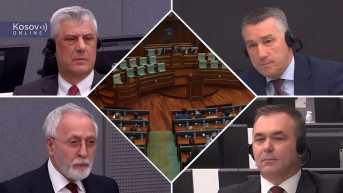
Rather than in two weeks' time, the Kosovo Specialist Chambers in The Hague will deliver its judgment against four former Kosovo Liberation Army (KLA) leaders, who are standing trial for war crimes and crimes against humanity, in just over two months. Political analysts interviewed by Kosovo Online agree that the court's decision is certain to influence the pace of political developments in Kosovo.
Written by: Jelena Milenkovic
As political parties in Kosovo await the certification of the final results of the snap parliamentary elections and public debate continues over possible post-election coalitions, news arrived from The Hague that the verdict against the former KLA leaders, initially expected on July 20, has been postponed until September 16.
As anticipated, the strongest reactions came from the Democratic Party of Kosovo (PDK), founded by Hashim Thaçi, as well as from the KLA War Veterans' Association and several legal experts.
Thaçi's former associates, most notably senior PDK officials Vlora Çitaku and Enver Hoxhaj, described the court's decision as "shameful and unrelated to justice," "political," and "absurd." They also criticized the continued detention of the four former KLA leaders—Hashim Thaçi, Kadri Veseli, Jakup Krasniqi and Rexhep Selimi.
At the same time, it was notable that no reaction came from the ruling Self-Determination Movement (Vetëvendosje), its leader and caretaker Prime Minister Albin Kurti, or his party colleague and Acting President Albulena Haxhiu.
Observers of political developments have little doubt that the court's decision, regardless of its outcome, will affect Kosovo's political landscape. The key question is whether—and for whom—it would be more advantageous to accelerate the formation of new institutions in order to avoid uncertainty over the verdict's political impact, or to wait until the Trial Panel delivers its decision.
An Acquittal for Thaçi Would Complicate Kurti's Position
Milos Pavkovic, Strategic Director of the Centre for European Policies, believes it would be in the interest of caretaker Prime Minister and Self-Determination leader Albin Kurti to expedite the formation of institutions by attempting to form a government and secure an agreement on the election of the president before the verdict is delivered.
"A potentially acquittal of Hashim Thaçi would pave the way for his return to political life in Kosovo and would undoubtedly complicate Albin Kurti's position in any future elections, should new institutions fail to be formed before the verdict," Pavkovic told Kosovo Online.
As for the opposition, he believes that if its objective is to unseat Kurti, its strategy could be to prolong the process of forming institutions for as long as possible while awaiting a favourable decision from The Hague. Riding the momentum of such a verdict, the opposition could then seek new elections, hoping to achieve a stronger result, particularly as Kurti has been steadily losing voter support from one electoral cycle to the next.
Although Pavkovic considers it might be a better strategy for the opposition to attempt to reach a coalition agreement with Self-Determination, he notes that this is ultimately a matter of political calculation and each party's assessment of what best serves its interests at this moment—whether to enter negotiations with Self-Determination or delay the process in the hope that a renewed political crisis and shifting political landscape would ultimately bring them greater electoral support.
A Conviction Would Benefit Kurti
Political analyst Nexhmedin Spahiu agrees that an acquittal in The Hague would significantly benefit the Democratic Party of Kosovo.
"Everyone has expectations regarding the verdict. It will certainly influence the dynamics of political life in Kosovo. If the verdict is an acquittal, prolonging the process of forming institutions would suit the Democratic Party of Kosovo. If it is a conviction, that would favour Albin Kurti," Spahiu told Kosovo Online.
He also stressed that delivering a judgment in such a complex case is no simple task, given the extensive case file, the large number of witness testimonies and documentary evidence.
"After all, the most experienced judges, prosecutors and defence lawyers are at the Hague tribunal. They do not operate like some of our courts, issuing decisions based merely on their own discretion. Their judgments are based on documents and witness testimony, and it naturally takes time to analyse all of that," Spahiu concluded.
Former KLA commanders Hashim Thaçi, Kadri Veseli, Jakup Krasniqi and Rexhep Selimi have been charged with crimes against humanity—including persecution, imprisonment, other inhumane acts, torture, murder and enforced disappearances—as well as war crimes, namely unlawful and arbitrary detention, cruel treatment, torture and murder. During the period covered by the indictment, all four held senior positions within the KLA General Staff.
According to the indictment, Thaçi, Veseli, Krasniqi and Selimi bear individual criminal responsibility for crimes committed by KLA members during the non-international armed conflict as part of a "widespread and systematic attack against persons perceived as opposing the KLA."
The ten-count indictment charges them with persecution on political and ethnic grounds, imprisonment, unlawful arrest and detention, other inhumane acts, cruel treatment, enforced disappearance, two counts of torture and two counts of murder.
According to the indictment, KLA members committed crimes against approximately 407 detainees, at least 102 of whom were killed, between March 1998 and September 1999. The indictment identifies 75 victims—51 Serbs, 23 Albanians and one Roma.
Six counts of the indictment charge Thaçi, Veseli, Selimi and Krasniqi with crimes against humanity, while four relate to war crimes. The indictment further alleges that all four participated in a joint criminal enterprise.
The defendants have been in detention in The Hague since November 2020, and their trial began in 2023.
A total of 134 witnesses testified during the proceedings, including 125 called by the Prosecution, two by the Victims' Counsel and seven by the Defence. In addition, 164 witness statements were admitted into evidence in written form.
In her closing arguments in February, Chief Prosecutor Kimberly West stated that the testimony and evidence presented during the proceedings had confirmed that the alleged crimes had been committed and that the accused were responsible for them. She requested that the Trial Panel find all four defendants guilty on all ten counts of the indictment and sentence each of them to a single prison term of 45 years.


comments