
A conversation is inevitable; otherwise, Serbia is violating UN Security Council Resolution 1244
The Franco-German, i.e. European proposal for Kosovo is not acceptable for Serbia, if it implies explicit recognition of Kosovo and acceptance of Pristina's membership in the United Nations, because Serbia will not agree to that, but Belgrade must participate in the talks because if it does not - violates UN Security Council Resolution 1244, analysts say.
After the President of Serbia, Aleksandar Vucic informed the public about the existence of a new Franco-German proposal for Kosovo, and parts of that document were "leaked" in the media, it seems that the right-wing part of the political spectrum was the loudest in the reaction, in a clear position that the proposal should be rejected because it represents capitulation.
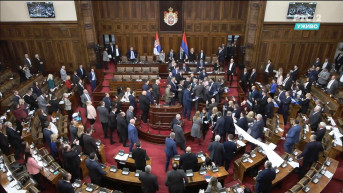
They also voiced their objections at the session of the Assembly of Serbia, dedicated to that topic, when, in addition to the incidents, the parliamentary "right-wing" parties - Dveri, the Oathkeepers, and the Nada coalition, around the New Democratic Party of Serbia, decided to act together on this issue, strongly opposing the proposal, sometimes even asking for the negotiations to return to the auspices of the UN.
They complained that the proposal had been secret, but they did not use the opportunity to gain insight into the document, because they refused to go to the President, claiming that they did not want to if they could not inform the public about what was in the proposal.
Political scientist Boban Stojanovic says for Kosovo Online that for him, at least what has been seen of the plan, is unacceptable, if it is an agreement, as President Vucic himself said - between two states, without explicit recognition, because when an agreement was signed based on on "two states", it was an interstate agreement.
"In that sense, I understand why part of the party scene thinks it should be rejected, but I wouldn't call it capitulation. At this moment, I am against saying - we will not negotiate. I think that nobody said that, that all relevant political actors, including Dveri and Oathkeepers, had said that negotiations should continue, but not about Serbia allowing Kosovo to become a member of the UN," Stojanovic said.
When it comes to the consequences of rejecting this agreement, Stojanovic notes that in the past 15 years, without Kosovo's recognition and membership in the UN, Serbia has not suffered any serious sanctions, but believes that it is the opposite and adds that we should know exactly if the formal European integration would stop, are we threatened with economic and political sanctions if the proposal is rejected.
Although President Vucic said that 90 percent of what had been found in the media was true, the public is not officially aware of the actual content of the proposal, which is why it is ungrateful to comment on that proposal, Predrag Rajic from the Center for Social Stability says, but he points out that Serbia must negotiate.
He reminds that Serbia is also bound by UN Security Council Resolution 12 44 to negotiate the final status of Kosovo, which clearly states that the final status of Kosovo will be reached through direct negotiations between Belgrade and Pristina, that is, the Serbian and Albanian sides.
"So, if we were to refuse to negotiate on the status of Kosovo and Metohija, we would actually violate all previously signed agreements and resolutions, including those that we ourselves refer to and that guarantee us the right to our southern province, which includes Resolution 1244 itself," Rajic told Kosovo Online, talking about the possible consequences of the possible rejection of the proposal and negotiations on that basis.
He adds that the Franco-German proposal is a platform for negotiations, but that it remains to be seen how that process will continue, whether there will be a draft agreement, and what it would look like.
For him, it is clear that so far there has been some progress in the negotiations with the West because Belgrade no longer insists on recognizing the unilaterally declared independence of Kosovo.
"Serbia has its own red lines; it does not want and will not recognize the unilaterally declared independence of Kosovo and does not want to agree with Kosovo's application for full membership in the UN. And everything else is a matter of negotiation. Both about the status of the Serbs in Kosovo and Metohija, as well as about the status of Kosovo and Metohija in Serbia," Rajic said.
When asked if the proposals of the "right-wing" opposition were realistic, or if they consciously "play" on emotions, Rajic says that their goal is to make a political profit and secure enough votes to be present in the parliament, while for difficult topics and problems, they offer easy and simple solutions.
"That is the definition of demagoguery and populism. And of course, they use manipulations, they insist on trying to present everything through an emotional prism, but none of those options offer a solution; they don't say what can and should happen and how they plan to realize it. It is fundamentally harmful to society. And all those options are acting extremely irresponsibly at such an important moment," Rajic pointed out.
The right-wing parties also supported the protest in front of the Presidency on Statehood Day, which Rajic considers a long-term wrong move, because they side with the bullies, adding that state authorities should examine the role of all political actors in this.
"The extreme rightists cannot come to power through elections, that's why they support violence as a form of political struggle because they believe that they can come to power through chaos on the streets. Certainly, the possibility that they have the most direct contact with foreign services cannot be ruled out, and this should be investigated. We should have no illusions, all world actors here are trying to find contractors for their plans, and they are guided exclusively by their own interests, and Serbia's interest is stability and peace," Rajic said.
Stojanovic states that the policy of any option, or organization, should not only be a question of Kosovo because, for ordinary citizens, it is a question of "red lines" that Serbia should not agree to.
"About who will produce the electricity, whether this or that will be on the bills, what kind of license plates will be... All of that can be negotiated, but I don't think that accepting Kosovo's membership in the UN is playing with emotions. It is also a factual change of the Constitution and the territory of this country. Simply, it is an emotional, but more rational question," Stojanovic says.
He adds that it is necessary to negotiate about everything, about technical things, people's lives, lakes, mines, and license plates, along with two "red lines", recognition and membership in the UN, which, he says, are the same for everyone.
When it comes to the protests, he says that it does not suit the opposition that supported them, because a small number of people were present, but he also adds that he would not be surprised if "the story about carrying and finding weapons was staged", that, of course, the sniper should not be carried around, but that it only benefits the government.
He adds that Foreign Service stories are "part of folklore."


0 comments