
Conversion from Islam to Catholicism in Kosovo: Sporadic Cases or Emerging Trend?
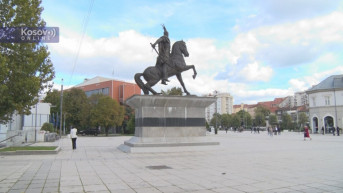
The topic of Albanians converting from Islam to Catholicism occasionally surfaces in Kosovo, but due to a lack of documented data, speculation ranges from isolated instances to predictions that this process could become widespread. According to Pristina-based demographic researchers interviewed by Kosovo Online, these are sporadic cases unlikely to become a mass trend.
By Dusica Radeka Đorđevic
The Decanski Movement association, whose members promote voluntary exit from Islam, marked its first anniversary on October 20. Representatives of the movement advocate for preserving Albanian national identity and values, under the motto: “We are no longer Muslims.” Meanwhile, the association's coordinator, Veselj Lekaj, claims that both Islam and Serbian Orthodoxy are harmful to Albanian society.
Around a month ago, Arber Gasi, a member of this movement, stated he was among the first to “complete the process of converting to Catholicism,” asserting that this trend has also started in Albania.
Adriatik Kelmendi, a journalist from Klan Kosova TV, recently posted on "X" that the Decanski Movement has quickly converted hundreds of Kosovars to Catholicism, suggesting that Albanians should return to their "previous faith"—Christianity, as they are a European people.
Dragisa Mijacic, coordinator of the EU National Convention’s Working Group for Chapter 35, also commented on this issue, claiming that Kosovars are converting en masse to Catholicism, which he believes will bring social challenges. In the coming years, he suggests, religious identity issues among Albanians will become more prominent than they have been.
“There is significant discontent within the Islamic community over this conversion process among its followers. Were it not for the dialogue and relations with Serbia, this would be the primary issue for them. However, the ongoing matters with Serbia overshadow this issue,” Mijacic observed.
The Islamic Community of Kosovo and the Diocese of Prizren-Pristina declined to comment on the matter.
According to demographer Sami Behrami, these conversions are isolated cases that do not significantly alter the religious structure of Kosovo’s population. “The census data from this year has not yet been published, but the 2011 census showed that Kosovo’s population consisted of 93% Muslims, over 2% Catholics, nearly 3% Orthodox Christians, and about 1% belonging to other faiths. While media reports suggest shifts in this structure, I believe these are sporadic cases that do not affect the religious composition of the population,” Behrami told Kosovo Online.
Behrami expects Kosovo's latest census results, including data on religious affiliation, to be published by the end of December. He is confident that the 2024 data will not differ significantly from that of 2011.
"To change religious affiliation by even one percent, at least 15,000 people would need to convert, which is currently impossible in Kosovo," Behrami states. "Converting from one religion to another is permitted and legal in Kosovo; people are exercising their rights recognized by Kosovo's Constitution and laws. Those who choose to convert do so to feel better, but this has become more of a media issue. I don’t believe there is a political background to this, although, unfortunately, politicians could potentially exploit it."
Historian Bedri Muhadri from the Historical Institute in Pristina told Kosovo Online that he does not expect individual cases of conversion from Islam to Catholicism in Kosovo to become a trend with significant impact, and he believes each case should be viewed individually.
Regarding the Decanski Movement, Muhadri explains that it promotes the idea of converting from Islam to Christianity, particularly Catholicism, but he considers it unlikely to gain significant momentum or pose a risk to the "strong religious tolerance among Albanians."
"I believe that the right to religious belief is an individual right, an individual will. Kosovo is a secular state, which means it accepts religious activities that operate freely and are organized independently of state institutions," Muhadri notes.
From a historical perspective, he adds that it is generally known that the Albanian (Arbëresh) population across its entire geographic area, due to historical circumstances from antiquity through the Middle Ages and prior to Ottoman rule (from the 1st to the 16th century), was predominantly of Christian faith, both Catholic and Orthodox.
"The indigenous Albanian population across its entire territory, including Kosovo, which was known as Dardania before the Ottoman period, had its own religious traditions and places of worship. With the arrival of the Ottoman authorities from 1450 to 1900, the Albanian population transitioned from Christian faith, both Catholic and Orthodox, to the Islamic faith—specifically Sunni Islam and the Bektashi order, also a Sunni branch. Historical records show that some Albanian Muslims are now converting or returning from Islam to the Christian faith," Muhadri emphasizes.
He also points out that among Albanians, their "core identity is rooted in national affiliation, based on blood, language, and clan, rather than Islam or Christianity."
An English historian who traveled through Albanian villages in Albania and Kosovo in the early 19th century noted: "When you ask any Albanian what they are, they answer that they are Albanian, whereas other nations like the Serbs or Bulgarians will say they are Orthodox and only afterward state their ethnicity." Albanian cultural revivalists from 1850 to 1918, in their writings to foster national consciousness, spoke of "Albanianism" as their true faith, alongside the practice of Muslim and Christian rites or even Bektashi ceremonies. Muhadri cites the famous Albanian Renaissance poem by Vaso Pasha: "Do not look to the church or the mosque, for the faith of Albanians is Albanianism."
In Kosovo, he concludes, religions function freely, and this diversity is part of its rich heritage.
The conversion cases from Islam to Catholicism, according to Belgrade-based historian Stefan Radojkovic, are an intra-Albanian ethnic matter that will have no consequences for the Serbs. However, he notes that it will be interesting to observe the reaction of the Islamic community.
The Catholic community, as Radojkovic noted for Kosovo Online, has always existed in Kosovo, both among Albanians and among ethnic Croats, who once lived there in greater numbers.
"The presence of the Catholic Church in Kosovo and Metohija is not new; what is new is the momentum generated by their missionary efforts. This has proven quite successful, and there are several reasons for this. First, Ibrahim Rugova was once involved in the construction of a cathedral in the center of Pristina, which not only symbolized the Catholic Church's presence in Kosovo but also provided encouragement, at least within the Albanian community," Radojkovic explains.
On the other hand, he points out that there are international lobbying efforts aimed at presenting Kosovo as a multicultural and multireligious environment.
"On a global scale, identity is linked to Mother Teresa, a Catholic nun of Albanian origin, albeit from Skopje. The ultimate goal is for the Vatican to recognize the Pristina administration, and over the past 20 years, this has led to a larger number of Albanians converting to Catholicism than was traditionally the case among them. Of course, we must also consider personal choices; some people may be searching for meaning in religion, with some becoming more devout Muslims, while others convert to Catholicism. One thing is certain: their attitude toward Serbs, the Serbian community, and the Orthodox Church in Kosovo and Metohija will not significantly change. This remains purely an intra-Albanian ethnic issue," Radojkovic emphasizes.
Within the Albanian ethnic community, he adds, all three religions are present—Catholic Christianity, Orthodox Christianity, and Islam—with Islam dominating in Kosovo, while the Catholic Church is increasingly coming to the forefront.
"What will be interesting for those following intra-Albanian relations is how the Islamic community will react to this, as they are ultimately competing for the same flock, or in other words, share the same target group," our interlocutor says.
He believes that a larger number of Catholics in Kosovo will not impact the Vatican's stance on Kosovo's status.
"The Vatican does not allow itself to be guided by the particular interests of individual religious communities or their congregations in any region. The Vatican is an independent state with its own policies, which it pursues regardless of any developments on the ground. Here, it will not be decisive whether there is a larger or smaller number of Catholics in Kosovo. What will be decisive is the relationship between the Republic of Serbia and Pristina. It is the Vatican's practice not to recognize any legal change in status until there are sustainable agreements that they can support," Radojkovic explains.


0 comments