
Djindjic and the Kosovo issue 20 years ago: Refusal of recognition, comparison with Republika Srpska, pressures, and assassination
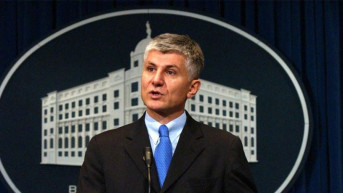
Serbia's rights to Kosovo were not something that could disappear, Kosovo was the state's number one priority, and the late Serbian Prime Minister Zoran Djindjic said in his last interview, and today, 20 years after his murder, this thesis is more relevant than ever.
At the beginning of March 2003, in the light of discussions with representatives of the international community about the relationship between Serbia and Kosovo, Djindjic warned that it was crucial to solve the issue of Serbian statehood and that Serbia "does not need a cuckoo's egg in the state's nest".
"I would not like to take part in something that would make someone 50 years from now have a reason to say about me: that Djindjic was naive, he was building a state for someone else," Zoran Djindjic told Novosti six days before his death.
Among other things, he was remembered as a politician with European aspirations, and great ambitions and a prime minister who was assassinated on March 12, 2003, in the center of Belgrade at the entrance to the Government of Serbia.
Pristina declared unilateral independence in 2008.
His friends and connoisseurs of the political situation of that time say that Djindjic worked to affirm the Kosovo problem at the international level and that he advocated that the problem be solved in favor of Serbia and the Serbs in Kosovo.
Historian and writer Bojan Dimitrijevic, who is also the author of the biography "Zoran Djindjic", told Kosovo Online that Djindjic "inherited" a ruined state and that he had understood the complexity of the Kosovo issue in mid-2002 in a conversation with international representatives whose pretensions had been directed towards the formation of an independent state of Kosovo.
After coming to power, Djindjic found, Dimitrijevic points out, a situation where KFOR forces were in Kosovo, and the administration was in the hands of the United Nations.
"Only in the middle of 2002, in meetings with representatives of the international community, did he begin to understand that in the international community, among the main partners at that time, the prevailing attitude was to move towards something like the creation of Kosovo's statehood, independent of Serbia. It was probably a big surprise for Djindjic and then he started to wonder why the insistence on that and why a similar standard is not applied to events in Bosnia and Herzegovina, i.e. the organization of Bosnia and Herzegovina," Dimitrijevic said.
In principle, he says, Djindjic was the man who, in the second half of 2002 and the beginning of 2003, insisted on "raising that issue" in the relations between Serbia and the international community.
Dimitrijevic reminds that, at the time when Slobodan Milosevic was still in power, there was a story that Djindjic had a concept to divide Kosovo and that it was in line with the ideas of Dobrica Cosic, but that when he came to the position of prime minister, he rejected that idea and committed to open dialogue with the international community in order to raise the issue - "What about Kosovo and Metohija".
"He was aware, as he said in 2003, that an independent state was emerging in Kosovo and that there were processes that would transform Kosovo and Metohija into something that was a de facto state outside of Serbia. On the other hand, he pointed out to the Serbian public in some of his interviews that time worked for the Albanians and not for the Serbian side. In one of his last addresses, he pointed out that Serbia and he would never recognize any independence of Kosovo, indicating that it was the state's number one priority," Dimitrijevic said.
Djindjic had believed, he added, that the status of Kosovo was the status of Serbia and that the statehood of Serbia could not be concluded if the status of Kosovo was not known.
Dimitrijevic emphasizes that, also, one of Djindjic's theses from the end of the 80s was that the center of Serbia moved to the north and that Kosovo is part of some historical past - that the center of the Serbs moved towards Belgrade.
However, the historian points out, Djndjic pointed out to the representatives of the international community that in Kosovo, Serbs and Albanians did not live together, but lived next to each other.
"That was a response to the claims of the international community that a multi-ethnic society was being built in Kosovo. Djindjic rejected those claims, pointing out the paradox of society in Kosovo; pointing out that it was basically two different societies. And he himself pointed out that no one had ever told him that this was not true and that his arguments were rebuttable," Dimitrijevic said.
The most impressive statement by which Djindjic expressed his awareness of the problems in Kosovo was, according to Dimitrijevic, that "he does not want someone in 50 years to say that Djindjic was naive and built a state for someone else".
Dimitrijevic points out that during his mandate, Djindjic launched concrete initiatives to contribute to the improvement of the position of the Serbs in relation to Albanians.
He states that, thanks to the government of the time, Serbian security forces and the Ministry of Interior of Serbia took control of the municipalities of Presevo and Bujanovac, which were once occupied by Albanian rebel forces.
"It was one of the good models of cooperation between Serbia and NATO and the international community. However, it was only at that moment, but later there was intense pressure to do something with Kosovo, without it being in the context of the Serbian state, which, as I said, Djindjic had already detected in the middle of 2002 and had started to open up the issue," Dimitrijevic said.
According to him, many in the West did not understand Djindjic's position on Kosovo as a logical question for the prime minister of a sovereign state but equated him with Milosevic.
"When we read 20 years after the statement which Zoran Djindjic said about Kosovo, we see that he detected the problem and that he began to indicate to the international community that we were heading towards the problem, but that the assassination cut all that off and that now we have those statements of his as a warning for today," Dimitrijevic concludes.
When asked if Djindjic had had a change in his views on the issue of Kosovo, the historian assesses that there was no special change, but that Djindjic, based on a theoretical consideration of a politician who was in the opposition, faced a real problem when he became prime minister.
Dimitrijevic says that Djindjic inherited a ruined state and that after coming to power he faced various challenges, from returning the country to the international framework, the United Nations and the Council of Europe, through the ruined economy, to the connection of the security services with organized crime and the police with crime and corruption.
"In those circumstances, Kosovo was not immediately recognized as a problem, but Djindjic set it as a priority when he realized that international negotiators were insisting on a slightly different context of Kosovo, in which the rights of Albanians and the guilt of Serbia are often highlighted, as well as forcing something that would later turn into Kosovo's statehood,” the historian said.
He adds that Djindjic insisted on restoring the rights of the Serbian state in a more realistic context, while on the other hand, he began to link the issue of Kosovo and Republika Srpska into one concept of reorganization in the area of the former Yugoslavia, but also in the Balkans.
Even then, says Dimitrijevic, the US and NATO countries, which carried out military intervention and aggression against the FR Yugoslavia, were hostile and unfriendly towards Djindjic's opening of this issue.
"I am sure that Djindjic stopped the issue of Kosovo or changed it into some kind of broader context there would not be a sudden declaration of independence in 2008, but those are the “what if” situations. The bottom line is that Djindjic opened the issue and faced the same difficulties that we are facing today. Many today believe that the opening of the Kosovo issue was the reason for the assassination on March 12, 2003," Dimitrijevic concludes.
The president of the Association of Serbian Economists and former minister in Djindjic's government, Aleksandar Vlahovic, told Kosovo Online that Djindjic had recognized that Serbia, with an unresolved status regarding the status of Kosovo, and without taking measures, would be in a passive position.
"It is precisely for this reason that in 2002 and 2003 he tried to take the initiative and reach an appropriate agreement that would in any case ensure the citizens of Kosovo, above all the Serbian community in Kosovo, to live in normal conditions, without tensions and everyday conflicts. On the other hand, he had the goal of solving the Kosovo problem to actually make the path to the European Union easier for Serbia as a whole," Vlahovic said.
He believes that Djindjic consistently conducted his policy on Kosovo, as he did in the case of other political and economic issues.
Vlahovic recalls that during the time of Zoran Djindjic, he was the head of the Ministry of Economy and Privatization, adding that the government of the time was energetically involved in stopping the process of mass privatization initiated by the Kosovo Privatization Agency.
"We believed that privatization could not be started until the existing ownership relations were cleared up. And precisely thanks to that basic postulate, that the market economy is based on the free market and the inviolable right to contract and property, there in early 2002 and early 2003. In 2008, the Privatization Agency of Kosovo stopped the whole process. It continued maybe two years later, I have the impression that the governments that came after us did not vigorously represent and defend that well-known position in market and capitalist economies that you simply cannot privatize something which already has its owner," Vlahovic said.
Vlahovic concludes, even though he was in a completely different department and dealt with other topics, that Djindjic very precisely built his platform for solving the Kosovo issue.
"I am convinced that it went in the direction of increasing the broad autonomy of Kosovo within Serbia. I will remind you that all this happened immediately after the Kumanovo Declaration or the Kumanovo Agreement, and long before Kosovo declared its independence," the former minister points out.


comments