
The meeting in Brussels will make sense if Kurti accepts the commitment to form the CSM
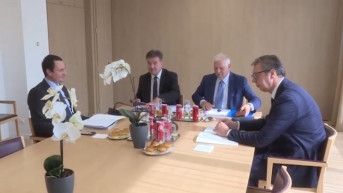
The result of the meeting between Serbian President Aleksandar Vucic and Kosovo Prime Minister Albin Kurti on Monday in Brussels will depend on international mediators and whether the representative of Pristina will accept to discuss the Community of Serb-majority Municipalities without obstruction, according to the interlocutors of Kosovo Online, experienced diplomats Zoran Milivojevic and Milovan Bozinovic.
The EU Special envoy for dialogue, Miroslav Lajcak, said a few days ago that he expected Belgrade and Pristina to accept the Franco-German plan on Monday, but the question was how Kurti would express himself in relation to the issue of the implementation of the already reached agreements, more precisely on the formation of the CSM, which was pending since 2013.
The views of the parties are opposed - President Vucic emphasized that Belgrade remained on its "red lines" and insisted on the establishment of the Community of Serb-majority Municipalities before any further negotiations, while Kurti did not deviate from the position that he was interested, above all, in mutual recognition.
In such circumstances, it seems that a lot will depend on the intentions, but also the ability and will of the European mediators.
Diplomat Zoran Milivojevic tells Kosovo Online that he is not optimistic about the meeting, bearing in mind that Kurti still insists on maximalist goals, so the success of the meeting depends on the mediator.
He points out that the Community of Serb-majority Municipalities must be on the table at the meeting, as a condition for any breakthrough in the dialogue to occur.
"Only when the Brussels Agreement as a whole is finalized, when the CSM is formed, then we can expect some progress and discussion on other topics, including the European plan. The EU wants to increase the dynamics, achieve some results, and ensure Serbia's agreement at any cost to start discussing the European plan. And that, as Lajcak stated, parallel processes, the CSM, and the European plan were being conducted. This is unacceptable for Serbia," Milivojevic emphasized.
He adds that for Belgrade, the idea that the CSM issue is incorporated into the European plan and that it represents a whole is unacceptable.
"What will happen on Monday - we will see, but everything depends on the mediator, that is, on the EU, but also on Washington, which invested its political authority and credibility by advocating for the establishment of the CSM, as a previous issue. Any success on Monday will depend on it. If Kurti does not accept it and remains in the position that there is no talk of the CSM and that he does not want it on the agenda, the only conclusion is that he has the support of some Western factors for such a policy, so the question is whether he can be counted on in the future to some serious dialogue and discussion about normalization," Milivojevic believes.
He underlines that if Kurti's position remains, it is a serious risk for security and stability in these regions and for all the processes behind which the West stands and which they stand for in the function of peace and stability.
"All of that is called into question if Kurti is allowed to implement his policy and try to realize his goals," Milivojevic warns.
According to him, given Kurti's views, no agreement is expected on Monday.
"What they are tying to their goals, because both Washington and the EU want to solve the problem, bearing in mind the protracted Russian-Ukrainian war, so that they would round it off and definitely close this region and have it in the sphere of the transatlantic community - that is another matter. But Serbia has its national interests which it will not renounce and there is no chance to change its position to renounce the CSM and to allow it to enter the dialogue which should be an instrument for creating the conditions for the recognition of Kosovo,” Milivojevic concludes.
The former ambassador of Serbia in Germany, Milovan Bozinovic, assesses that the meeting in Brussels was prepared "long and controversially", and that, if it turns out that the interlocutors still cannot talk concretely, then it would be a big blow to the process, that the question would be how to continue further.
He notes that the EU has invested a lot of political and other authority, and considering that the CSM has been negotiated and promised, someone from the EU must also say that it will be done.
"Because, if this is not said, and Kurti, who is prone to a maximalist attitude and verbal exhibitions, remains on his side, we should be concerned about the dialogue. I would say that the EU has this in mind. There are great risks that this conversation will be lost in an unpromising moment. But it is something that can be seen and it must be prevented," Bozinovic said.
He added that some gain from the upcoming meeting would be the beginning of a concrete dialogue on the CSM, but indicated that this might also take a long time.
"It is reasonable to expect that once both sides accept the Scholz-Macron plan then the dialogue will be more serious and meaningful because then it is already a vision of the future, but you cannot disavow it at the beginning, and that is what Kurti is inclined to do. You need to prepare for a more difficult dialogue than until now, based on the premises of that plan," Bozinovic said.
If the EU stands firm, which is the only reasonable thing, and insists on the CSM, then all the implications of the Scholz-Macron plan would follow.
"The deadline until the end of the year for an agreement is too optimistic, maybe until the middle of next year, but I don't dare to expect anything from negotiators like this and with everything we've seen. Everything is possible if both sides get serious, and now is the chance," Bozinovic said.

0 comments