
Why is it important for Pristina to "open" the bridge on the Ibar right now and what is the goal?
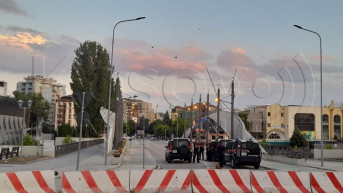
The decision made by the Albanian councilors in the North Mitrovica Municipality Assembly to send the authorities a request to enable the freedom of movement for cars on the main bridge on the Ibar and to free up the space around the bridge met with numerous sharp reactions, both from the Serbian state leadership and political representatives of the Serbs from Kosovo, as well as the citizens of North Mitrovica who say they are worried about their safety. The representatives of the international community said that it was not time to open the bridge, and the KFOR NATO mission stated that it was an issue that had to be resolved through political dialogue.
The interlocutors of Kosovo Online believe that the new municipal government in that city wants to take advantage of the current political moment, or rather the vacuum that occurred after the elections in four municipalities in the north.
Analyst Ljubomir Stanojkovic believes that at this moment it is much more important for Pristina to activate this issue than to actually open the bridge on the Ibar.
"The bridge over the Ibar is a symbol of the resistance of citizens in the north towards the encircling of absolute legal and political jurisdiction over the entire territory of Kosovo by the Pristina authorities. This bridge is still a thorn in the side of the government structures in Kosovo. Bearing all this in mind, the aspiration to open the bridge for car traffic is always present with them," Stanojkovic says.

Stanojkovic believes that the new municipal government in North Mitrovica has decided to take advantage of the moment, regardless of the negative political situation.
"A new moment has come in North Mitrovica, a new municipal government made up of Albanians has been established. Such a government, which is not legitimate and knowing that, rightly, that it will not last long, decided to take the step of opening the bridge, regardless of the negative political moment and, by all accounts, at the same time having reservations as to whether it can be realized," Stanojkovic adds.
According to his words, Kosovo Prime Minister, Albin Kurti, believes that the international community will be lenient regarding the opening of the bridge due to, as he stated, its lenience when it came to the CSM.
"On the other hand, we should mention a very important moment, which is that both Brussels and Washington activated themselves to start with the formation of the CSM as soon as possible, which is a huge problem for Mr. Kurti that he has to solve. And we know very well what his earlier views are therefore, Kurti believes that the formation of the CSM represents a major concession to the international community and that it will see through some of his populist moves, which certainly include the opening of the bridge on the Ibar. Kurti is even more satisfied with the fact that he was approved visa liberalization and by the fact that a big step has been taken towards the membership of Kosovo in the Council of Europe," Stanojkovic says.
According to Stanojkovic, the opening of the bridge over the Ibar for car traffic is an extremely negative move for the citizens of the Serbian community at this moment.
"First of all, it would be a strong blow to them, in an emotional and psychological sense, because it would mean, not only symbolically, but practically, that Pristina has rounded up its jurisdiction over the whole of Kosovo. Especially considering that the Serbs' aversion to the central authorities may be at the highest level," Stanojkovic points out.
He adds that another major problem of the opening of the bridge can be the security factor because, in a situation where high tensions are present, the risks of a wider-scale conflict with unpredictable consequences are very possible.
"Nevertheless, at least in my opinion, the international community reacted in a timely manner this time, and the decision to open the bridge on the Ibar for automobile traffic will wait until more favorable conditions are created," Stanojkovic concluded.
Igor Markovic, a senior researcher at the NGO Aktiv from North Mitrovica, believes that it is necessary for the ruling party in Pristina to divert its attention from a series of problems that Kosovo has been facing for many months.
"It turned out that the positive outcome in connection with visa liberalization was not something that Kurti could use for too long in the Kosovo public and in the fight with political dissidents, and that is why he chose through the branch of his party in North Mitrovica to launch a new topic around which the Serbian and Albanian sides debate vigorously," Markovic says.
He reminds that, moreover, the criticism directed by the opposition to Kurti's government regarding the potential formation of the CSM is getting louder, and the pressures of the international community are increasing in that direction.
"Thus, in order to divert attention from the obligation to form a Community of Serb-majority Municipalities, he is starting a new topic, i.e. the revitalization of the main bridge in Mitrovica, which also has the potential to collapse the already fragile relationship between Pristina and Belgrade, as well as Albanians and the Serbs on Kosovo," Markovic says.
According to Markovic, the goal of Albin Kurti and Self-Determination is to show the public in Kosovo a successful strategy of "the so-called final integration of the north of Kosovo into the Kosovo institutional system".
"Instead of working more seriously on the return of the Serbs to local and central institutions, symbolic moves are being used that neither help the process of integration of the Serbs nor fundamentally solve the problem of the legal-institutional vacuum that has been going on in the north of Kosovo since November last year. This strategy implies a symbolic ' breaking the backbone' of the institutions supported by Serbia in Kosovo through actions that are essentially only and exclusively symbolic and do not offer a positive outcome for the everyday life of ordinary citizens in the north," Markovic says.
He adds that the opening of the bridge for traffic, the holding of elections in improvised constituencies (containers), and the deployment of Special Units of the Kosovo Police for the fight against smuggling and illegal trade, are only part of that "unsuccessful campaign of Self-determination that tries to hide the disastrous economic policy, failures at the level process of normalization of relations, as well as population migration from Kosovo".
"At the end of the day, the Main Bridge in Mitrovica is not the only one, and there are others that are functional in terms of traffic flow. Even with the complete opening of this bridge, which carries an exceptional political and symbolic weight, Albin Kurti and Self-Determination would only get a few political points that they would not bear fruit in the long term," Markovic adds.
Analyst Nexhmedin Spahiu also believes that the new municipal government in North Mitrovica wants to take advantage of the moment, because, according to him, in a few months the mayor of North Mitrovica will again be a Serb, who will certainly not allow the opening of the bridge on the Ibar.
"It is important to open the bridge now because in a few months, the mayor will be a Serb, and the future mayor from the Serbian community does not want to accept such an obligation as opening the bridge, so as not to become a traitor," Spahiu believes.
Spahiu, however, is of the opinion that the opening of the bridge over the Ibar is more in the interest of the citizens of North, than South Mitrovica, because the citizens of that part of the city would get access to the main road by opening the bridge.
He estimates that the opening of the bridge would not affect safety.
"When it comes to security reasons, there are no obstacles. There are other bridges, if they want the situation to worsen or create problems, why is that one problematic," Spahiu asked.
He added that the bridge was certainly open for pedestrians, and that there were no security problems, but that it was more about the "mythical character" of the place where conflicts between the Serbs and the Albanians had taken place in the past.
"This is not about a security problem, but about a myth that arose in the post-war period. Clashes between the Serbs and the Albanians took place there, which is why the closed bridge became a myth. It was expected that when the mayors were Serbs, a decision would be made about opening the bridge, but they didn't do it so as not to be accused of such a decision," Spahiu concluded.


comments