
Dzihic: There is still no atmosphere for concrete talks between Kosovo and Serbia
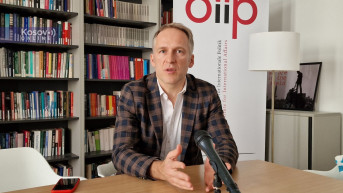
During this year, some kind of agreement between Belgrade and Pristina will have to be reached, although it will not be a final agreement, Vedran Dzihic from the Austrian Institute for Foreign Affairs says in an interview for Kosovo Online, and states that "a lot of water will flow through the Ibar" until sustainable relations between Serbia and Kosovo are established.
Some solution must be found, Dzihic points out because the alternative is further destabilization, which does not suit anyone, adding that the Franco-German proposal is a good basis for talks.
Undoubtedly, he says, there are pressures on both sides, but he also assesses that rationalization is needed in the Serbian approach, as well as much more pragmatism on the part of Kosovo, on some specific issues, in order to move from the phase of "silence" to the phase of concrete talks.
What do you expect from the next round of dialogue between Serbian President Aleksandar Vucic and Kosovo Prime Minister Albin Kurti in Brussels, announced for February 27?
It is difficult to talk about expectations, bearing in mind that the dialogue has not worked at all for many years. It is no longer a dialogue, they are somehow silent while sitting at the same table, that is, communicating the same messages that we all know. Given the pressure that has built up in recent months and weeks, and the conviction of Western actors that they have to do something - it is obvious that they will have to start talking. But, although some announce that they will move towards a framework agreement very quickly, within a few days or weeks, I don't see the prerequisites for that on either side. On the Serbian side, Vucic "buried himself in a trench" from which it is difficult to get out, and he is looking for a way out through the Community of Serb-majority Municipalities, while on the other hand, we have the clear position of Albin Kurti, who accepted to discuss the CSM, but his idea of the Community is completely different from what Vucic envisions. So I don't see a way to take that off the table; to open up some other issues. I expect some kind of field testing and we'll see how determined the West, the Americans, the French, and the Germans, will be and how strong that pressure will be. And then only in the next round, I expect the fog to clear up and to start talking concretely because that kind of atmosphere is not reached yet.
Can the Franco-German proposal lead to a solution to the Kosovo issue?
We certainly have to move from the deadlock, so any plan that has enough "critical mass" of the large countries of the EU and the US is a plan that is worth not only thinking seriously about it but seriously working on it, since the Serbian-Kosovo relations entered a great impasse, miles away from what was in 2013, 2014, 2015. We are in an area that has been erased with a lot of animosities, and mistrust is deepening rapidly day by day, in an area where the quality of life of the Serbs in Kosovo is worse than it was, as a result of all the animosity and the creation of hatred and fear. It is a path of no return and a path to total isolation and total blockage of all relationships. But the neighbors have to live together in some way and the Serbian community, Serbia, and Kosovo also need a solution, since the "status quo" is always dangerous and represents walking on the edge.
Looking at the proposal from that perspective, I think that the proposal is important and necessary, but that it essentially contains something that, perhaps, the Kosovo side would not want to see, because it would be more important for them to move more directly toward mutual recognition, which is not directly provided for in this agreement. For Belgrade and the Serbian side, some moments will always be seen as a defeat from the perspective of the nationalist, right-wing, conservative public. But, in some way, the moment must be broken and this is a good start, but still, a start, because first, we have to see how certain items of the Franco-German proposal would be implemented, and how the other elements from the 2013 agreement would be implemented. Many mechanisms need to be worked out and specified so a lot of water will flow through the Ibar until we actually reach a sustainable relationship between Serbia and Kosovo.
Albin Kurti persistently refuses to form the Community of Serb-majority Municipalities, as agreed by the Brussels Agreement. Do you believe he will have to fulfill that obligation in the end?
Now it's details, tactics, strategy setting, and feeling the ground. It is obvious that the pressure on Kurti was enormous when he even came to the step of saying that the implementation and elaboration of the idea of the CSM must be started, while at the same time, for the internal, Kosovo public, he hides behind the Kosovo constitution and the position that he will not divide Kosovo according to ethnic principles. And now it's really a question of dynamics and tactics in the negotiations, how strong the pressure will be, and which step will happen first. If Kurti manages to make some progress on the issue of an 'intermediate solution' that leads to recognition and gets at least a "yes" from Serbia, Brussels, and America, then he will have to start implementing the CSM, with elements that will leave him enough space to do so. However, it should not be a copy of Republika Srpska.
On the other hand, the Serbian side can't be maximalist in the negotiations. Vucic used the Kosovo issue in recent years to mobilize the domestic political public, and there was essentially no desire to resolve anything. Bearing in mind the geopolitical situation and the war in Ukraine, and the pressure on Belgrade to finally make up its mind, Vucic will have to understand that this cannot go on indefinitely. And that means that we have to see what the concrete proposals are for the CSM, how to stop the process of blocking Kosovo's independence, and what it means when Kosovo knocks on the door of an international organization. There are big questions, there will be some tries, and I don't believe that it can be resolved in a few days or weeks. It is a too serious matter; there are too many emotions and facts, and I think that we have to work intensively on this issue all this year in order to reach a solution.
Is a solution possible this year?
Some kind of solution, not a final one, will have to be found this year because the alternative is a further escalation of relations, which is not in favor of either Belgrade or Pristina, because there is nothing to be gained there - neither Serbia can start a new war, nor can it enter Kosovo, nor does Kosovo have the strength to fight Serbia. Both parties should have a rational interest. A rationalization of the Serbian approach is needed, but also a lot more pragmatism on the part of Kosovo on some specific issues. Kosovo is an independent country, there is no going back and there is no chance for Serbia to regain sovereignty over Kosovo. The question is how to take the first step, whether the Franco-German model is tolerated, to open the space to start building dialogue, economic and interpersonal relations outside of all tensions; to improve the quality of life for the Serbian community in Kosovo, and for the Albanians in parts of Serbia. There is a need for space that must be used and I think the West will insist that this happens.
Is the example of South Tyrol a possible solution for the rights of minorities, i.e. the Serbs in Kosovo?
It would be bad to create a structure that would go in the direction of Republika Srpska because any kind of further ethnic-territorialization in the area of the Western Balkans is fatal and opens up new problems. We need to approach more creatively. South Tyrol is one possible example; some elements could be incorporated here that could be useful, but there are other examples of autonomy. Here, we have to enter into a serious process with experts who deal with minorities, but for creativity, first of all, political will is needed, which was not there until now. That is the first step and that is why we need some first comprehensive agreement that would open up space for expert groups that would develop a serious plan for the rights of the Serbian community and the autonomy of the Serbian community in Kosovo.
What is the position of Albin Kurti, given that messages were heard from US officials that "the CSM will be formed, with or without Kurti"?
The pressure on Kurti is enormous, and a much more pluralistic political scene is noticeable in Kosovo than in Serbia, where there is unanimity at work. In Kosovo, progress can be seen in terms of democratic development, and pluralism of the media and the public, with political pressure from the opposition, which uses every opportunity to try to threaten the majority of Albin Kurti. Kurti has profited from the events of the last few weeks or months, as at such moments we always have a rallying effect around the leader. But already in the next period, there will be a lot of pressure, not only on this but also on other issues, the fight against corruption, promises to young people, social justice, education... I expect the opposition to be much more critical in the coming period.
Does the EU have something to offer Serbia and Kosovo, some "carrot", to resolve the issue of normalization of relations as soon as possible?
The carrot is very small, it has weakened a lot. Before the start of the war in Ukraine, it didn't even exist anymore, in Serbia, according to surveys, the desire for the EU is small, but in Kosovo, it is somewhat higher. And that is the essential question of what the EU, which has not managed this process well for the last six, seven, or eight years, can offer. It must be a different enlargement process, a specific integration step, whether as a joint economic union, or sectoral integration. But it must be on the table as soon as possible, in order to awaken the European spirit and conduct political debates and win elections on that basis.
If, hypothetically, Serbia and Kosovo come to an agreement, and Kosovo gets the green light to become a member of the UN, would Russia at this moment give its consent to such a thing?
In this situation, it is impossible to get Russia's consent for anything and it is not a question that is being asked now, but at some point, the question will be raised as to how the UN will function after this global conflict and whether there will be a reconfiguration. Maybe Kosovo will find itself as part of a bigger package, and the moment Serbia stops offensively fighting against that membership, maybe a perspective opens for some political compromise in which "some other Moscow" could finally say yes.

0 comments