
War crimes indictments as a means of pressure on Serbs – Can the OSCE report bring about change?
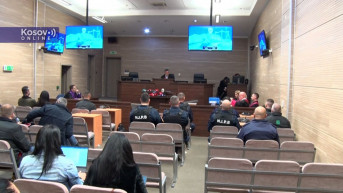
The OSCE's trial monitoring report, according to which as many as 88 percent of war crimes cases brought against Serbs have resulted in convictions, has been described by Kosovo Online's interlocutors as fair, balanced, and focused on the core issues. At the same time, they caution that they do not expect its publication to lead to any meaningful changes. They also point to the detrimental effects of trials in absentia and argue that such proceedings are being used as a form of political pressure against Serbs.
Written by: Veljko Nestorovic
After the Kosovo Assembly adopted amendments to the Criminal Code in 2022 allowing war crimes trials to be conducted in the absence of the accused, a significant number of indictments were subsequently brought against Serbs.
According to a report by the Humanitarian Law Center in Pristina, during 2025 criminal proceedings were conducted in 50 cases involving 154 members of the Serbian forces charged with war crimes.
Since the beginning of this year, several convictions have been handed down. In one of the few cases ending in an acquittal, Dragan Ristic from Đakovica was cleared of all charges.
Ristic was arrested on 25 February 2025 at the Jarinje administrative crossing and acquitted on 18 March 2026. From the outset, his defence counsel, Jovana Filipovic, maintained that the case involved a clear case of mistaken identity. Ristic spent more than a year in detention.
Attorney Ljubomir Pantovic told Kosovo Online that the OSCE report on the monitoring of war crimes proceedings is "entirely fair, balanced, and addresses the core of the problem."
Pantovic said what particularly caught his attention was that the report raises an issue which he and his colleagues have highlighted for years in the Pristina courtrooms trying war crimes cases—namely, that indictments against non-Albanian defendants, primarily Serbs, are overly broad and insufficiently specific.
"From these indictments, it is impossible to determine precisely what the accused is charged with, what he allegedly did, or how those alleged actions constitute a war crime. The indictments are vague, imprecise, unclear, and, in every respect, very poorly drafted. The most recent example is the Banjska indictment. Anyone who has followed that trial could see that it is completely chaotic, imprecise, and unclear, making it impossible to establish from the indictment itself what the defendants allegedly did in Banjska. Nevertheless, the court accepted it, and the harshest sentences were subsequently imposed. The report also addresses other problems that are evident in all such proceedings—excessive delays, prolonged pre-trial detention, and a lack of judicial impartiality. These are not fair trials. The defendants' right to a fair trial is not respected, nor is their right to a judicial decision based on evidence and established facts," Pantovic explained.
Legal adviser with the Humanitarian Law Center, Amer Alija, told Kosovo Online that no one can be indicted or convicted on the basis of circumstantial or insufficiently clear evidence, stressing that individual criminal responsibility requires a precise determination of what a specific person actually did.
"In its report, the OSCE presented several findings and recommendations addressed to the competent institutions. One of those recommendations is that indictments should be more precise with regard to the individual criminal responsibility of the accused. This is certainly one of the report's justified findings and recommendations, because individual criminal responsibility must be established on the basis of the specific acts of the accused. No one can be indicted or convicted on the basis of circumstantial or insufficiently clear evidence. Individual responsibility requires that it be established precisely what the particular person did. Naturally, the allegations contained in an indictment do not mean that the court will automatically accept them," Alija explained.
He also recalled that both the Supreme Court and the Court of Appeals have, in certain cases, overturned convictions precisely because the individual responsibility and the specific acts attributed to the accused had not been sufficiently substantiated.
"For that reason, the OSCE's recommendation is justified, and Kosovo's judiciary should take it into account by filing indictments only where there is direct evidence linking the accused to specific criminal offences," he said.
Commenting on why as many as 88 percent of proceedings resulted in convictions, Alija noted that the Law on Trials in Absentia entered into force three years ago.
"Since the law entered into force, 27 or 28 indictments have been issued in absentia, covering more than 130 members of the Serbian security forces. The possibility of filing indictments in absentia has certainly contributed to the increase in the number of persons charged with war crimes. In recent years, almost all indictments have been brought against members of the Serbian forces. If we compare the period covered by the OSCE report with the earlier period, when UNMIK and EULEX had jurisdiction, we can see that indictments were then brought against members of both sides of the conflict. Looking at the period since the end of the war in 1999, Kosovo's judiciary has in fact handed down more convictions against members of the Kosovo Liberation Army (KLA). The reason for this is that members of the Serbian military and police forces were not available to Kosovo's prosecution service, police, and other judicial authorities. Consequently, during that period there were more convictions of KLA members because the defendant's presence at trial was mandatory. Today, trials in absentia are possible, which has resulted in a higher number of indictments against members of the Serbian forces," Alija said.
He emphasized, however, that the Humanitarian Law Center does not support trials in absentia because anyone convicted in absentia has the right, if later apprehended, to request that the proceedings be reopened and that a new trial be conducted from the beginning.
Alija also noted that Serbia has likewise begun conducting trials and rendering judgments in absentia.
"If this trend continues, we will have justice only on paper, not genuine justice for the victims, because those convicted will not actually serve their sentences. Everything will remain at the level of formal judicial proceedings."
Asked about the number of unresolved war crimes cases involving Serbian victims, Alija said that everyone who committed war crimes, regardless of ethnicity, must be prosecuted, adding that only such an approach can enable the region to move forward.
"At the same time, we have approximately 10,000 innocent victims and civilians who were killed during the war or who are still listed as missing. If politicians or anyone else deny war crimes, that sends the wrong message, and under such circumstances it is difficult to speak about a future based on cooperation and reconciliation. Transitional justice is not limited to criminal trials. It also encompasses other mechanisms—reparations for victims of war regardless of their ethnic background, educating young people on the basis of accurate facts about past events, as well as other transitional justice mechanisms that must all be pursued equally and simultaneously," Alija said.
Attorney and former military prosecutor Dragan Pasic also told Kosovo Online that the rights of the accused are compromised from the very outset of the proceedings, as defendants are not ensured the opportunity to be present at trial, let alone to examine witnesses, despite the fact that direct cross-examination is a fundamental component of a fair trial.
"There is no contact whatsoever between court-appointed defence counsel and the accused. In a word, this amounts to the collapse of the evidentiary process, because the entire prosecution case is based on old witness statements taken during the UNMIK or EULEX period," Pasic said, adding that he does not expect the OSCE report to bring about any substantive changes or reforms in Kosovo's judiciary, either in procedural terms or in the application of substantive law.
He further argued that criminal prosecutions are being used as a political instrument to prevent displaced Serbs from returning.
"What we are witnessing is the application of the Croatian model. As we know, this approach was previously used in Croatia. I expect the number of such proceedings to continue increasing. We are moving beyond the realm of law, and this conduct transcends legal boundaries, entering, I would say, the realm of literature. It is a quintessential Kafkaesque process. People are being tried without even knowing that proceedings have been initiated against them. They are assigned court-appointed lawyers who serve merely as a statistical formality. Court summonses are sent by ordinary mail instead of through official international channels. What else can this be but a Kafkaesque absurdity, where fictitious proceedings are conducted under fictitious laws? You would agree that only Kafka could have described such a situation in his novel The Trial," the former military prosecutor explained.
Speaking about why the international community at times appears to "look the other way" in such cases, Pasic maintained that the explanation is clearly political, arguing that international influence over Pristina remains undeniable.


0 comments