
Wigemark: Justice is slow here, the situation is tense; it would be very bad if the Serbs from the south also left the institutions
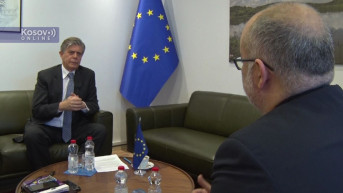
The security situation, especially in the north of Kosovo, was very tense, and it would be very bad if the Serbs from the south also left the institutions, the head of the EULEX mission, Lars-Gunnar Wigemark, said in an interview for Kosovo Online.
We spoke with Wigemark at the headquarters of the EULEX mission in Pristina, and at the beginning, we immediately raised the issue of security and events in the north of Kosovo, after the arrest of Dejan Pantic and the Serbs going to the barricades in protest.
You came out with the information that the EULEX patrol had been attacked. What is it about, is there any evidence for it?
"Our patrol was attacked while approaching the roadblocks near Rudar north of Mitrovica, there was a local Serbian population at these barricades, but I cannot say with 100% certainty who threw the stun grenade. Also, I would like to take this opportunity to express my appreciation for the statements of President Vucic and others in which it is requested that EULEX and KFOR should not be attacked and that we were here to fulfill our mandate.
The EULEX, together with KFOR and the Kosovo Police, is closely following the developments. As you know, there are many barricades on the roads, especially on the road from Mitrovica towards Leposavic, Jarinje, and further towards Serbia. Also, there are some other roadblocks. In general, I think that the local population, whether they are Kosovo Serbs or Kosovo Albanians, or other ethnic groups, but of course, we are talking about the dominant ethnic Serbs who are the majority there, are very worried. People are scared. There has been a security vacuum for more than a month since the Serbs left the Kosovo institutions. I regret it very much because the participation of the Serbs in Kosovo's institutions is regulated by agreements that were reached during the Dialogue almost ten years ago. Although everything may not have worked perfectly, I know from Kosovo Serbs in the judiciary, judges, policemen, and others that these institutions worked. Perhaps not perfectly, but there was integration into Kosovo's institutions," Wigemark said.
Does your mission have information about the nationality of the perpetrators of this act and on what basis are the claims that they are the Serbs? Was it perhaps a "false flag" operation?
Our police officers remained in the armored vehicle, but a stun grenade was thrown at the vehicle as they approached the roadblocks near Rudare north of Mitrovica. There is no doubt that the incident happened. We have no indication that this is a "false flag" operation. The local Serbian population was on these roadblocks. Some had been masked, as you said, so unfortunately you don't know who is behind the mask. Some were even armed, which is even more serious. We do not have the mandate to investigate such an incident - that is the duty of the Kosovo police. They have been dealing with this case and as far as I know, they have no suspects yet, but the situation is very fluid with hundreds of people participating in these roadblocks and most of them are local residents. I heard one explanation according to which it had been thought that a Kosovo police vehicle had been approaching and that is why the stun grenade was thrown. But that's not a very good excuse. We must condemn the use of violence. I can't say with 100% certainty who threw the stun grenade. Based on our findings, we have very good information about who is participating in these barricades - local residents who had been encouraged by former local authorities; we also know that there are former police officers who are also participating in these activities, unfortunately. But that's their choice. For us, this is as unacceptable as well as the fact that our vehicle had been attacked. Fortunately, no one had been injured. I would like to use this opportunity to express my appreciation for the statements of President Vucic and others in which they request that EULEX and KFOR should not be attacked and that we are here to fulfill our mandates. We will condemn any attack whoever the perpetrator is. We do not want violent solutions. We encourage everyone to exercise restraint. Our officers did not try to respond to the attack they experienced in any way, they did not get out of the vehicle, nor did they shoot. That is not our role and mandate. And I repeat that it is good that there are clear signals from everyone that EULEX and KFOR are here to stabilize the situation. We have increased the number of patrols in northern Kosovo in the last month to try to fill the security vacuum in the north. We are there, and we follow, but we cannot replace the Kosovo police. We are not here to do work for the Kosovo police and institutions. They have to do their job. But as we all know, a lot of people have withdrawn from the official institutions in the north of Kosovo. The existence of unofficial institutions that would replace the official ones is also not a solution, it is not legal.
The High EU Representative for Foreign Affairs and Security Policy, Josep Borrell, announced the possibility of strengthening the EULEX forces. What is your assessment, is it necessary, and to what extent?
We always need more people to rotate our staff. At the beginning of November, we had received reinforcements before tensions escalated. We have a police unit mainly from Poland that is very professional and well-trained, especially for crowds and riot control. We also have 24 Italian carabinieri who arrived at the beginning of November and a small group of special police from Lithuania. In addition, we have police advisers working in the north and in North Mitrovica who are very useful for understanding the situation on the ground because, unfortunately, there is a lot of room for misunderstanding and mistrust. Now we see situations where tensions are high due to a lack of trust. What is necessary is de-escalation, as we have said many times, and for people to remain calm despite the high tensions.
The EULEX delivered to the police commander in Leposavic medication for the arrested Pantic, do you have any information on whether he received the same?
"I have contradictory information. I have information that he had received therapy and that he had not. We are investigating this situation. We delivered the medicines to the Kosovo police in Leposavic and demanded that they ought to be delivered to Mr. Pantic, who is being held at a location that I cannot officially confirm because I do not know exactly where he is. We are told that the medication had been delivered. But there are contradictory statements from some sources. We are now checking, we will send a police unit and a police advisor to Leposavic. It is very important that Mr. Pantic is treated according to all appropriate standards, and that he is in the appropriate detention center because I am not sure where he is physically detained; whether that location is appropriate according to Kosovo law; whether his rights are respected; whether he has seen a lawyer; whether he is in contact with his family. He also has to cooperate in terms of giving a statement, he must be aware of the charges. I understand he was heard via video link and given a 30-day detention. Rest assured that we are monitoring this case closely," Wigemark said.
The EULEX no longer has executive functions in the judiciary in Kosovo. Do Kosovo courts work professionally? Are the police acting professionally?
The EU Rule of Law Mission has a clear mandate and an agreement with the Kosovo authorities on monitoring, mentoring, and advising the judiciary. This allows us to monitor the entire chain of justice from the investigation, the police to the judiciary, and even concerning places of detention. So we can cover the entire chain of justice. Now that the Serbian community has withdrawn from Kosovo's institutions, trust is even less. That is why I emphasize that it is important for the Serbs to return because there is a way to build trust. The institutions did not work perfectly in the judiciary. And most agree with that. Justice is slow here. Court hearings are not productive. There are problems with cases of high-level corruption. There is too much interference in various ways. Everyone is aware of this. But at the same time, I believe that the judicial system has progressed from what it was, say, 10 years ago. There are improvements. We regularly deliver monitoring reports and make specific recommendations. I must say that the Kosovo Judicial Council is trying to follow these recommendations. This does not mean that everything is of the highest standard. But I know from the Kosovo Serbs, I talk to, because I regularly go to the north of Kosovo and my colleagues monitor many cases, for instance the Teodosijevic case, the case of the assassination of Oliver Ivanovic, and even some civil lawsuits regarding land and fiscal cases. There are a lot of backlogs, but this applies to all residents of Kosovo. My suggestion is to focus even more on how justice is served for the Serbian community in Kosovo. We are already involved in monitoring the case of Mr. Pantic because there are serious allegations of terrorism. There are several other similar cases that, by the way, have not attracted this much attention, but deserve to be monitored. It is in everyone's interest. Sometimes judges and prosecutors ask us to monitor sensitive cases. We all know about the assassination of Oliver Ivanovic case. Many people are afraid to testify. If there are special cases that we need to monitor, please tell us because we cannot monitor all cases. We have been already monitoring over 300 cases, of which 50 are high-profile. We follow cases from rape to environmental cases and organized crime. We understand everything well, although we cannot disclose all the details to the public. Since I took over the Mission, my idea is for it to be more transparent. Regarding the legal framework, Kosovo meets most of the European standards for human rights. But there are gaps in terms of implementation. Like in the north where, in addition to security, there is also a vacuum in the rule of law. The first victims will be ordinary people and my understanding is that people are very concerned. Now even in Pristina, people understand that the situation is serious. There are legitimate fears of Kosovo Serbs.
Article 9 of the Brussels Agreement implies that the police composition in the north reflects the ethnic structure. Did sending units from five other regions violate that provision?
The Brussels Treaty must be respected. The Kosovo police in the north of Kosovo must have predominantly Serbs in their ranks. If a Kosovan Albanian was born in North Mitrovica and grew up there, and at the same time speaks perfect Serbian, I don't see why he couldn't also be part of the police in the north. The problem is if the policeman does not speak Serbian. That's why there is a problem when five or six hundred policemen withdraw in the north, then they must be urgently replaced with new policemen in order to function.
The Serbs said that they would return to the institutions only when the CSM is formed. What is your view on that, as well as the fact that the CSM was not formed for nine years, although the EU is the guarantor of its formation?
In my understanding, because I am not participating in the Dialogue, certain agreements were signed within the Dialogue and have already been implemented. The Kosovo police and the judiciary are integrated. As for the CSM, I listened to Kurti this morning as he has a different view on the formation of the CSM, which differs from the position of President Vucic. But there must be a real dialogue. It is in the interest of the population because they are the first to benefit from it, as well as the first to suffer the consequences. Regarding the missing persons, we share all the information with the Kosovo Serbs that the Mission obtained while we had an executive mandate until 2018. This is still a great mystery. With more than 1,600 missing persons, roughly a third or so are Kosovo Serbs.
But President Osmani and Prime Minister Kurti never say that there are Serbs among the missing persons and that the authorities in Pristina will look for them.
But it is known exactly who the missing people are. These are statistics and facts. The names are known.
The EULEX is a mission of the rule of law, is there a rule of law in Kosovo when it comes to the rights of the Serbs and their property, as well as the property of the Serbian Orthodox Church? The decision of the Constitutional Court to return the land to the Visoki Decani monastery is not respected.
The decision was made by the Constitutional Court, the highest court of Kosovo, so that decision must be implemented. I think it's very simple. You can disagree with the decision. But once it is adopted, it must be implemented.
What if the Serbs from the south of Kosovo would also leave the Kosovo institutions?
Disaster is a hard word, but it would be very bad. That would be a step backward. We can already see an unsustainable situation from which no one benefits, especially the local community. Everything should be resolved through reliable institutions that have European standards, under no circumstances should people take the law into their own hands. We want Serbia and Kosovo to progress on the path of European integration. I have personally been to this region, the former Yugoslavia, Belgrade, I have seen the collapse of Yugoslavia, the horrors of war that affected all communities and the last thing we want, after 20 or 30 years of trying to normalize relations between the nations living in the region, are new problems to arise. Relationships have to work. It is not only a political issue but a social one. I saw that people can live with each other. That's the objective here. Fundamental rights must be respected. Everyone should be equal before the law regardless of religion, political beliefs, or social status.
If the Serbian parties boycott the local elections on April 23, will this lead to a new crisis?
I don't think a boycott is ever the answer. I think you should participate. All registered political parties should participate and see who has the most support. Considering the current situation, I think postponing the election was a smart decision. But mayors and councils that represent the local community are necessary. The local community should reflect the will of the people. The people in the north should decide who will represent them.

comments