
Albanian parties united in Gracanica elections: Is there a tendency to change the Municipality’s ethnic structure?
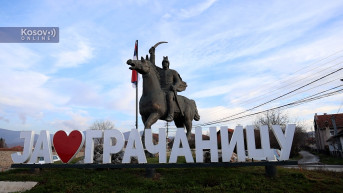
What the four largest Albanian parties in Kosovo—Self-Determination, PDK, LDK, and AAK—failed to achieve at the central level—forming Kosovo’s institutions even six months after the parliamentary elections—they managed to achieve locally in the municipality of Gracanica. The cooperation of these parties has led to the formation of the Albanian Alliance, which will compete for the position of mayor and assembly members in the local elections on October 12. While the Serbian List warns of an attempt to alter the ethnic composition of municipalities with a Serb majority, interlocutors for Kosovo Online assess that Albanians are united in actions directed against Serbs.
Written by: Milena Miladinovic
“The idea was joint, because the goal is good. Our goal is to represent everyone, without any distinction. I don’t know about the mandate, but we have a wonderful team and I believe we will make the most of it,” said Leutrim Ajeti, candidate of the Albanian Alliance for mayor of Gracanica and current deputy mayor of Gracanica, in a written statement for Kosovo Online.
How the joint idea came about is still unclear, given that these four parties are deeply divided at the central level, not missing an opportunity to accuse each other of corruption, violations of the law, and many other things.
According to Kosovo Online’s interlocutors, among Albanians there is no conflict when it comes to Serbs, so it is clear that the Albanian Alliance is nationally oriented, without a clear idea or program.
However, they stress that the greatest problem in this regard is the fact that the authorities in Pristina are attempting by all possible means to change the ethnic composition of municipalities with a Serb majority.
Gracanica, as a municipality with an attractive location for Albanians, is in that context facing a serious problem, our interlocutors assess.
According to the most recent population census in Kosovo, in which a large number of Serbs did not participate, Gracanica has 8,623 Albanians and 8,560 Serbs. For our interlocutors, the census results are not fully relevant, but they indicate that the demographic structure in Gracanica is changing.
The Serbian List has also noticed the intention to change the ethnic composition of the electorate.
Deputy President of the Serbian List Igor Simic emphasized that the party is concerned about tendencies to register voters from Albanian-majority municipalities into the voter lists of municipalities with a Serb majority, particularly south of the Ibar River, with the aim of changing the ethnic composition of the electorate and the assemblies of these local self-governments.
Simic, commenting on the formation of the Albanian Alliance and its participation in the elections for mayor and assembly members in Gracanica, emphasized that what is especially concerning is the silence of the international community on this matter.
“The Serbian List was criticized for not having enough political pluralism and similar issues. Unfortunately, we do not hear such comments from international representatives today, when those who cannot form a parliament in Pristina unite to compete for the position of mayor or assembly member in a Serb-majority municipality such as Gracanica,” Simic said.
As he added, this is what concerns the Serbian List, and that they will speak about it in more detail during the campaign.
“We see the tendency of the central authorities in Pristina to register voters from Albanian-majority municipalities in those with a Serb majority, primarily south of the Ibar, with the aim of changing the ethnic composition of the electorate and, eventually, the ethnic composition of assembly members in those local self-governments,” Simic concluded.
United Against Serbs
Aleksandar Rapajic, Program Director of the NGO Center for Advocacy of Democratic Culture from North Mitrovica, emphasized that the tendency to alter the ethnic composition in the municipality of Gracanica has been ongoing for a decade.
“Gracanica has been facing this issue for quite some time, if not more than a decade. There has been artificial pressure, property purchases, settlement of Albanians, particularly in more urbanized areas such as Caglavica and Gracanica. Slowly the ethnic composition has been changing. Since it has lasted for more than a decade, it is beginning to show results. This undermines the very idea of creating the municipality of Gracanica, which was originally established to form a Serb-majority municipality in that part of central Kosovo, but we now see that the interests of Albanians are somewhat different,” Rapajic said for Kosovo Online.
Regarding the formation of the Albanian Alliance, Rapajic underlined that the unification of the four largest Albanian parties shows that Albanians are united when it comes to acting against Serbs.
“When it comes to Serbs, this unites Albanians to the maximum. If something is done against Serbs, Albanians immediately unite and do not criticize each other at all. Although Albanian parties attack one another on various issues, they never criticize what is being done to Serbs in Kosovo and always remain silent. The fact that a joint list was made in Gracanica shows how nationally oriented this is; there is no vision or program behind it, only the idea to collect votes under one list, and then probably, in cooperation with some Serbian parties close to the government, perhaps try to influence the formation of the municipality,” Rapajic added.
Although the tendency to change the ethnic structure also exists in North Mitrovica, Rapajic stressed that this municipality is still not in the same difficulty as Gracanica, Novo Brdo, and Strpce.
“Currently, Novo Brdo and Gracanica are in the biggest trouble. As for Novo Brdo, it is not as interesting to investors, but in Gracanica and Strpce, which are very attractive to citizens because of their location, this is becoming a serious problem,” Rapajic concluded.
Unity Aimed at Preserving Power
Ivan Nikolic of the NGO “Communication for Social Development” (CSD) hopes that the participation of Albanian parties in the local elections in Gracanica will not be reflected negatively on the ground through tensions.
“It is difficult to specify, or even assume, what this will look like after the elections, for the simple reason that speculations are now being made on the basis of data that are not relevant—in this case, the recent census, which was only partially conducted. We do not have accurate data on how many people actually live here. I think it would be much more relevant to draw parallels with the electoral roll, and perhaps some assumptions could be made on that basis,” Nikolic said for Kosovo Online.
He recalled that in the previous term Albanian parties held one seat in the Municipal Assembly of Gracanica, and that in this case, if their plan for unification is fulfilled, they can expect at least three. As he stressed, this will not drastically influence key decision-making in the Assembly of Gracanica, but it is nevertheless a serious indicator of what is happening and how the municipality’s demographic structure is changing.
“What has happened is not unexpected at all. Honestly, I expected it to happen earlier, given the entire narrative about the Serbian community by Albanian political representatives. What is happening is absolutely not surprising. I sincerely hope it will not reflect negatively on the ground in terms of interethnic tensions, and I would truly appeal for all sides to accept it as a fair sporting competition—which unfortunately it never is—but at least to strive for it to proceed that way,” Nikolic said.
When asked whether Albanian parties could take power in Gracanica, Nikolic pointed out that this cannot be expected in the near future.
“I think it is impossible in these elections, but at this pace, in the future, I would not be surprised if it goes in that direction, especially considering the relative disunity within the Serbian community. If this unity is not strengthened, such an outcome is something we may face in the future,” Nikolic concluded.
No Surprises in These Elections, But in the Next Ones…
Security studies researcher Nikola Vujinovic does not expect surprises in Serb-majority municipalities in the upcoming elections, but he emphasized that Pristina’s electoral engineering will continue, and already in the next elections Serbs may face difficulties in retaining power in these municipalities.
“I do not expect surprises in this round of local elections. We have already witnessed electoral engineering in the parliamentary elections, when one mandate was taken away from the Serbian List. In these elections I do not expect such surprises. But the tendency is that the engineering will continue, and perhaps already in the next cycle we may face problems in retaining even the municipalities with the largest Serb majority,” Vujinovic told Kosovo Online.
According to him, the tendencies of altering the ethnic composition are currently most visible in the northern municipalities of Kosovo, although, as he emphasized, the situation south of the Ibar is also difficult for the Serb community.
“Pristina’s engineering is most visible in the north of Kosovo and Metohija, due to politically motivated attacks on the Serbian ethnic community. Although this is not yet visible in numbers, we can notice that the number of Serbian families there is decreasing, that they are being expelled, that their property is being taken, and that territory and agricultural land are being seized for bases, police stations, and so on… Unfortunately, the situation south of the Ibar is even harder for the Serbian community, but it receives less public attention, because the north of Kosovo is the fortress of the Serbian people, and this is Albin Kurti’s attempt to penetrate it,” our interlocutor added.
As he emphasized, in every election there are new preconditions for Serbs who wish to participate, aimed at reducing the number of voters from the Serbian community.
“In every election cycle we have faced certain preconditions that had to be met. The primary condition, which most displaced Serbs do not want to accept, is Kosovo-issued documents, since this is a prerequisite for voting. Another condition appeared during the parliamentary elections, with so-called conditional polling stations, where previously one could vote anywhere on the territory of Kosovo and Metohija. Now it is uncertain whether that will be possible again. This is yet another maneuver by the so-called Kosovo government of Albin Kurti, intended to reduce the number of Serb votes and thereby preserve at least part of the positions they gained a few years ago in local governments,” Vujinovic concluded.


comments