
Vidovdan Commemorative session in Gracanica: Everything bearing the mark of Serbian existence remains a target
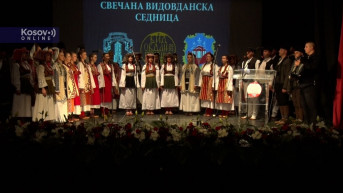
The traditional Vidovdan commemorative session of the Municipality of Gracanica and the Provisional Authority of the City of Pristina, attended by institutional representatives as well as numerous officials from central Serbia and the region, was held today at the "Gracanica" Cultural Center.
The session began with the Serbian national anthem “Boze pravde” performed by the “Venac” Ensemble.
Metropolitan of Raska and Prizren, Teodosije, emphasized that Vidovdan is a day to remember who we are as God’s people.
“On Vidovdan 1389, led by the Holy Prince Lazar and Serbian noblemen and warriors, we as a people confirmed the covenant of Christ and Saint Sava, forging the Kosovo Covenant that flows from these two. We reaffirmed what our Lord Jesus Christ did—sacrificed Himself for our salvation. Likewise, Saint Sava gave up his throne and earthly comforts for the sake of his people and their future. Confronted with danger threatening our state, our people, and our sacred sites, Prince Lazar chose to defend what was holiest to us and consciously gave his life, choosing Christ and the eternal kingdom, knowing that the earthly kingdom is short-lived, while the Heavenly is eternal. Only on such sacrifice can the future of a God-fearing nation be built,” the Metropolitan said.
He added that Gracanica welcomes Vidovdan with radiance, joy, prayer, and song.
“That we still exist despite all the tribulations of our history and the challenges we face today is precisely because we chose Christ and eternity. What makes a people God’s people is the readiness to serve God and others. That is why our holy sites are spread across Serbian lands—especially in Kosovo and Metohija—where we encounter the living God, sites that inspire us and keep us from straying,” Metropolitan Teodosije stated.
Terzic: Vidovdan Unites the Serbian People
Milos Terzic, Assistant Director of the Office for Kosovo and Metohija, emphasized that Vidovdan is a covenant that keeps the Serbian people united.
“Extremists from Pristina, who also supported events in Belgrade like the protests, tried to ban our national symbols and our most beautiful flag. While you are defending the Serbian flag, certain structures in Belgrade are trying to desecrate Vidovdan. But Vidovdan is a holiday that should unite the Serbian people, not divide us or be a point of discord. I feel they choose dates based on a British playbook—just like they did on March 27, 1941, when hotheads took to the streets shouting ‘Better the grave than a slave,’ and then we ended up with both slavery and a million Serbian graves in the NDH. We must never allow such mistakes again. Serbia today is not weak. It is governed by political Serbs, not a delusional Belgrade elite from Vracar,” Terzic stated.
He stressed the need to continue the fight for Serbian national values and interests, and for an economically and politically strong Serbia.
“We must bind our identity, the Vidovdan Covenant, and our societal and material progress—that is the policy defined by President Aleksandar Vucic. We must not allow geopolitical fog to steer us from our Serbian path. Vidovdan is always there to clear our vision, to remind us who we are, where we are, and where we wish to go—and also to reveal who insults our Patriarch and seeks to destroy our state and heritage,” said Terzic.
He reassured that Serbs targeted by Pristina, Sarajevo, or Zagreb will be safe in Serbia and emphasized that Vidovdan will remain a symbol of the Serbian people’s resilience and survival in Kosovo.
Subaric: Gracanica is the Heart of Serbian Spirituality
Ljiljana Subaric, Mayor of the Municipality of Gracanica, highlighted that Gracanica is the heart of Serbian spirituality, culture, and history.
“Gathered today on the eve of Vidovdan in a place that has preserved our people's memory and dignity for centuries, we bow deeply to the souls of Kosovo’s heroes and the greatness of their sacrifice. Vidovdan is not just a holiday—it is the foundation of our identity and our unwavering will to remain and endure on this sacred land. The Kosovo Covenant is not the past—it is an eternal obligation that reminds us to preserve what our ancestors left us: churches and monasteries, graves and hearths, faith and language, name and honor,” Subaric declared.
She recalled that on Vidovdan in 1389, the Serbian people made the ultimate sacrifice in defense of their dignity and survival.
“That day lives on—not just in stories, but in the daily lives of those of us who remain here to guard our sacred sites and identity. Even today, over six centuries later, our people continue to suffer. Today, we no longer face spears, but injustice, fear, and pressure. Children who speak Serbian, centuries-old churches, and flags that symbolize our identity—all remain targets. It is not just a people being attacked, but memory, culture, and the right to a dignified life,” she concluded.
Zivic: A Day of Mourning, Pride, and Covenant
Novak Zivic, President of the City Assembly of Pristina, emphasized that Vidovdan holds a special place in the collective memory of the Serbian people.
“It is a day of mourning, but also pride—a day of remembrance and of covenant. A day when we recall the Field of Kosovo, great sacrifices, and eternal values that shaped our identity. The city of Pristina, with centuries-old Serbian roots, continues—despite all challenges—to preserve the memory of its sacred sites and heroes. Our responsibility, as representatives of the people, is to remember and persevere in protecting our identity, spirituality, and rights on these lands,” he said.
Zivic added that Serbs today are subjected to pressures typical of conquerors and usurpers.
“Our red, blue, and white tricolor is banned. For five centuries, our flags, church bells, and schools were forbidden. We were forced to pay marriage taxes and a blood tax,” Zivic stated.
Closing Ceremony and Awards
At the conclusion of the session, Novak Zivic presented certificates of appreciation to distinguished institutions and individuals, including Metropolitan Teodosije, the Office for Kosovo and Metohija, the Gracanica Cultural Center, the NIJP Panorama-Jedinstvo media outlet, and the “Order of the Dragon” association.
The National Theatre of Pristina, temporarily based in Gracanica, performed a dramatic depiction of the Battle of Kosovo, reminding attendees of the courage and sacrifice the Serbian people made more than six centuries ago.


0 comments