
Announcement of joint military forces of Albania and Kosovo – Kurti’s pre-election Trump card or a new reality?
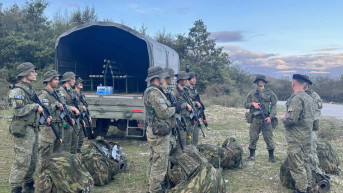
Kosovo is planning to create a joint military unit with Albania – at least according to the statement of Kosovo’s caretaker Prime Minister Albin Kurti. Tirana has remained silent on his announcement made a few days ago, NATO has not commented either, while condemnations have come from Belgrade. What remains unclear is, if such a unit were indeed to be formed – consisting of members of the Albanian Armed Forces and the Kosovo Security Force (KSF) – what powers it would have, whether it would operate on the territory of Albania and Kosovo, and whether it would be considered part of NATO in the event of armed conflict. For interlocutors of Kosovo Online, Kurti’s announcement is primarily political and aimed at serving his election campaign.
Written by: Veljko Nestorovic
It is true that the Albanian Armed Forces and the KSF already cooperate and conduct joint exercises, but forming a joint unit would be something entirely different.
Security studies researcher Nikola Vujinovic told Kosovo Online that this is merely another statement by Kurti in the context of his election campaign.
“This is just a list of wishful thinking. The fact that Kosovo and Albania could probably form such a unit is a real possibility. But I think that, on the one hand, it has absolutely no security consequences. On the other hand, I see it more as an attempt to once again show that you are the leader in Kosovo. In other words, a political story. The fact is, this is in line with the alliance recently concluded between Kosovo, Croatia, and Albania, so it could be said this is a kind of operationalization of that alliance. In essence, my deep conviction is that, from the perspective of the Serbian community in Kosovo and Metohija, and the Serbian state, there is no room for fear or concern, but one must be aware that it is happening and prepare countermeasures,” Vujinovic explained.
He also pointed out that the alliance concluded in March was primarily a political message to Belgrade.
“Interestingly, the alliance of Kosovo, Albania, and Croatia did not mention Serbia directly or indirectly as the target of this alliance, while the declaration of Slovenia and Croatia stated that they wanted to preserve peace in Kosovo and Metohija and Bosnia and Herzegovina. In that way, it was indirectly aimed against Serbia. This is indeed a further operationalization of the March agreement, but I also do not see any security dynamics here. Slovenia and Croatia are NATO members – they cannot act outside that structure in a security sense, meaning they cannot do anything new. This is more of a political message primarily to the Republic of Serbia and official Belgrade: ‘we are watching you, and we are ready for you.’ Whatever that may mean, I would call it, in simple terms, wishful thinking – an attempt to assert relevance. The message is: ‘we are important, we have a say, we are not just objects of European or global politics.’ Whether for internal, external, or regional use, it is an attempt to show importance. But if you are in NATO, which is by definition a defensive military alliance, why do you need any other alliance? Does this mean you do not trust NATO? Or is it perhaps a message from Croatia, Slovenia, and Albania that they do not trust the U.S. and want their own military alliance?” he asked.
Security and defense expert Redon Çiriazi told Kosovo Online that creating joint military forces between Albania and Kosovo faces legal, technical, and diplomatic obstacles.
“I think Mr. Kurti’s statements are somewhat exaggerated. We know Kosovo has made investments in the security sector, and we have seen a relatively large increase in the budget. Compared with 2018, when the defense budget was around €53 million, by 2021 it rose to €100–120 million, while the 2025 budget is projected at €208 million. This shows a significant increase in the budget of the Kosovo Security Force. Nevertheless, I think forming joint military forces between Albania and Kosovo faces legal, diplomatic, and technical obstacles. The conclusion should be that this is more of a political statement, perhaps driven by the current crisis faced by the government, and by the expectations of Kurti’s voters for heightened patriotism or even nationalism, which would undoubtedly secure more votes in the upcoming elections.”
Çiriazi further stressed that the creation of a joint military unit is not carried out through public proclamations, but through diplomacy, legal changes, and rigorous technical processes.
“Let’s analyze this: It is very important to coordinate actions with international actors, meaning in the diplomatic dimension – with the EU, the U.S., and NATO. We know that their priority is regional stability, maintaining peace, and preventing security crises that may arise from unpredictable statements like these. This means that a lot of political and diplomatic work is required so that any such agreement gains international approval. This is absolutely necessary. It also matters for the continuation of dialogue. Such news would not be well received by Serbia. We saw the immediate and very negative reaction of Serbian media. This suggests that such a move would cause even greater obstruction from Serbia regarding dialogue. I don’t think Kosovo is interested in further isolating itself or blocking dialogue, but rather in expanding cooperation. Coordination with the international community therefore serves as a ‘buffer’ that facilitates dialogue, not a trigger for new security crises,” Çiriazi said.
On what would be necessary for Albania to accept this initiative from Kosovo’s caretaker prime minister, Çiriazi explained:
“The legal framework is crucial. Let’s suppose Albania agreed in principle with Kurti’s move – which we do not know, since Tirana has not reacted. For Albanian Armed Forces to be deployed, parliamentary approval is required. The creation of such special military units would need an absolute majority in parliament (84 out of 140 votes). Even if Albania could manage this, Kosovo would have a much harder time. In Kosovo, changes to the armed forces and KSF require KFOR’s approval, as stipulated by the Kumanovo Agreement of 1999. Thirdly, a bilateral agreement and compatible strategic points would be necessary. Not only has this not been discussed with Albania, but such agreements cannot be concluded overnight – they require a continuous negotiation process. This agreement would have to define command and control elements, the jurisdiction of the joint military unit, its status, standard operating procedures, and the impact on cooperation with NATO. Furthermore, since Albania is a NATO member, if this joint unit were to be involved in an armed conflict, would that mean Albania, and consequently NATO under Article 5 of its Charter, would be drawn in?”
Historian Siniša Vulic interpreted the initiative as a continuation of the policy Kurti has pursued since 2021.
“This message should primarily be understood as strengthening the so-called Kosovo army – completing the process of its formation through armament and training. Any idea of a joint unit with the Albanian Army should also be seen in the context of Greater Albanian policy and the idea of uniting Kosovo with Albania in every possible respect. This has been Kurti’s policy since 2021, one he has pursued openly and vocally. At every possible occasion – receptions, ceremonies with members of Albanian communities abroad – representatives from Pristina present symbols of Greater Albania or other emblems reminding people that Albanians in different states constitute a single entity, with the tendency to unite into one political whole. By its very nature, any action aimed at affirming Kosovo’s independence and strengthening its armed forces is, inevitably, directed against Serbia – even if Serbia is not its immediate target,” Vulic said.
0 comments