
Asian tour of Osmani: Kosovo’s diplomatic offensive toward ASEAN?
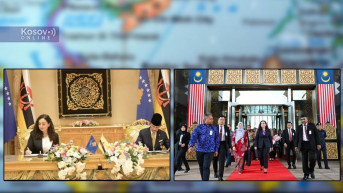
A new embassy in Kuala Lumpur, an honorary award for Malaysia’s Prime Minister, and finally a privilege for Kosovo citizens to travel visa-free nearly 10,000 kilometers to Brunei, on the northern part of Borneo Island—this summarizes Kosovo President Vjosa Osmani’s multi-day visit to Southeast Asia. According to interlocutors for Kosovo Online, this marks an undeniable attempt at a diplomatic offensive targeting ASEAN—a regional organization of ten Southeast Asian countries, where the most economically and politically influential member, Indonesia, has unequivocally refused to recognize Kosovo.
Written by: Djordje Barovic
“The opening of the Embassy of Kosovo in Kuala Lumpur is truly an important milestone in our bilateral relations and will certainly facilitate trade, investment, education, culture, and tourism between our two countries. Most importantly, the focus should be on trade and investment cooperation to leverage Kosovo’s potential and its strong ties with the European Union,” said Malaysian Prime Minister Anwar bin Ibrahim.
Before that, Kosovo President Vjosa Osmani had decorated him with the Order of Independence.
Following Malaysia, Osmani visited Brunei, where she signed a visa waiver agreement with Sultan Hassanal Bolkiah.
She emphasized this as a “significant step in further cooperation.”
For commentators speaking to Kosovo Online, there is no doubt that Pristina is aiming for more substantial inroads into ASEAN, the Association of Southeast Asian Nations, founded in 1967 in Bangkok, Thailand.
Out of the ten ASEAN member states, four have recognized Kosovo: Malaysia, Singapore, Thailand, and Brunei. The other six—Indonesia, the Philippines, Cambodia, Laos, Myanmar, and Vietnam—have not.
Trends and Solidarity
Slobodan Marinkovic, former Serbian ambassador to Indonesia and also Serbia’s envoy to ASEAN, told Kosovo Online that despite diplomatic efforts, the remaining countries in the organization are unlikely to change their stance.
Marinkovic said that Pristina is trying to use “Muslim solidarity” to gain influence in Southeast Asia, while also aligning with global trends.
“They are following a global trend. All major powers and serious economies are trying to build ties with Southeast Asia. In this specific case, they are using the notion of Muslim solidarity, which dates back to the early days of Kosovo’s so-called independence and its first recognitions,” explained Marinkovic, who served on a non-residential basis as ambassador to Malaysia, Brunei, Vietnam, Cambodia, Singapore, Thailand, and the Philippines.
Despite Kosovo opening a second embassy in the region after Thailand, he does not expect “serious breakthroughs” by Pristina in this part of the world.
“Malaysia was one of the first countries to recognize Kosovo’s independence, and it would be extremely difficult for them to achieve the same in other ASEAN countries and the wider region. Even with the new embassy, Kosovo won’t be able to make major or serious inroads. These are vast countries—Malaysia is one of the ‘Asian Tigers’ with challenges of its own, but it still has a per capita income of over $30,000,” said Marinkovic.
He believes Kosovo’s diplomacy is doing everything it can to gain recognition globally, and it’s “natural” for them to turn to countries that have already recognized its independence.
“They are doing what they can to raise their profile internationally and are going where they have room to operate. It's only logical they would visit two Muslim countries that have recognized them, to demonstrate to their own public that something is being done to affirm Kosovo's independence. But no major shifts in essential relations can come from that,” Marinkovic said.
He emphasized that only four out of the ten ASEAN member states recognize Kosovo.
“In my strong opinion, that number won’t increase. The key is that Indonesia— the world’s largest Muslim country—has not recognized Kosovo. Despite attempts, it has not managed to influence the others to follow suit. Through the Organization of Islamic Cooperation, they do manage to reiterate annual support for so-called Kosovo independence, but only with Indonesia adding significant reservations, thus maintaining good relations with us and offering great support in that part of the world,” said Marinkovic.
When asked why he is so confident that no new recognitions will occur, the diplomat explained that the “fundamental reasons” for non-recognition by those countries remain strong and well understood.
“No initiative by Kosovo can change the regional balance. Things will remain at the level of Malaysia and that one embassy,” Marinkovic said.
Potential and Allies
Political analyst Artan Muhaxhiri is also skeptical that Kosovo has the capacity to pressure Southeast Asian countries into new recognitions but notes that a major ally could potentially help.
“It’s very difficult to say, because gaining recognition is far more challenging. Kosovo is small, economically and militarily weak, and can’t offer much or exert significant pressure to secure recognitions. However, external factors could play in Kosovo’s favor—especially if a major ally steps in to help sway these countries toward recognizing Kosovo’s independence,” Muhaxhiri told Kosovo Online.
He noted that one of the significant recognitions came from Israel.
“That was a very important geopolitical and geostrategic moment, but I don’t believe Kosovo has benefited much from it, particularly in political or military terms, despite Israel’s status as a major global power,” the analyst emphasized.
Nevertheless, he sees the opening of the embassy in Malaysia and the visa waiver with Brunei as positive developments.
“In principle, it’s a good trend. Kosovo was practically nonexistent in that part of the world, and there are countries with tremendous economic potential that Kosovo could benefit from,” Muhaxhiri said.
He added that what follows will be more important than just opening an embassy.
“There must be many programs and ideas on how to use these relationships, and that remains to be seen. Still, I believe Kosovo already has plans and ideas for how to make the most of these new channels of political cooperation,” he concluded.
Support and Irony
Foreign policy analyst Borislav Korkodelovic has no doubt that Kosovo is trying to gain new recognitions through its diplomatic offensive in Southeast Asia—especially within ASEAN.
“Osmani came to Malaysia and then to Brunei with the clear aim—openly stated—to persuade as many Southeast Asian countries as possible to recognize Kosovo’s unilateral independence. That is the goal of Kosovo’s diplomacy, and in Malaysia and Brunei, it finds fertile ground. Malaysia is a significant Muslim country; it was among the first to recognize Kosovo and the first Asian country to open a liaison office in Pristina. Malaysian police and military have participated in UN missions. It’s an ongoing process,” said Korkodelovic.
He added that Osmani is continuing Pristina’s foreign policy push for recognition and may try to leverage Malaysia’s ASEAN presidency, which ends later this year.
He noted that ASEAN is a significant economic, political, and diplomatic bloc of Southeast Asian countries.
“At this moment, we are in a good position. For how long, remains to be seen, since there are ten members,” he said.
He reminded that Malaysia is one of the strongest Muslim countries in the region and was active during the breakup of Yugoslavia, particularly during the war in Bosnia.
“There is a certain irony in the fact that Malaysia unconditionally supports Kosovo’s independence, while at the same time it faces secessionist movements in at least three of its provinces—Johor, Sarawak, and Sabah. It also has a significant territorial dispute with the Philippines over the area formerly known as North Borneo—now Sarawak. The Philippines claim it as their own. So, Malaysia has unresolved territorial and ethnic issues but is highly active in other similar disputes,” Korkodelovic explained.
He emphasized that it is crucial for Serbia that the largest and most politically and economically influential country in the region—Indonesia—remains firm in its non-recognition of Kosovo.
“Serbia has a good position here. Thanks to our diplomatic efforts, it has become a partner to ASEAN. Kosovo has not achieved that yet—perhaps Malaysia is trying to initiate it now,” Korkodelovic concluded.



0 comments