
Awaiting verdicts for former KLA leaders: Final justice for the victims, new divisions in the Balkans, or a complete failure of justice
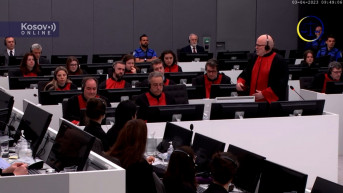
The trial of former Kosovo Liberation Army (KLA) leaders before the Kosovo Specialist Chambers in The Hague has reached its closing arguments, and a final judgment on whether Hashim Thaçi and the other accused are guilty of war crimes and crimes against humanity is expected within three to five months. Throughout the proceedings, no one denied that crimes — including killings, torture, and abductions — had occurred. The central debate focused instead on whether Thaçi, Selimi, Veseli and Krasniqi exercised control over the KLA.
Written by: Veljko Nestorovic
The defense shifted responsibility onto local KLA commanders and acts of retaliation. Should the Court acquit Thaçi and the other former KLA leaders, it would be remembered that no one was held accountable for the crimes committed against innocent civilians, including political killings — particularly after NATO troops entered Kosovo in 1999, when numerous murders, looting and destruction of property were reported.
The prosecution has requested 45-year prison sentences for each of the four accused on all 10 counts of the indictment for war crimes and crimes against humanity. Reactions have meanwhile come from Albania, Kosovo, Albanian political parties and North Macedonia.
Hashim Thaçi has been in detention since November 2020, and nearly six years later the first-instance judgment is expected.
Attorney and former military prosecutor Dragan Pasic told Kosovo Online that the Specialist Prosecutor’s Office has substantiated the allegations in the indictment and that legal experts expect convictions in the case of Thaçi and others.
“In my view, the Kosovo Specialist Prosecutor’s Office has conducted a clear, explicit and unequivocal factual and legal analysis that significantly strengthens the foundations of the indictment. The joint criminal enterprise doctrine, a legal concept recognized in international criminal law, was the primary focus of the prosecution’s analysis of events that took place during 1998 and 1999 in Kosovo and Metohija and in northern Albania,” Pasic stated.
Regarding the extent to which politics may influence the verdict in the case against Thaçi and others in The Hague, Pasic noted that political considerations affect judicial decisions worldwide.
“I believe that various political interest groups and political leaderships at the international level will seek to exert influence. However, the integrity of these judicial institutions is also at stake. In my view, it is impossible for politics to override undisputed facts, particularly when it concerns crimes carried out in a brutal manner by the highest-ranking leaders of the so-called Kosovo Liberation Army. They wielded political as well as military influence, while defense witnesses sought to focus solely on their political roles, arguing that they had no effective control over the KLA, which allegedly lacked a centralized structure. However, the evidence presented refutes such claims by the defense,” Pasic concluded.
Attorney Amer Alija from the Humanitarian Law Center believes that defense witnesses in the proceedings against Hashim Thaçi, Kadri Veseli, Jakup Krasniqi and Rexhep Selimi were credible and testified that the KLA was not an ideal, hierarchically structured army with effective control over its fighters.
“We will now see what the Trial Chamber decides, because the public had limited access to the prosecution’s submissions. Around 50 percent of prosecution witnesses were anonymous, and we had no insight into their statements. Likewise, in roughly 80 percent of the material evidence, the public, media and observers did not have access,” Alija said.
He recalled that the Court is expected to deliver its first-instance judgment in the case against Thaçi and others within three to five months.
In an op-ed for Kosovo Online, Zeljko Sajn wrote that the court in The Hague trying former KLA leaders is often portrayed as a belated act of international justice.
“However, a closer analysis of its origins, mandate and political context reveals a far more complex phenomenon. The Kosovo Specialist Chambers are not the product of universal legal consensus, but rather the result of prolonged political balancing between the need for accountability and the interests of major powers in preserving the order established after 1999,” Sajn wrote.
What a Conviction Can — and Cannot — Change
“A conviction of senior KLA leaders would have significant symbolic and political impact. It would judicially confirm that crimes against Serbs and other non-Albanians occurred and were not isolated incidents without command responsibility. This would seriously undermine the myth of a ‘clean side’ in the conflict. Nevertheless, such a judgment would have no legal effect on the legality of NATO’s intervention, nor would it open the question of responsibility of Western states. The Court’s mandate has been carefully circumscribed precisely to prevent such implications. In that sense, the Court functions as a pressure valve: part of the truth is acknowledged, but its expansion beyond the permitted framework is prevented,” Sajn concluded.


comments