
Ban on the Serb List: Kurti’s strike at Belgrade or a slap to the international community?
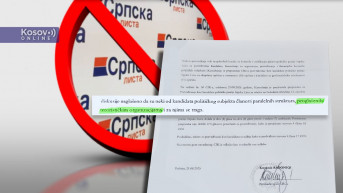
The Central Election Commission has banned the Serb List from participating in the upcoming local elections, stating that “some of the candidates are members of parallel structures designated as terrorist organizations and are wanted.” For analysts, there is nothing spectacular here – merely a déjà vu exercise. They warn that this decision is not directed only against Serbs in Kosovo, but is also an attempt by Albin Kurti to test the “red lines” of the international community.
Written by: Djordje Barovic
Leader of Self-Determination Albin Kurti, on the eve of last year’s parliamentary elections, lamented that a “historic opportunity” to ban the Serb List had been missed. Now, a “make-up exam” is at hand.
The Central Election Commission (CEC) decided last night that the Serb List does not meet the requirements for the upcoming local elections.
“We have a political party that has a terrorist past and a terrorist present. In addition, there are other elements, people who have participated in terrorist and various other attacks,” said CEC member from Self-Determination Sami Kurteshi, explaining the request for the ban.
He was joined by another Self-Determination member of the CEC, Alban Krasniqi.
“The decision represents an important victory for democracy, for the integrity of the electoral process, and for civic and state security,” declared only a few hours later his wife, acting Minister of Justice Albulena Haxhiu.
Ironically or not, the ban on the Serb List came only a few hours after U.S. Embassy Chargé d’Affaires in Pristina Anu Pratipati met with acting Prime Minister Albin Kurti.
“I spoke with the acting Prime Minister about steps that we understand he and Self-Determination are considering, related to excluding certain political parties from participation in the upcoming local elections. To be clear, we believe all citizens of Kosovo should have the full opportunity to elect their representatives,” Pratipati said.
The first to react after the decision was announced was OSCE Mission Head in Kosovo Gerard McHugh.
He assessed the CEC’s decision as “undermining democratic pluralism.”
“Excluding political actors undermines democratic pluralism, weakens trust in institutions, and reduces opportunities for all communities to be fairly represented,” McHugh stressed.
President of the Serb List Zlatan Elek described the ban as a continuation of the international community’s “anemic” statements in response to Pristina’s behavior.
At an extraordinary press conference, he said the ban was “discriminatory and unlawful” and announced that the Serb List would take “all necessary steps to ensure its mayoral and councilor candidates are certified.”
He warned that Kurti, with such policies, “paints targets on the foreheads of political entities, above all the Serb List,” recalling that just days earlier, on August 17, the printing house of Serb List’s candidate for mayor of Zubin Potok, Milos Perovic, had been set on fire, and that this morning, the vehicle of councilor candidate in Zvecan, Caslav Sofronijevic, was torched.
“It’s just a car, iron – another will be bought,” Sofronijevic told Kosovo Online.
He explained that what happened to him was a clear attempt to intimidate both him and his family.
“I have lived in this town for 62 years. I devoted my entire life to peaceful politics, to making this place livable, to building a better life. Clearly, some believe that such politics is not good and want to impose their own… My children and grandchildren watched the fire from the balcony, neighbors rushed to help… but it is what it is,” Sofronijevic said.
The decision of the CEC will now be reviewed by the Election Complaints and Appeals Panel (ECAP), which has a key role in resolving electoral disputes and often serves as the last instance for political entities’ appeals. ECAP is an independent body of the CEC, composed of members from the judiciary.
This same institution, on December 25 last year, upheld the Serb List’s appeal after the CEC had, using the same arguments, banned the party from participating in parliamentary elections.
Expected – Unlawful Decisions
Senior researcher at the Kosova Democratic Institute Eugen Cakolli is convinced ECAP will once again deliver the same ruling.
He interprets the CEC’s decision as “expected – but unlawful.”
“What we saw yesterday at the CEC session was something that was actually anticipated. For some time now, there has been an antagonistic discourse toward the Serb List, as well as strong involvement of international representatives who had spoken with outgoing Prime Minister Kurti and others to prevent the exclusion of political parties. That was a signal,” Cakolli told Kosovo Online.
He emphasized that the CEC’s decision was not based on law and would therefore most likely be overturned.
“I believe the decision is not legally grounded and will most likely be annulled by the Election Complaints and Appeals Panel, which will probably certify the Serb List, since it fulfills the legal requirements,” Cakolli stated.
Regarding Self-Determination’s accusations, included in the CEC’s decision, that the Serb List is a “terrorist organization,” Cakolli said such claims would require a court ruling.
“Such a decision would have to explicitly state that this party is to be denied certification. Until then, it has a legal right to participate,” he argued.
He also believes the CEC’s decision is actually “a favor to the Serb List.”
“They will use it as propaganda in the elections to portray themselves as victims. Moreover, the decision risks becoming a propaganda tool for the Serbian state internationally, to argue that Kosovo’s institutions are not ready to allow Serbs to participate in elections,” Cakolli stressed.
Testing “Red Lines” and “Good Serbs”
For historian Stefan Radojkovic, the ban on the Serb List’s participation in the local elections is not surprising, but it represents clear pressure on the Serb community in Kosovo.
“There had already been such announcements, and now they are partially fulfilled. The pressure on the Serb community is obvious, and all this is consistent with Self-Determination’s ideological orientation. They argued that only local Albanian and Serb populations should decide on self-governance in Kosovo and Metohija. In practice, that meant that Serbs in Kosovo and Metohija could participate in elections but could not have any ties, whether real or perceived, with Serbia and its institutions,” Radojkovic told Kosovo Online.
He highlighted the irony of labeling the Serb List a “terrorist organization.”
“It is particularly striking that they called the Serb List a terrorist organization, given the history of Albanian armed struggle in Kosovo and Metohija against Serbian institutions. That has a particular irony,” the historian said.
He has no doubt that the CEC’s decision sends a clear message from Pristina that only “good Serbs” are welcome, but he is convinced it will not persuade the Serb community to vote for “Kurti’s proxies.”
“This is a message to the Serb community that the only ‘good Serbs’ are those who rely solely on the provisional administration in Pristina, and especially on Prime Minister Albin Kurti. But that will simply not convince Serbs to vote for any of Kurti’s proxies; rather, if this decision stands, they will likely vote for any other party that authentically represents Serbs of Kosovo and Metohija,” Radojkovic stated.
He also found the CEC’s voting pattern telling.
“Opposing the Serb List were two Self-Determination representatives, while representatives of other Albanian parties merely abstained. That suggested several things. First, that the cause of the decision lies solely with Self-Determination—which is, of course, what it wanted: to present itself as the party uncompromisingly opposed to anything perceived as Serbian influence in Kosovo and Metohija,” Radojkovic argued.
He interpreted the abstention of opposition parties, primarily the LDK and PDK, as an attempt to avoid being “associated as allies of the Serbs.”
“At the same time, they did not want to side with Self-Determination, preferring instead to distance themselves in case there are reactions, especially from Washington,” he said.
Radojkovic noted that the CEC’s decision came after U.S. Embassy Chargé d’Affaires Anu Pratipati had “clearly conveyed” to Albin Kurti that “obstructions” regarding the Serb List and other Serbian community parties were not expected or tolerable.
“Albin Kurti is testing the ‘red lines’ of the international community, even though the U.S. Embassy representative had just made it clear that such actions were neither desirable nor acceptable,” Radojkovic said.
He argued that the proper Western response would be concrete measures, including sanctions against certain politicians.
“That would be a real step, but I am not overly optimistic,” he concluded.
Still, he does not expect “strong reactions or major condemnations.”
“No strong reactions or major condemnations are to be expected, and certainly not concrete measures by the international community, especially Washington. But it will be interesting to see how far Albin Kurti can push the ‘line’ and display uncooperativeness,” Radojkovic concluded.



0 comments