
Is Basha the cause or “collateral damage” of the new political crisis in Kosovo?
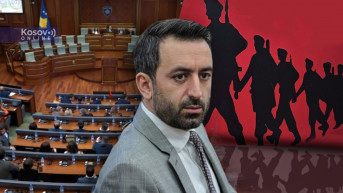
He had barely taken his seat as president of the Kosovo parliament, and Dimal Basha already found himself the target of sharp criticism both from the opposition and from veterans. While some accuse him of violating the Constitution by claiming that the “parliament has been constituted,” others are demanding his resignation over a scholarly paper written about a decade ago in which the role of the KLA was discussed negatively. For analysts, Basha is merely “collateral damage” of a deep political crisis that has now taken on a “new format.”
Written by: Djordje Barovic
Kosovo Democratic Institute Executive Director Ismet Krieziju remarked:
“The political situation has entered a deep crisis. Some are playing at being speaker of the parliament, others treat the parliament as unconstituted. Now, neither the calendar for forming the government is moving forward, nor is the work of the assembly. They have succeeded in restoring political and institutional crisis to normal.”
On 26 August, Self-Determination MP Dimal Basha was elected as the new president of the Kosovo Assembly during the 58th continuation of the constitutive session. He received the support of 73 deputies, while 30 voted against and eight abstained.
One citizen of Pristina commented:
“In my opinion, he is the wrong person. Still, he was elected, and it’s good that at least one step forward was made.”
Just a day later, Pristina media revealed that Basha was one of the co-authors of a 2012 academic paper that, among other things, alleged the KLA had cooperated with criminals, including drug traffickers.
Although he apologized, and co-author Jana Arsovska, a professor at John Jay College of Criminal Justice, clarified that Basha was responsible only for the third chapter, the KLA Veterans’ Organization demanded his immediate dismissal and an investigation by the Prosecutor’s Office.
Hysni Gucati, president of the organization, declared at a press conference:
“The categories that emerged from the KLA war demand the urgent dismissal of Dimal Basha and the initiation of investigations before the Kosovo Prosecutor’s Office. The reasons are well known: participation in a special propaganda war against the KLA and the Republic of Kosovo, as well as personal ties and cooperation with suspicious individuals, including collaborators from North Macedonia, who negatively impact the development and integrity of our country.”
He insisted that Basha cannot evade responsibility with a mere apology:
“Mr. Basha is the co-author of that scholarly paper. He cannot avoid responsibility with a simple statement attempting to justify those claims… Mr. Basha has no open doors with the KLA veterans. Not only him, but people of his type. Perhaps they have open doors in Serbia.”
In addition to veterans, many legal experts also argue that Basha’s claim that the parliament has been constituted is unconstitutional. Western diplomats in Pristina appear to share this view. After meeting with Osmani, British Ambassador Jonathan Hargreaves underlined the “urgent need for the next steps in forming the Assembly in accordance with Kosovo’s constitution.”
“Political Games”
Diplomat and university professor Bljerim Canaj believes that the attacks on Basha stem from “political reasons and games,” while Self-Determination’s attempt to block the Serb List is only making that party “stronger and stronger.”
Canaj emphasized that legal experts agree Basha’s claim that the Assembly has been constituted “contradicts the Constitution,” as the process requires the election of the president and all vice presidents of parliament. The deadlock, he stressed, stems from the Serb List’s candidate.
“As a citizen of this country, after what happened in Banjska, I too would be against cooperating with the Serb List. But you cannot block it because that is unconstitutional. The Serb List has nine deputies in parliament, and Serbs trust the Serb List,” Canaj told Kosovo Online.
He argued this was a political move by Self-Determination that only strengthens the largest Serbian party in Kosovo:
“The more Kurti blocks the Serb List, the stronger it becomes, since it seems only SL defends Serb interests in Kosovo. If he had really wanted to block the Serb List, he wouldn’t have given them 300,000 euros for elections, but at least after Banjska he would have made an effort to declare whether it was a terrorist or unconstitutional party. The fact is, when Kurti needs the Serb List, he works with them, and now, because elections are coming, he works against them. After elections, I am sure it will be different.”
Canaj also noted that while veterans’ organizations demand Basha’s dismissal over the 2012 paper, Self-Determination has “always played along with the KLA.” Meanwhile, opposition behavior, he added, is another “political game”:
“Now it is dangerous for the opposition to vote for the Serb List because Self-Determination would immediately attack them as collaborators. That is why they did not vote ‘for’ or ‘against,’ but abstained. It is all political play.”
Consensus and “Bad Messages”
Marko Milenkovic, associate of the NGO New Social Initiative, observed that reactions to Basha’s election reveal both a lack of political consensus among parties and Self-Determination’s own dissatisfaction with his appointment.
“I think Self-Determination itself is not satisfied with Basha as Speaker, since there are different views within the movement. We haven’t seen official congratulations, and we know Self-Determination is a political entity bringing together different profiles of people, so it’s questionable whether there is consensus about him,” Milenkovic told Kosovo Online.
He recalled that the PDK voted “for” because Basha was a “somewhat acceptable candidate,” while the LDK declared him “completely unacceptable.” He also pointed out that former KLA actors voiced objections, and some suspect Basha could trigger divisions based on religious orientation and past positions.
According to Milenkovic, the real issue is that the parliament has not been properly constituted:
“We still have no progress on electing a vice president from the Serbian community, which is both a constitutional requirement and a necessary step in constituting and functioning of the Assembly as the main legislative body. This shows that within that body, many laws, principles, and the Constitution are being violated. This sends a bad message not only to communities in Kosovo but also more broadly about Kosovo as an actor in the region and the international community.”
“Political Archaeology”
Political analyst Ognjen Gogic sees the campaign against Basha as part of “political archaeology and forensics” in Kosovo and essentially “a testing of strength” ahead of local elections.
He noted that the accusations should be viewed in light of the unresolved political crisis:
“Whoever had taken that position would probably have been attacked, because the crisis in Pristina has not been resolved. There are still no clear relations among parliamentary parties, especially regarding the formation of the government, and now we have this ‘archaeology,’ this ‘forensics.’ They are digging to find whatever can be used for campaigning.”
According to Gogic, the 13-year-old paper mentioning the KLA negatively was enough to spark outrage:
“Of course, that is enough in Kosovo to raise the dust, because it is considered ‘sacrilege’ when anyone, in any way, questions the KLA.”
He added that the campaign is directed not only against Basha and Self-Determination, which nominated him, but also against the PDK, which supported his election and at the same time “claims the legacy of the KLA”:
“It is also an attack on the PDK. That is the party that enabled him to be elected, and yet it is supposed to uphold the KLA’s values. It is absurd that it supported him. But this is just part of the ongoing political campaign in Kosovo, against the ruling party and in the context of the new balance of power ahead of local elections.”
Gogic is convinced that such information is being released to erode support for both Self-Determination and the PDK:
“But that is legitimate and everyday practice in political life. There is nothing unusual about it.”
He underlined that Basha’s election was essentially “a coincidence of circumstances”:
“Even he himself was surprised to find himself in that position. The Assembly was severely blocked, with parties wrangling over who could be a candidate. In the end, Self-Determination proposed Basha probably not expecting anyone to vote for him. It was a bluff that didn’t work. His election was probably a surprise for everyone in the political scene.”
Opposition parties, he recalled, had from the beginning insisted they would only support a Self-Determination candidate who was not at the same time a member of the technical government. Eventually, Self-Determination put forward such a candidate, expecting rejection, but miscalculated.
Thus, Basha’s election, Gogic concluded, was “an unexpected outcome for all political actors.”

0 comments