
Basha “in remedial class,” crisis in parliament still unresolved
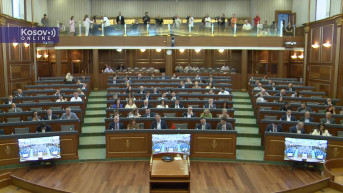
The curtain has not yet fallen on the constitution of the ninth convocation of the Assembly of Kosovo. By ruling that the election of the parliament’s vice-president from the Serbian community must take place within 12 days of the decision entering into force, the Constitutional Court has effectively sent Assembly President Dimal Basha “back to remedial class.” Many analysts assess that the Court’s position was expected, but at the same time there are fears that this decision does not mean an end to the political crisis.
Written by: Dusica Radeka Djordjevic
“The constitutive session of the Assembly, launched on April 15, 2025, was not concluded as a result of the failure to elect the vice-president of the Assembly from among the deputies of the Serbian community. The Assembly has not been constituted in accordance with the provisions of Article 66 and Article 67 of the Constitution of the Republic of Kosovo,” states the Constitutional Court’s decision published yesterday.
The European Union Ambassador in Kosovo, Aivo Orav, stated today that this decision is being “analyzed” and expressed hope that the Assembly would be constituted as soon as possible.
“We urge you to form the Assembly and to form the Government,” Orav said.
There has not yet been a reaction from Self-Determination, the party of Dimal Basha, who on August 30 concluded the constitutive session and declared the parliament constituted.
On the other hand, the Serb List welcomed the Court’s position. In their statement, they emphasized that their view was confirmed—namely, that Assembly President Dimal Basha acted unconstitutionally and attempted “once again to take away what has been defined as the constitutional right of the Serbian people within the Assembly.”
“This is a small but extremely significant victory for the Serbian people in the face of the multitude of decisions by the regime in Pristina, which, by violating all regulations, has violated the collective and individual rights of our people,” the Serb List stated.
Given that the election of the parliament’s vice-president from the Serbian community requires at least 61 votes, the development of the situation in the coming period is difficult to predict—especially in light of Self-Determination’s announcement that it will not support the election of a vice-president from the Serb List.
“Malicious intentions”
Milica Andric Rakic, Program Manager of the NGO “New Social Initiative,” says that even without the support of Self-Determination deputies, the election of a Serbian vice-president could still take place, provided that there is willingness within other political blocs.
“Regardless of whether they will vote for the Serbian representative, they can, in principle, respect the decision and acknowledge that the Assembly has not been constituted. As for the pragmatic aspect, even if Self-Determination does not vote, there are enough deputies in the other bloc who could elect a Serbian representative. We will see what their stance will be from that principled perspective,” Andric Rakic told Kosovo Online.
For a final assessment of the situation, she added, it is necessary to wait for the full publication of the Constitutional Court’s decision, which may bring additional clarifications, including possible mechanisms for overcoming the political deadlock.
“It would be necessary to see the Court’s full ruling—whether 61 votes are really required, or whether it might propose another modality if all voting methods are exhausted. Otherwise, the Court may say that if the vice-president is not elected, the Assembly is automatically dissolved,” Andric Rakic said.
She therefore concludes that although the Court’s decision is final and legally binding, it does not in itself mean that the political crisis will be resolved.
“The political crisis does not exist because something in the procedures was unclear, but because someone was abusing the procedures, pretending that they were unclear, in order to use the Constitutional Court to prolong the formation of the Assembly,” she pointed out, adding that she does not rule out “new, creative ways of blocking the Assembly.”
But, as she noted, from this moment onward it is more than clear that only someone with very malicious intentions could continue blocking the constitution of the Assembly, or its constitution merely for the purpose of calling new elections.
Andric Rakic also stressed that the part of the Constitutional Court’s statement referring to compliance with the Assembly’s Rules of Procedure could have consequences for the legitimacy of the election of Emilija Rexhepi, who was elected vice-president representing other minorities individually, and not as part of a package with the Serbian candidate.
“This potentially means that the election of Emilija Rexhepi may be challenged, since she was elected individually, contrary to the Rules of Procedure. But we cannot yet make any claims until the Court’s reasoning is seen,” Andric Rakic explained.
Senior researcher at the Kosovo Democratic Institute (KDI), Vulnet Bugacku, also stated that it remains to wait for the full publication of the Court’s ruling and reasoning, in order to know the further steps and understand the course to be followed regarding the election of the vice-president from the Serbian community.
In any case, as Bugacku pointed out for Kosovo Online, the Constitutional Court’s decision legitimized the fact that the Assembly cannot be considered constituted without the election of the president and all vice-presidents.
Three scenarios
Milos Pavkovic, Director of Strategy at the Center for European Policy, underlined that there are three possible outcomes for the election of the parliament’s vice-president from the Serbian community, bearing in mind that the Serb List holds nine of the ten guaranteed seats for the Serbian community, while Nenad Rasic, leader of the party “For Freedom, Justice and Survival,” is in fact Self-Determination’s candidate for this position.
“One option is for Rasic to be elected, the second option is for someone from the Serb List to be elected, and the third is that no one is elected, which then opens up a new question and a new constitutional crisis, since the Constitutional Court remained unclear in its July ruling about what happens if the parliament is not constituted,” Pavkovic told Kosovo Online.
If the parliament is not constituted within these 12 days, he said, a new decision of the Constitutional Court will be required to finally determine whether the parliament is dissolved, who dissolves it since technically it has not been constituted, or whether extraordinary elections are called. He now expects a period of political negotiations, identifying the upcoming local elections on October 12 as a key moment.
“The results of the local elections will greatly influence the further course of the constitution of the Assembly. If Self-Determination achieves a good result and wins the majority of municipalities, that will increase its chances of completing the process of constituting the Assembly and forming the government. If the opposite happens, and the opposition wins more cities and municipalities, that will certainly give them momentum to take matters into their own hands—potentially electing their own candidate, reaching some deal on a candidate, or insisting on extraordinary parliamentary elections where they might stand a better chance of success than in February. But it is very difficult to project which option is more realistic,” he concluded.
The Constitutional Court’s decision is also considered expected by political analyst from Pristina, Shkelzen Maliqi, who noted that the Assembly’s Rules of Procedure were the main argument on which the Court relied.
“Obstruction of the Ahtisaari Plan”
“The Rules of Procedure are clear, and they were adopted two or three years ago by the ruling party, Self-Determination. They clearly state that the majority of deputies from the Serbian minority propose a candidate for vice-president and that he or she is elected by a majority vote. There was nothing disputable there. They themselves adopted this new rule, and the Constitutional Court merely referred to it,” Maliqi told Kosovo Online.
He added that there had been “a lot of games” by the ruling party to delay the process of constituting the Assembly of Kosovo, as well as the return of Serbs in the north to Kosovo’s institutions.
As he stressed, Kosovo’s Prime Minister in a technical mandate, Albin Kurti, has a plan to obstruct the Ahtisaari Plan and all obligations arising from it, but that he will not succeed.
“Now the constitutional order must be restored. I believe that Kurti himself is obstructing all of this because he may have some other plans, to call into question the constitutional order and the Ahtisaari Plan and everything that arises from it. I do not think that will succeed, and it should not,” Maliqi concluded.




0 comments