
Changes at the helm of the German Embassy in Pristina: Rohde’s “legacy” and Rudolph’s intentions
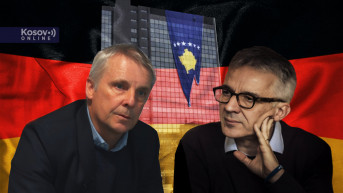
After five years, one of the most influential embassies in Kosovo is seeing a change in leadership. Germany’s outgoing ambassador Jorn Rohde is being replaced by Rainer Rudolph. Rohde leaves behind a turbulent period marked by visa liberalization and the EU’s punitive measures, while Rudolph faces an ongoing institutional crisis and the unresolved question of the Belgrade–Pristina dialogue, according to interlocutors of Kosovo Online.
Written by: Djordje Barovic
“After five years here, I must say goodbye, and I will miss Kosovo,” said the outgoing German ambassador to Pristina, Jörn Rohde, in a farewell video message at the end of September.
At the conclusion of his term, he gifted Kosovo’s President Vjosa Osmani a jar of homemade jam.
It appears that he gave nothing to the Prime Minister in technical mandate, Albin Kurti, although Kurti thanked him for his engagement as the longest-serving ambassador in Kosovo.
In a farewell interview for Kosovo Online, Rohde was clear that Kosovo should begin implementing the “Community of Serb-Majority Municipalities,” while Serbia should accept Kosovo “as a sovereign state in every sense.”
Rohde is being replaced by experienced German diplomat Rainer Rudolph.
Judging by his humorous remarks, he will aim “not to mess things up” in Pristina.
“All you have to do is work as a diplomat for 25 years, trying not to mess things up, and then, if you’re lucky, you become the vice president of the Munich Security Conference,” he said in 2023, when asked how he attained that position.
The CSM and Hypocrisy
Former FRY ambassador to Germany, Zoran Jeremic, told Kosovo Online that the Serbian community in Kosovo cannot be satisfied with the performance of the outgoing German ambassador, Jörn Rohde.
He believes that Rohde’s successor, Rainer Rudolph, will continue Germany’s “hypocritical policy” toward the Belgrade–Pristina dialogue and the position of the Serbs.
“It will be the same classical, more or less hypocritical policy where he (Rudolph) speaks of the need to protect the territorial integrity of Ukraine, yet comes as ambassador to a country that emerged from his own state’s recognition of Kosovo — by violating Serbia’s territorial integrity. The same hypocrisy that existed before will continue, perhaps in a slightly different form, but we can already see it as Germany and Europe attempt to frame their role in Kosovo as advisory or supportive — far less than the mandate they actually hold — precisely because both Germany and Europe have accepted to serve as the venue and facilitator for dialogue between the two sides,” Jeremic emphasized.
He added that this approach is evident in Germany’s stance on the Association of Serb-Majority Municipalities.
“Germany has withdrawn from it. They created the Ohrid and other agreements, which have now led to a simple situation: the Community of Serb-Majority Municipalities does not exist. They have redefined it as the ‘Association of Municipalities with a Serbian Majority,’ which practically means that once the Serb majority disappears — and that is indeed the goal of what’s happening in Kosovo — there will be no need for such an association, or it will simply be an empty shell dealing with some nominal organization of the health or education system that no one will even need,” Jeremic explained.
He expects Rudolph to continue European and German policy in Kosovo.
“More or less, we can expect continuity of the European and German approach to Kosovo, which could change only if there were a strong and decisive American intervention — but given Trump’s current priorities, that seems unlikely, and even if it happened, it’s unclear what it would look like,” said the former FRY ambassador in Berlin.
Jeremic describes Rudolph as an experienced diplomat who served as vice president of the Munich Security Conference, “where all of NATO’s policies for Europe over the past decades were articulated.”
At the same time, he notes, Rudolph is “a diplomat who knows how to carry out the tasks he is given.”
“He is a seasoned diplomat who has worked in Vienna and Warsaw, and at one time in the office of the German Chancellor. He knows his assignment and how to execute it. He will implement the policy of the German Foreign Ministry, which now operates in alignment with the Chancellor’s office under the same political leadership, so there is no duality in executing German foreign policy,” Jeremic said.
He interprets Rohde’s farewell message to Kosovo as a standard diplomatic gesture.
“He parted from Kosovo in a classic, polite diplomatic manner — thanking people for their kindness and the ‘beautiful nature’ — while omitting the real circumstances in which he left Kosovo,” Jeremic stated.
Commenting on Rohde’s statement to Kosovo Online that Serbia should accept Kosovo as a sovereign state in every form, Jeremic said the ambassador had “consistently followed Germany’s policy.”
“The mandate of the former German ambassador Jörn Rohde was marked by what is reflected in the Ohrid Agreement and subsequent arrangements, as well as his persistent efforts to pressure Serbia into recognizing the Pristina authorities as legitimate and Kosovo as a sovereign state. That characterized his entire term,” Jeremic noted.
He added that Rohde, as a responsible diplomat, carried out Berlin’s instructions in coordination with other Quint ambassadors.
“What he left behind in Kosovo is something the Serbian community cannot be satisfied with. The Albanian community had its own goals, which he largely supported, often prioritizing Albanian over Serbian interests,” Jeremic said.
As an example of such policy, he mentioned Rohde’s approach to “Kosovo citizens,” which avoided distinguishing between Albanians and Serbs.
“But since Albanians are the overwhelming majority, this effectively reduced Serbs to a minority — even comparing them, at one point, to the Danish minority in Germany, which is absurd,” Jeremic emphasized.
A Shift in Course and a Warm Welcome
Political analyst Shkelzen Maliqi believes that the tenure of former German ambassador Jörn Rohde was marked by a tougher stance toward Albin Kurti, while his successor Rainer Rudolph will continue supporting the Franco-German plan for Kosovo.
“I didn’t follow everything in detail, but I know he was perhaps the most active ambassador — alongside the Americans, who are always vocal here. Rohde definitely hardened his position toward Kurti, especially last year when Germany’s attempt to secure Kosovo’s membership in the Council of Europe failed,” Maliqi told Kosovo Online.
He emphasized that the policy shift came after Kurti promised then-Chancellor Olaf Scholz that Kosovo would meet one of the conditions — sending the CSM Statute to the Constitutional Court.
“They didn’t send it, and that attempt collapsed. The Chancellor had personally intervened, persuading EU member states that don’t recognize Kosovo to accept the procedure and allow Kosovo’s admission to the Council of Europe. It was a missed opportunity — an important step toward potential EU and NATO membership,” Maliqi said.
Instead, he argues, Kurti pursued “his own plans.”
“Kurti had his own agenda — largely aimed at destabilizing the existing order and constitution, reopening old issues. That’s risky for stability — not only in Kosovo but across the region,” Maliqi said.
He believes that Rudolph will be “warmly welcomed” in Pristina and will be well informed about the local situation.
“He will likely continue supporting the Franco-German plan. I think the dialogue will resume in full capacity, but new negotiators are needed. Kurti himself has indicated that dialogue isn’t his priority, which he has shown through obstruction rather than constructive engagement. Things could also shift on the Serbian side, leading to potentially better cooperation,” Maliqi said.
He stressed that the EU already insists on implementing the agreed commitments.
“The EU insists that the agreement verbally accepted by both Vucic and Kurti is binding for both states — and it’s the ticket for EU accession,” Maliqi concluded.
Liberalization and Sanctions
Aleksandra Joksimovic, Director of the Center for Foreign Policy, noted that Rohde’s five-year term was marked by both visa liberalization and EU sanctions imposed on Kosovo.
From the new German ambassador, Rainer Rudolph, she expects “continuity of Germany’s established policy” toward Kosovo.
“The new ambassador will simply represent a continuation of Germany’s existing policy,” Joksimovic said.
She added that “ambassadors don’t create policy — they contribute to its implementation.”
“Changes at the highest diplomatic levels are routine. Ambassadors don’t shape foreign policy — they execute it. Foreign policy is made in capitals. That’s why we rarely see major policy shifts even when governments change in key EU states, let alone at the ambassadorial level,” Joksimovic explained.
Commenting on Rohde’s term, the former Serbian ambassador to the UK said it was “a turbulent period in Pristina.”
“It was quite a turbulent time, mainly because of Kurti’s conduct, which drew criticism from nearly all EU members — to varying degrees and publicly or privately. We know the EU imposed certain sanction measures on Kurti. Even if not fully enforced, the EU’s message was clear: it disapproves of Kurti’s policies toward the Serb community in the north — and toward the Serb community in general,” Joksimovic said.
She described the current political situation in Kosovo as a “frozen dialogue” and a “paralyzed system.”
“At this point, we have a frozen dialogue caused by the inability to form institutions in Pristina. The system is essentially paralyzed and non-functional. Yes, a parliamentary speaker has been elected, but further steps toward forming key institutions and the government remain stalled. There is a prolonged vacuum,” the former diplomat said.
Joksimovic emphasized that Germany remains firm on its conditions for Kosovo’s Council of Europe bid, the key one being the submission of the CSM Statute to the Constitutional Court.
She clarified that because these conditions have not been met, Pristina is now further from the Council of Europe than it was before.
“Germany is one of the main advocates of Kosovo’s full independence. It was also among the sponsors of the Council of Europe membership initiative. However, during Rohde’s term — as he himself mentioned in his farewell speech — that goal was not achieved. Today, Kosovo is further from Council of Europe membership than when it first applied. That is another consequence of Kurti’s political actions and his approach toward the Serbian community,” Joksimovic concluded.


0 comments