
Costa’s visit to the Western Balkans: A step toward enlargement or the illusion of an accelerated process?
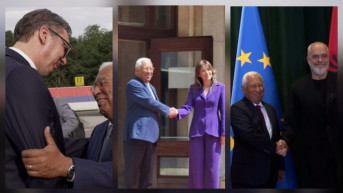
The President of the European Council, Antonio Costa, is touring the Western Balkan countries, a move that Kosovo Online’s interlocutors describe as a positive signal regarding the intensification of the EU enlargement process. Nevertheless, they emphasize that regional integration remains conditional, particularly in the case of Serbia and Kosovo, where the normalization of relations continues to be a key factor. They also question the European Union’s ability to genuinely deliver on its enlargement ambitions.
Written by: Jelena Novakov
Costa is visiting Serbia today, where he met with President Aleksandar Vucic and reiterated the EU’s continued support for the country’s European path. During their talks, they discussed issues related to the judiciary, the Regulatory Authority for Electronic Media (REM), electoral legislation, and ODIHR recommendations. President Vucic emphasized that it is important for Serbia to align itself with the rules and standards the European Union has established for candidate countries.
Meanwhile, during his stay in Pristina, Costa stressed that the normalization of relations is crucial for the European future of both Kosovo and Serbia, adding that progress has been achieved but that implementation of the Ohrid Agreement remains necessary. In Pristina, Costa met with Albulena Haxhiu and Albin Kurti. On that occasion, Kurti stated that Kosovo is ready to obtain candidate status and begin accession negotiations with the European Union.
The President of the European Council also visited North Macedonia, Albania, and Bosnia and Herzegovina, and will conclude his Western Balkans tour by attending the EU–Western Balkans Summit in Tivat.
Conditions and Normalization
Nikola Dencic, Foreign Affairs Editor of Radio Belgrade’s First Programme, told Kosovo Online that Antonio Costa’s visit demonstrated that the door to the European Union remains open, but not unconditionally, as accession will continue to be based on reforms and merit.
“What we expected, and what we indeed heard from the President of the European Council, is that the EU remains committed to enlargement. Both in Belgrade today and during previous meetings, Costa repeatedly stressed that the door remains open,” he said.
According to Dencic, the European Union currently considers the integration of the Western Balkans particularly important, but he stressed that accession remains subject to conditions.
“The message from Brussels remains that the accession process continues to be merit-based, that the necessary reforms must be implemented, and that without them there will be absolutely no progress,” Dencic said.
He recalled that Costa emphasized that the normalization of relations between Kosovo and Serbia remains one of the fundamental conditions for progress on their European path.
“It is important that the term ‘normalization’ remains in use and that Belgrade is not being asked, at least for now, to recognize Kosovo or establish relations on that basis. However, an agreement at a certain level remains necessary. We hear similar messages from other international actors, regardless of whether they support Serbia’s position and territorial integrity or recognize Kosovo’s self-proclaimed statehood,” he noted.
Commenting on Costa’s messages to Kosovo officials, Dencic said that the European Council President had highlighted the need for a more measured political rhetoric.
“There is no dispute that elections were held and that there was a winner, but the fact remains that the EU certainly could not have been satisfied with what has been taking place for more than a year now. The political crisis is indeed significant,” Dencic said.
According to him, the summit in Tivat could include discussions on new enlargement models, a new type of negotiation framework, or a new form of membership. Dencic also agreed with Costa’s assessment that the growing frequency of EU–Western Balkans meetings is a positive development.
“In recent weeks, we have heard that a new enlargement concept proposed by the German Chancellor is being seriously considered, although it has faced criticism both within Germany and from certain European leaders. For now, it remains on the table. We may not be talking about full membership, and the process could take a different form, but our countries would nevertheless become integrated,” he said.
Europe Needs the Western Balkans
Diplomat Albert Prenkaj told Kosovo Online that European Council President Antonio Costa views the European integration of the Western Balkans as a geostrategic necessity for Europe, adding that normalization of relations remains the key factor on the European path for both Serbia and Kosovo.
“President Costa’s observation that, in times of ‘global geopolitical uncertainty and economic instability,’ enlargement is not merely an option but a geostrategic necessity for Europe, reflects the view that enlargement represents an investment in peace, stability, and security across our continent. President Costa emphasized that normalization of relations between Kosovo and Serbia is essential for the European future of both countries,” Prenkaj said.
According to him, the European Council expects the Tivat Summit to assess the progress made in the gradual integration of the Western Balkans into the EU and to consider ways of addressing common challenges and strengthening security.
“Although Costa insists that EU enlargement is not an option but a ‘geostrategic necessity,’ the summit agenda suggests that this concern is perhaps more rhetorical than substantive. Under such circumstances, I would expect a more agile and proactive approach,” he said.
Prenkaj argued that if enlargement is truly of geopolitical importance, the process should be accelerated through an “integration alongside standards” approach rather than maintaining “standards as a precondition for integration,” particularly given the uncertainty prevailing at the global level.
EU Ready for Enlargement
Andreja Stojkovski, Executive Director of the Prespa Institute in North Macedonia, told Kosovo Online that the messages delivered by Antonio Costa during his Western Balkans tour suggest that the European Union is prepared to admit new member states, adding that this issue could feature prominently at the upcoming EU–Western Balkans Summit.
“The message we keep hearing—that enlargement is very high on the agenda and has once again become a priority for the European Union—is that countries currently in the accession process should do everything possible to accelerate their progress. I believe such an approach also implies that the Union itself is ready to receive new member states,” he said.
Commenting on Costa’s messages regarding Kosovo, Stojkovski noted that they reflected positions the European Union has consistently maintained and which focus primarily on institution-building.
He expects similar messages to be reiterated during the EU–Western Balkans Summit in Tivat. In addition, he said there is a possibility that leaders will discuss German Chancellor Friedrich Merz’s proposal to accelerate the accession processes of Ukraine, Moldova, and the Western Balkan countries.
“Since this will bring together all political leaders from the region, we will likely hear another repetition of the messages directed at each individual country. There will also be discussions about how to complete or round off the accession process and how countries can continue to advance,” Stojkovski concluded.
The EU’s Capacity
Albanian analyst and political editor of the daily Tema, Ili Pata, told Kosovo Online that Antonio Costa’s Western Balkans tour carries primarily a political message and is intended to clarify the direction the European Union intends to take with regard to the region.
However, he argued that the integration process has lost momentum due to internal challenges and that the European Union has failed to transform enlargement into a genuine political priority.
“I believe that the issue of enlargement is increasingly becoming a matter to be resolved by the most powerful EU member states rather than by the European Union as a whole, with Germany and France playing the leading roles. I think the summit in Tivat will serve more as a political signal from Germany than as a unified EU position, particularly following Chancellor Merz’s letter concerning Ukraine and Moldova. New developments are expected that could reshape the EU agenda, potentially to the detriment of our countries,” he said.
Speaking about Serbia’s integration into the EU, Pata identified Germany’s ambition to play a major role in the Belgrade–Pristina dialogue as a central issue, while also noting Albania’s involvement in the broader process.
“I believe the issue with Serbia, as we know, is Kosovo. In the negotiations among major powers concerning Kosovo, the European Union has so far played no significant role, whereas Germany has sought to establish one. I think that is the essence of the problem. Germany wants to play an important role in the negotiations between Serbia and Kosovo, and this will remain an issue in the future. Albania is also part of this equation because whenever Albanians are involved, it concerns a country that is very close to us,” Pata concluded.

0 comments