
Deadline for forming the Assembly has expired: Whose court is the ball in?
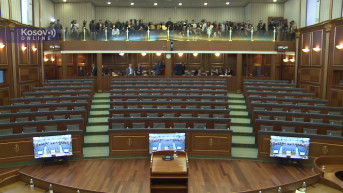
Kosovo is most likely on the brink of snap parliamentary elections, as 103 full days have passed since the elections on February 9, and the newly elected MPs have failed to constitute a new Assembly, despite having met 54 times. According to interlocutors of Kosovo Online, no other scenario is currently seen as viable. They believe the next steps lie with the Constitutional Court and the President of Kosovo, who is expected to initiate a new electoral process—meaning that the “Kurti 2” government in a caretaker capacity could remain in place until the end of the year.
Written by: Dusica Radeka Djordjevic
The last attempt to form the Assembly before the expiration of the 30-day deadline set by the Constitutional Court on June 26 failed last night shortly after 10 PM.
As of today and until August 8, a temporary measure issued by the Constitutional Court on July 24 is in effect, prohibiting MPs from making any decisions or taking actions related to constituting the Assembly resulting from the February elections.
The Self-Determination Movement (Vetëvendosje), which is leading the caretaker government, places the blame for failing to elect their candidate as Assembly President on the opposition parties, while the opposition claims it has been offering compromises throughout the process.
Since February, there has been speculation that Self-Determination would form a new government with Fatmir Limaj's NISMA party, but even last night’s meeting between Limaj and Kosovo President Vjosa Osmani, held just before the scheduled Assembly session at 10 PM, did not change the course of events.
“I told the president that the 30-day deadline for forming the Assembly had passed. Nothing happened—only talks,” Limaj, leader of NISMA, said last night.
So, whose court is the ball in now?
Former Constitutional Court judge Kadri Krieziu told Kosovo Online that President Vjosa Osmani, together with the Constitutional Court and the Central Election Commission, is now responsible for technically preparing for snap elections.
“The Constitutional Court’s decision is law, which means MPs had the duty to constitute the parliament within 30 days. This decision has consequences, such as the loss of mandates due to their failure to constitute the Assembly, which is a constitutional requirement,” Krieziu explained.
Snap parliamentary elections are also seen as the most likely outcome by Milos Pavkovic from the European Policy Center in Belgrade.
“The temporary measure prescribed by the Constitutional Court, which is now in force, means that there will be no parliamentary sessions until August 8. It is uncertain what will happen after that date, but everything seems to be pointing toward new elections. It would be very difficult for the Court to propose any other solution in a future ruling,” Pavkovic told Kosovo Online.
The problem, as he explains, arises from an informal yet institutionalized practice that the winning party always nominates the Assembly President. Given the current distribution of power and the minimal or non-existent coalition potential of Self-Determination—which received the most votes—their candidate couldn’t secure enough support.
“They refused to make any compromises, citing this informal practice, while the opposition knew that Self-Determination didn’t have a majority. This created a deadlock, and I don’t see what could change that now,” Pavkovic added.
No Support from the West
On whether there might be foreign pressure to resolve the situation without elections, Pavkovic said he doesn't believe foreign ambassadors are particularly inclined to do Self-Determination or Kurti any favors, given that Kurti has brought Kosovo’s relations with international partners to a minimum.
“I don’t see a scenario in which Kurti gains Western support or sees his candidate elected. On the other hand, the opposition could theoretically unite around an anti-Kurti platform to elect an Assembly President, which would technically announce a change in government. But considering the power dynamics within the opposition, and each party’s ambition to lead, that too seems unlikely. I believe we’ll be heading for new elections, possibly combined with the local ones in October,” he said.
This scenario—merging parliamentary and local elections—is also seen as the most likely by Aleksandar Rapajic, Program Director at the NGO Center for the Promotion of Democratic Culture from North Mitrovica. He expects that the first step will be for the President to ask the Constitutional Court for guidance, which would serve to delay the election announcement so that they can be held on October 12, together with local elections.
“If the current deadlines are observed, after the failure to form the Assembly, the President has 30 days to call elections, which are then held 45 days after the announcement. That timeline makes October 12 unrealistic, as elections would have to happen earlier. There’s no logic in holding two elections within weeks of each other. Therefore, the President will ask the Constitutional Court what to do next, which will delay the process by a week or two so everything can be aligned for October 12,” Rapajic told Kosovo Online.
Kurti Still Governing
According to Rapajic, the current situation benefits Self-Determination and the caretaker government, because “the Kurti government is still in power.”
“Despite performing worse in the elections and lacking the numbers to form a majority, Kurti’s government still governs. It does not act as a technical government—it makes decisions, spends the budget, issues tenders, and adopts significant policies. A technical government shouldn’t do that. This benefits Self-Determination, as they remain in power without winning the election,” he observed.
If parliamentary elections are held on October 12, final results could be expected in early November, which would mean that the Assembly might be formed by the end of the year—if it is formed.
“In essence, Kurti’s government is prolonging its rule for another year,” Rapajic emphasized.
He sees no alternative scenario to new elections.
“It’s impossible for the current Assembly to continue functioning and for these MPs to try to constitute it again,” he said.
Self-Determination MP Dimal Basha warned the opposition last night, ahead of the 54th attempt to hold a constitutive session, that this was the last chance to form the Assembly in accordance with the Constitution. If new elections occur, Basha expressed confidence that the LDK-PDK coalition would receive the punishment it deserves for failing to vote on the Assembly's formation.
Agim Shahini, President of the Kosovo Business Alliance, also believes there should be consequences for those responsible if new elections are held.
“If there are new elections, the President of Kosovo should clearly state who is to blame—whether it’s the opposition or Albin Kurti. Then the people can decide whom to vote for and whom to punish,” Shahini told Kosovo Online.
“We don’t have the time or the resources to spend another €20 million on elections, halt the economy and all processes, and go through another campaign. We already have local elections scheduled, but what’s happening in the Kosovo Assembly is something no one anticipated,” Shahini concluded.


comments