
Decani Charter: A Document on the Duration of Serbs in Kosovo
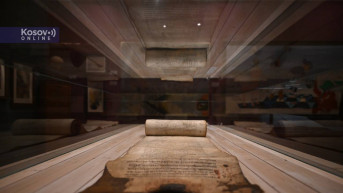
In the State Archive of Serbia, on the occasion of the Statehood Day, the founding charter of the Visoki Decani Monastery, one of the most significant monuments of Serbian medieval culture in Kosovo, has been displayed. This legal document provides valuable insight into the demographic picture of Kosovo in the 14th century, as explained by experts interviewed by Kosovo Online.
Historian Anja Vulic of the State Archive of Serbia explains that charters like the one from Visoki Decani are crucial for understanding Kosovo's history.
Along with the Decani Charter, two other notable charters are mentioned: the Gracanica Charter from 1321, written on the lintel of the church of the Dormition of the Theotokos in Gracanica, signed by King Stefan Uros II, and the Svetostefanska Hristovulja, a charter from King Milutin written after the completion of his tomb-church, the Monastery of Saint Stephen in Banjska.
Historians have not been able to determine the exact year of its creation but estimate it was between 1312 and 1317. A copy of this charter was found in 1889 in Old Sarajevo, Istanbul.
The Decani “Hrisovulja” from 1330, stored in special conditions at the State Archive of Serbia, is the first of these three significant documents. Written in the form of a scroll, it measures 330x5,200 millimeters and is sealed with the royal gold seal of King Stefan Uros III Decanski, son of King Milutin and father of Emperor Dusan.
Multiple Interpretations
Anja Vulic explains in an interview with Kosovo Online that the founding charter of the Visoki Decani Monastery should be interpreted from multiple perspectives. It is not just a legal or founding document of a monastery but also a kind of 14th-century population census.
"On one hand, it is a legal act, a founding act of a monastery and estate. On the other hand, it has exceptional literary features because it is not just a copy of earlier charters," Vulic emphasizes.
She adds that the format of charters in the 14th century was adopted from Byzantine and Roman traditions, but this particular charter stands out in its eschatology, particularly in describing the Battle of Velbazhd and the victory over the Bulgarians.
"What is perhaps most significant about the charter is that it represents a sort of population census," Vulic notes, pointing out that in the central section of the charter, the villages that King Uros Stefan III Decanski donated to the monastery are listed.
From this, one can see the structure of the population, the number of villages, and that it was mostly Serbian. What's also significant is that this part of the document was written in the vernacular, unlike the rest of the charter, which was written in the Serbian version of Old Church Slavonic, as it was intended for practical use.
The majority Serbian population is also evident in the listing of "heads of households," or families, in each of those villages.
"In the 14th century Kosovo and Metohija, particularly Metohija, show that only in two villages is the population 'Arbanas,' meaning Albanian. In all other villages, the population is Serbian. This conclusion is based on the names and practically on the male heads of households mentioned," Vulic clarifies.
Vulic reveals that the State Archive of Serbia has initiated a campaign to have the founding charter of Visoki Decani added to the UNESCO World Heritage List, as it currently is not listed because it is not physically located in the monastery.
The Visoki Decani Monastery is already on the UNESCO list, first in 2004 as a protected cultural heritage and in 2006 as a site in danger, which is very concerning. "It would certainly be nice and important for the founding charter of the monastery to be protected in this way," Vulic concludes.
Primary Historical Sources
Museum advisor Bojan Popovic from the Museum of Frescoes in Belgrade emphasizes that the founding charters of monasteries in Kosovo are primary historical sources that testify to the existence of Serbs in the region. The first founding charter of the Visoki Decani Monastery is one of the oldest and most important of these.
"It bears witness to the founding of the Decani Monastery and the reasons for its construction. It also marks the boundaries of the monastery and lists the people living on its lands. From this, we can draw topography, toponyms, and see a great number of names. It is, above all, a primary historical source because we learn that this region was completely inhabited by Serbian people," Popovic states.
Bojan Popovic, a museum advisor from the Museum of Frescoes in Belgrade, points out that Visoki Decani has two other charters written in the form of codices (books).
"One of them is still in the monastery, while the other is believed to be most likely located on Mount Athos, and it may one day be found," he explains.
These two charters were issued for practical reasons, Popovic clarifies:
"Had it been used merely as a legal document, which it was, to guarantee boundaries, it would have been easier to carry and present evidence on-site," he adds.
From these monastic charters, we can learn many details about the time period.
"They reveal much. They list the names of people who lived there, topographical details that can still be tracked today. From them, we even learn about the climate of the region. Some charters mention specific cultures that have since disappeared, like silk production, and the types of domestic animals raised," Popovic explains.
He also notes that a challenge for the study of medieval Serbia is the fact that many city archives have been lost.
"In our city archives, like in Novo Brdo, there were many documents that would have made it much easier to write history, but to some extent, these monastic charters help fill the gap," he says.
Popovic also highlights that other charters, like the Svetostefanska Charter from the Banjska Monastery and the Charter from the Monastery of the Holy Archangels in Prizren, are very similar to the Decani Charter.
"One of them is in Istanbul, and the other was lost during World War I, but its content has been recorded," he points out.
Some founding charters have been preserved on the very walls of Kosovo monasteries, as is the case with the Gracanica Charter.
"Just like in the written charter, the arenga, or the wish and motivation of the founder, is first given in learned language, and then the monastery’s boundaries and rights are guaranteed, followed by the ruler's signature at the bottom of the charter. With this Gracanica Charter, we can know exactly when Gracanica was built and to whom it was dedicated," Popovic emphasizes.
He adds that even when there is no preserved document about the origin and life of churches and monasteries in Kosovo, we can learn about them in an indirect way.
"In one of the first charters, the Hilandar Charter, the settlement of Hoca and the Church of Saint Nicholas are mentioned, for which we have little evidence. But from the church itself, we learn that it was painted in the Middle Ages, that the local nobility probably cared for it, and most importantly, that it was later renovated during the time of the restoration of the Pec Patriarchate, and that it was maintained even in the difficult times of our ancestors," Popovic concludes.
Understanding the Past
Dr. Petar Ristanovic, a scientific associate at the Institute for Serbian Culture in Leposavic, emphasizes that the founding charter of Visoki Decani is one of the most significant sources for understanding the history of Kosovo during the Middle Ages.
"The founding charter of Visoki Decani is one of the most important sources for understanding the history of Kosovo and Metohija during the Middle Ages," Ristanovic explains to Kosovo Online.
He clarifies that the key issue is the lack of enough direct written sources documenting the demographics of that period in Kosovo.
"Because of this, this charter is a crucial document from which we can learn who lived in that area, where, and to some extent, how they lived. When combined with other, primarily archaeological and material sources, it allows us to form a somewhat hazy but sufficiently clear picture of Kosovo and Metohija in the 14th century," Ristanovic adds.
He further states that this is particularly important in the current political context.
"Perhaps the most important thing is that we can learn about the demographics of the region and its religion, which in modern terms we might call 'national identity.' From this, we know that during that period, particularly in the area that the founding charter of Visoki Decani designated for the monastery, which covered a large part of present-day Metohija, the population was predominantly Serbian. In 99% of the settlements, villages, and pastures, the inhabitants were Serbs. Only a small percentage of the population was Albanian, as evidenced by the names listed," Ristanovic clarifies.
He explains that the problem in studying Kosovo’s medieval history lies in the scarcity of written sources, which, although few, have been preserved in archives in Istanbul, Rome, and other major centers.
"There are more sources from this region, but not enough. They are mostly from later periods, particularly the Ottoman period, but even those are scarce. Therefore, we must supplement the Decani founding charter, as well as other written sources, with material sources found on-site, including archaeological and other finds. All of them together provide a relatively clear picture, one that shows that in the 14th and 15th centuries, the dominant population of this region was Christian, namely Serbian," concludes Ristanovic.
Misuse of History
Historian Marko Markovic discusses the significance of the Decani Charter, particularly in the context of today’s "political upheavals and the misuse of history for political purposes."
"Anyone who looks at the original Decani Charter, which is almost seven centuries old, will clearly see who lived in this area, who ruled it, and how powerful, developed, and culturally grounded the medieval Serbian state was," Markovic tells Kosovo Online.
He adds that the land of Visoki Decani spanned areas that cover territories of several modern-day Balkan countries.
"The entire estate of Visoki Decani, which was quite large and stretched across the territories of today's three countries—Serbia, Montenegro, and Albania—was almost entirely inhabited by Serbs. The situation remained the same in the subsequent period, as later written historical sources testify," says Markovic.
He clarifies that these sources refer to the existence of an independent Serbia and later the Ottoman rule.
"We have a census from 1455, which documents the lands of Vuk Brankovic, and it shows that the area of Kosovo and Metohija was almost entirely populated by Serbs—98 percent—while only two percent were non-Serbs. This primarily refers to the Dubrovnik people, members of the Catholic faith who were here near the mines, and a very small number of Albanians," Markovic claims.
He explains that the first significant demographic changes in Kosovo occurred at the end of the 17th century.
"The first serious demographic changes in this region happened only after 1690, with the first Serbian migration and later the second migration, followed by the most significant changes between 1878 and 1912, when a large number of Serbs were forced to leave this area and settle in the territory of the Kingdom of Serbia," Markovic emphasizes.


0 comments