
Dialogue and three new conditions: A Brussels chess game or a bad remake of the movie "Groundhog Day"
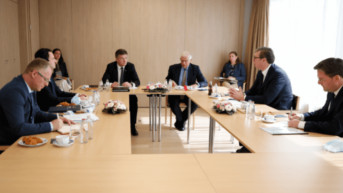
The new round of talks between the chief negotiators of Belgrade and Pristina ended in another fiasco. Unlike all previous ones, this outcome was absolutely expected. Interviewees for Kosovo Online emphasize that this outcome was clear as early as last week after Albin Kurti refused a tripartite meeting with Aleksandar Vucic and conditioned the continuation of the dialogue with three new demands.
Some call it a chess game. It is unclear whether Prime Minister Albin Kurti "checkmated" Belgrade, the European Union, or Pristina in Brussels.
For others, it's a bad remake of the movie "Groundhog Day," where the same day repeats over and over again, just like the negotiations in Brussels.
This was also the case yesterday.
For the chief negotiator of Belgrade, the director of the Office for Kosovo and Metohija, Petar Petkovic, yesterday's round of dialogue is proof that Pristina fundamentally does not want to normalize relations, and that the formation of the Community of Serb Municipalities, an unequivocal condition of the US and EU, is "the last hole in the flute."
"Pristina is killing the dialogue," said Petkovic.
For the chief Pristina negotiator, Besnik Bislimi, the key problem was that Petkovic exclusively insisted on adopting the European draft of the Community of Serb Municipalities (CSM).
"The only agenda item we had to make progress on was the discussion on finalizing the sequencing plan. But Petkovic was only interested in one point, which involved adopting the European draft statute of the Association of Serb Majority Municipalities," Bislimi told reporters after the meeting.
A chess game or a movie remake? Is this what the outgoing EU foreign policy chief Josep Borrell meant when he summarized not just the past week but also his five-year mandate in the EU, saying that the Belgrade-Pristina dialogue process requires courage, vision, and political will?
Last week, instead of the announced tripartite meeting between Albin Kurti and Aleksandar Vucic, Borrell ended the day by informing journalists that Kurti did not want the meeting and instead presented three new conditions, the key one being mutual recognition.
European officials also tried to "clarify" this term, further entangling the situation.
Among the first was EU spokesperson Peter Stano.
Announcing yesterday's meeting between the chief negotiators of Belgrade and Pristina, Petar Petkovic and Besnik Bislimi, he explained that the priority and agenda of the meeting were determined by "the utmost urgency of starting the implementation of the Agreement on the Path to Normalization of Relations between the two sides."
"There is no recognition involved, but of course, a logical consequence of normalization would be recognition. But that is something much later in the process," said Stano.
The main EU negotiator Miroslav Lajcak has always talked about normalization of relations. Last week, at the Dubrovnik Forum, he explained what he meant by that.
"Of course, it is up to the parties to determine what normalization means," Lajcak said.
Petkovic was brief and clear about all these "doublets."
"That movie won't be watched," he said.
A Vicious Circle
Sociologist Vladimir Vuletic vividly describes the meetings in Brussels as a remake of the movie "Groundhog Day." He adds that a suitable "doublet" could be - a vicious circle.
"When it comes to these talks, it's like Groundhog Day. The same thing repeats every time, there is no progress, and you actually wonder if progress is even desired. It's clear that Pristina and Belgrade are on different positions and that their ultimate interests are mutually opposed. However, those who are moderating these talks, if they truly aim to achieve some progress, should do something. Now my impression is that neither side has great enthusiasm to take a decisive step towards what is called normalization, which, obviously, everyone understands differently," Vuletic said in an interview with Kosovo Online.
He emphasizes that due to the slow progress in the dialogue on all issues, the Serbs in Kosovo suffer the most.
"For us and for the lives of people in Kosovo, the hardest part is that economic ties have been severed. By this, I mean the flow of goods and money; only the flow of people remains, but it has also slowed because there are many restrictions related to official visits. People are no longer sure when crossing the border whether someone might decide they are an element to be arrested... We see that although these talks are ongoing, the situation is getting worse," Vuletic emphasized.
He says that Prime Minister Albin Kurti's attitude towards the dialogue was best seen from his actions last week because it was more important for him to watch Albania in the European Football Championship than to engage in talks.
"These meetings between high officials only make sense if something is prepared and agreed upon in advance. But we saw, and we knew, that even if they had met, it would have been just to have coffee, because during the preparation period, Kurti went to the match. It was more important for him to watch Albania than to meet with Lajcak and discuss the dialogue. When it comes to conditions, Kurti does everything to avoid making any progress in the dialogue. Neither side has a fundamental desire to do anything. This is dangerous because it leaves the conflict and the wound open and creates a security problem. One must ask whether anyone is truly interested in keeping security an open question. That worries me," emphasized the sociologist.
"Everything is an attempt to feign talks because he is fundamentally not interested in any talks before Belgrade recognizes Kosovo. Due to pressure on him, he agreed to talk, but in such a way that the conversation leads nowhere, creating a vicious circle. It has been clear from the start that he is not interested in dialogue. Talks can occur after Belgrade recognizes Pristina, so that they can negotiate various issues as two mutually recognized states, but that is not the way to solve this process," Vuletic concluded.
Negotiations Without Negotiations
Professor Miloš Bešic from the Faculty of Political Sciences in Belgrade believes that after a series of unsuccessful meetings in Brussels and the new conditions set by Prime Minister Albin Kurti, the negotiations on normalizing relations should be stopped because it is clear that neither Pristina nor the EU has the political will to conclude them.
"I think these negotiations should simply be stopped. It is very clear that there is no political will for negotiations. It is very clear that Mr. Kurti's only goal and strategy is an independent Kosovo at any cost, without making any compromise or concession. And it is very clear that what we call mediators, international mediators in negotiations, are actually on the side of an independent Kosovo. There is no doubt that the Quint countries and all key EU countries support Kosovo's independence and do everything they can to pressure Serbia to achieve that independence," Bešic told Kosovo Online.
He adds that the Serbian leadership is aware that there are no real negotiations, but its position is forced at this moment.
"I understand Serbia's participation in all these negotiations, not because it has the will, desire, intention, or belief that this issue can be resolved, but simply due to a lack of choice and to show some goodwill so it cannot be said that Serbia refuses to negotiate. However, I think the Serbian state leadership understands very clearly that there are no negotiations and that nothing can happen without harming Serbia. Therefore, you must continue these negotiations, but without any hope that they will lead in any constructive direction," Bešic said.
He does not expect the new European administration to present a better strategy than the current one.
"They have a very clear strategy. They have a strategy to simply go from negotiation to negotiation until sooner or later one or both sides, primarily Serbia, lose patience and put an end to it. Do not forget, things happen on the foreign policy scene in the meantime, and there are mechanisms of potential pressure that can be exerted primarily on Serbia," Bešic emphasized.
He concludes that the key problem is that the Quint countries and the EU see the recognition of Kosovo by Serbia as the only outcome of the Belgrade-Pristina negotiations.
"The goal of these negotiations is for Serbia to recognize Kosovo. Sometimes this is stated de facto, which is the recognition of Kosovo. So, that is the goal of these negotiations. That goal is held by the Quint countries, the EU countries, and the mediators. Their goal is very one-sided, unipolar, in the interest of Kosovo, and they will continue these negotiations constantly using new mechanisms and arguments to pressure Serbia. It is very clear what is happening here," Bešic believes.
How Different People Interpret "Normalization"
Milan Gulic, a scientific associate at the Institute of Contemporary History, assesses that yesterday's round of negotiations between Belgrade and Pristina showed that the dialogue process is "without novelties" because the West exclusively considers the recognition of Kosovo as "normalization."
"Progress in dialogue nowadays in the West is mostly seen as the withdrawal of the state of Serbia from Kosovo and Metohija, and this has been continuously done since 1999. Even the little sovereignty that remained there is gradually being withdrawn, and this progress boils down to a dialogue where one side gets everything, and the other gets nothing. Well, that is not a real dialogue, but it is simply the outline of relations in the world at this moment," Gulic said in an interview with Kosovo Online.
Evaluating the seven-hour negotiations in Brussels between chief negotiators Petar Petkovic and Besnik Bislimi, which ended without results, Gulic says there have been "no special novelties for a long time."
"I wouldn't say that there are any particular novelties here. Simply put, Pristina has had serious support from the most significant Western countries for a long time, and it is aware of this and conducts its policy accordingly. They often issue demands, and despite the strong reactions, they usually manage to achieve what they wanted in the end," said Gulic.
He adds that it is wrong to conclude that only Prime Minister Albin Kurti or the Kosovo leadership since 1999 is responsible for the stalemate.
"I would say that this has been a decades-long policy of the Albanians, who have been doing the same since socialist Yugoslavia. They present demands through demonstrations, which are brutally suppressed, and in the end, the demands are fulfilled. This case will follow the same pattern," Gulic believes.
Who Makes the First Move?
Analysts from Kosovo agree that nothing unusual is happening in the dialogue between Belgrade and Pristina and that the key dilemma in this "chess game" remains - who should make the first move.
Visar Imeri, Director of the Musine Kokalari Institute for Policy, told Kosovo Online after yesterday's round of dialogue in Brussels that nothing unexpected happened and that the conditions set by Kosovo Prime Minister Albin Kurti last week are Pristina's tactic, which he is unsure will bear fruit because the Serbian side is not ready to meet them.
"Nothing unexpected happened; we heard the same stories as before, that we meet, talk, and each side holds its position without any progress. What Mr. Lajcak said, that they agreed on the next steps, was strange to me because neither Petkovic from Belgrade nor Bislimi from Pristina mentioned it. This means that either they don't want to talk about it, or Lajcak is very optimistic, just doing his job. So far, we have not seen any good and important results and steps in that direction," Imeri says.
What is happening in the dialogue, he points out, was seen after Kurti and Vucic were supposed to meet in Brussels but did not. According to him, this is a sign that the dialogue is currently dead.
"We constantly talk about an agreement that needs to be implemented but won't be implemented. It seems that neither side is willing to start the process of implementing that agreement," Imeri assessed.
He emphasizes that the Community of Serb Municipalities is one of the responsibilities Kosovo has, but Pristina will not do anything in that direction until, as he said, it receives some guarantees that the Serbian side will implement its part of the agreement.
"I think the letter sent by former Prime Minister Brnabic caused major problems in the dialogue process. One side cannot say it agrees with the agreement but will not implement point 24 and the like. If you agree with the agreement, it means you agree with the entire text, not just some parts. I think the biggest problem is that the Kosovo government, Prime Minister Kurti, and Deputy Prime Minister Bislimi keep saying they expect and demand some guarantees that Serbia will implement its part of the agreement, and then the Kosovo side will also make steps in that direction. I think that was the case last year, and we have the same problem now," he said.
He also emphasizes that when it comes to the conditions Kurti set, two of the three points are related to guarantees that Serbia will implement the agreed terms.
"That they will implement the de facto recognition of the Republic of Kosovo, but the third point is very serious. I think the Kosovo side has the right to demand that Milan Radoicic, who was the main organizer of the attack in Banjska, face justice, and if Serbia does not do this, he should come to Kosovo and face the Kosovo court," said Imeri.
If the Kosovo side sticks to these conditions, Imeri believes that there will be no progress in the dialogue in the near future because, as he points out, he does not see the Serbian side's willingness to do anything to fulfill them.
Bislimi's trip to talk with the Serbian side, Imeri somewhat sees as hypocrisy.
"If the position of the Kosovo side now is that there is no dialogue and no implementation of the agreement without these conditions, then why go? If Kurti does not want to meet with Serbian President Vucic, then why should Bislimi meet with Petkovic? It makes no sense. I think each side, both Kosovo and Serbian, each government, tries to have a strategy and some tactics in the dialogue process. I think the Kosovo government in this case is acting tactically, we will not stop the dialogue, but we will set conditions in the dialogue and see what happens," this analyst believes.
Imeri is convinced that there will be no major steps forward in the dialogue until a new Commission is formed in the European Union and the elections in the USA are over.
"We now have elections in the United Kingdom, the first round of elections in France is over, we will wait for the second round to see who will form the government there. There are very big issues, and in this situation, I think neither Kurti nor Vucic have any reasons to make a step forward towards implementing the agreement," Imeri concludes.
Changing EU Stance
Aleksandar Sljuka, a collaborator from the NGO "New Social Initiative" in North Mitrovica, told Kosovo Online that the meetings in Brussels are necessary, but that we "won't see anything sensational" until next year.
"We know that essentially until Kurti is appeased, there will be no major steps. However, I think these conditions will not be a decisive obstacle because the EU seems to have slightly changed its stance. Initially, it supported or tacitly approved all of Kurti's conditions and attempts to dilute the course of the dialogue. I think this will no longer be tolerated," Sljuka emphasized.
However, he is reserved about whether these pressures will affect the Kosovo Prime Minister.
"The question is how this will affect Kurti. I think it won't. We won't see anything sensational at least until next year. As long as Lajcak's mandate lasts, there will be no major progress in terms of forming the Community of Serb Municipalities (CSM)," Sljuka believes.
Commenting on the claim of the chief Pristina negotiator Besnik Bislimi that Petar Petkovic insisted on forming the CSM in Brussels, Sljuka says that such an approach by Belgrade has EU support.
"Such an approach by the Serbian side has EU support, and I think they will also insist that the Community be the first and most important issue in the sequence of implementation, to at least take certain steps, after which certain things can be expected from the Serbian side. This will be very difficult for Kurti to accept, especially considering that elections can soon be expected in Kosovo. He will not look to harm himself and lower his rating by forming the CSM at this sensitive moment for him," emphasized Sljuka.
Aleksandar Sljuka sees the announcement that Belgrade and Pristina should submit their comments on the EU's proposal regarding the sequence of steps in implementing the agreed terms to Lajcak by July 18th as a déjà vu of the negotiations concerning the dinar.
"We have essentially already seen this with the dinar. The sides have entrenched themselves in their positions, and the EU was powerless to unblock it. After seven meetings about the dinar, we saw no progress, and now that topic is practically no longer discussed. I think this is more of a welcoming speech from Borrell and Lajcak than an expectation of their constructive engagement regarding the implementation of that agreement," explained Sljuka.
Conditions for Dialogue
The President of the Kosovo Business Alliance, Agim Shahini, claims that the dialogue process is in a sort of moratorium due to the conditions set by Kosovo Prime Minister Albin Kurti, which, as he emphasizes, Serbia will not fulfill.
In an interview with Kosovo Online, Shahini does not believe that the problem between Kosovo and Serbia will be resolved anytime soon.
"In our assessment, the dialogue between Kosovo and Serbia is still in a moratorium because Prime Minister Kurti has requested three conditions from Serbia, which Serbia certainly will not meet. If these three conditions from Kurti remain firm, in my opinion, the dialogue with Serbia will be in a long-term moratorium," says Shahini.
He emphasizes that many factors will influence the further course of the dialogue, and he reminds that the summer break is starting.
"Additionally, there were elections in the European Union, so until other emissaries are appointed, then America goes into an election campaign, so there will be nothing, and after that, we will also enter the election process. Therefore, it doesn't seem to me that the Kosovo-Serbia problem will be resolved quickly," said Shahini.
He also reminded of the bans imposed by the Kosovo government, which mostly affect the Serbian people.
"We have a problem; Serbian citizens do not have their products here, and the ban is still in place, and they still have a problem with the dinar. There is still no solution for that," says Shahini.
The problem, as he emphasizes, is also that the citizens of Kosovo and Serbia do not view each other as friends, unlike other peoples in the region.
"For instance, we don't view each other as we view Macedonians or Montenegrins, or how Serbs view others. Instead, we see that we still have unresolved issues with each other, and our politicians do not prioritize resolving these problems," noted Shahini.
He reminded that other nations have also been at war, citing the example of Germany and France, but today these countries have the largest trade exchange.
"We had 370 million in imports from Serbia the year before last, and last year less than 200 million. This means that in this direction, everyone loses, there are no winners. Only the citizens suffer losses," he concluded.

0 comments