
Does Osmani have grounds to appoint a mandate holder for a new Kosovo Government?
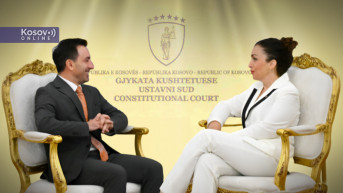
On paper, at least, everything seems clear. If the Assembly has been constituted, as its new president Dimal Basha claims, the next step would be for Kosovo’s president Vjosa Osmani to designate a mandate holder to form a new government. Still, her office has stated that “the Presidency’s legal team is conducting an analysis” regarding the process of constituting parliament. Legal or logical entanglement aside, interlocutors of Kosovo Online claim that things have not moved beyond the starting point, and that in any case another Constitutional Court ruling is inevitable. The only question is whether the appeal will come from Osmani herself or from someone else.
Written by: Djordje Barovic
“President Osmani informed President Basha that the Presidency’s legal team is conducting an analysis regarding the process of constituting the Assembly of Kosovo,” read yesterday’s statement following the meeting of the Kosovo president and the newly elected president of the Kosovo parliament, Dimal Basha.
According to Article 84 of the Kosovo Constitution, paragraph 14 provides that the president’s duty is to “appoint the mandate holder for the formation of the Government, upon the proposal of the political party or coalition that holds the majority in the Assembly.”
Although Saturday’s attempt to elect a deputy speaker of parliament from the Serbian community failed, Basha insists that the “Assembly has been constituted.”
However, most legal experts and opposition parties hold the opposite view.
One of the authors of the Kosovo Constitution, Ismet Salihu, argues that injustice was done to the Serbs in the Kosovo parliament during the attempt to constitute the Assembly. He claims that only the Serb List had the right to nominate a deputy speaker from the Serbian community.
Salihu stresses that the Assembly of Kosovo has not been constituted, despite Basha’s claims.
“The constitution of the Assembly of Kosovo only occurs once all bodies are completed—the president, deputy presidents, and committees. Until then, the Assembly cannot be considered constituted,” Salihu argues.
Former Constitutional Court president Enver Hasani is equally clear.
“There is no constituted Assembly without the election of the president and all deputy presidents,” Hasani emphasized.
The same was noted by Kosovo Democratic Institute associate Eugen Cakolli.
“The claim that the Assembly is constituted is not only politically meaningless, but legally void, in the sense that it produces no legal consequences,” said Cakolli.
For this reason, his colleague Vulnet Bugaçku urged Osmani to “act as the guarantor of constitutional functioning of the institutions.”
“The president must be cautious, prudent, and play her role as guarantor of the constitutional functioning of institutions,” Bugaçku said, expressing hope that Osmani “will not take any action that would seriously violate the Constitution.”
“If the president eventually begins consultations with the winning party and appoints a prime minister-designate to form the government while the case is pending before the Constitutional Court, then we could face a situation in which either the constitution of the Assembly or the appointment of the prime minister-designate is declared invalid,” Bugaçku warned.
The issue was already raised by the Serb List on October 30.
In their statement, they said they had filed an appeal due to the “serious violation of the rights of the Serbian people at Assembly sessions in Pristina.”
Interpretations and Consequences
Political scientist Ognjen Gogic believes the key question is whether Osmani’s legal team will “accept” the interpretation of the new Assembly president.
“Apart from the Serb List questioning the manner of electing—or rather failing to elect—the Serbian deputy speaker, there is now the open question of whether President Vjosa Osmani will accept Speaker Basha’s interpretation that the ‘Assembly has been constituted.’ If she rules that it has been, then steps toward electing a government must follow, and she, as president of Kosovo, must give the mandate to the election winner,” Gogic told Kosovo Online.
He explained that she has no clearly defined deadline for this, but that past practice has been to “do it without delay.”
“Therefore, if she concludes that the Assembly has been constituted, she should without delay give the mandate to the election winner, namely Self-Determination and incumbent Prime Minister Kurti. He then has 15 days to present his cabinet,” Gogic clarified.
He also stressed that this would be a key moment when opposition parties, in addition to the Serb List’s appeal, could themselves approach the Constitutional Court.
“It could happen that opposition parties, independently of the Serb List’s complaint, declare that the Assembly has not been constituted and that the president therefore had no grounds to give Kurti the mandate to form a government, and that they themselves file an appeal. In that case, the Constitutional Court would have to act more quickly, since consequences would already be arising. Such a reaction would actually accelerate the Court’s intervention,” Gogic emphasized.
Constitutional Court Ruling
Lawyer Ardian Bajraktari stresses that the 2014 Constitutional Court decision clearly states that the Assembly can only be formed with the election of all deputy speakers and that “any other interpretation is contrary” to that standard.
“The Assembly of the Republic of Kosovo is constituted by electing the president and deputy speakers, who make up the Assembly Presidency and are responsible for its administrative work. Without electing the members of the Presidency, the Assembly is not considered constituted,” Bajraktari told Kosovo Online.
He explained that the Constitutional Court had ruled on this 11 years ago.
“This was already decided in 2014 by the Constitutional Court of the Republic of Kosovo, and the ruling has since been reaffirmed in two recent judgments, one in June and the other in August. Any other interpretation or action is contrary to this standard, which was established by the Constitutional Court and remains valid and in force,” Bajraktari clarified.
Pressures and Preconditions
Marko Milenkovic, associate of the NGO New Social Initiative, emphasized that without the election of a Serbian deputy speaker of parliament, there are no conditions for Kosovo to receive a mandate holder.
“For Self-Determination, the only acceptable outcome is to move forward with the procedure, but it is clear that without a deputy speaker from the Serbian community this is not possible. In my opinion, the Assembly cannot be considered constituted at this moment, and I think the conditions are not met to have a mandate holder so as to enter the procedure for forming a new government,” Milenkovic told Kosovo Online.
Commenting on yesterday’s meeting between Osmani and Basha, as well as the statement that “the Presidency’s legal team is conducting an analysis regarding the process of constituting the Assembly of Kosovo,” Milenkovic emphasized that the key question is how Vjosa Osmani will respond to pressure from Self-Determination to continue the procedure.
“We will see how Vjosa Osmani responds to the pressure that will evidently come from Self-Determination to move forward with the process. There is always the option that Osmani again turns to the Constitutional Court with another request for interpretation,” Milenkovic said.
He added that the issue of the legitimacy of the Assembly’s constitution is already before the Constitutional Court, since the Serb List has appealed the procedure of electing the deputy speaker from the Serbian community.
He warned that Self-Determination will “apply additional pressure” on all parliamentary parties, especially the Serb List, until the Constitutional Court’s ruling.
“This opens the field for Self-Determination to exert additional pressure, shifting responsibility and blame to other actors, primarily the Serb List, and we will not have a constructive approach, just as we did not in the previous period,” Milenkovic argued.
He is convinced that Self-Determination will “continue to interpret the laws and Constitution to suit their interests.”
“This more or less reflects Self-Determination’s entire previous mandate and their approach of interpreting laws, rules, and the Constitution in a way that suits them, without ensuring a professional and equal approach in legal terms, and without taking into account the Serbian community and its positions, as well as those of other political actors and parties. In short, they do not view the overall political situation in a democratic manner, but in an autocratic way. This has been the case in the past, and I believe it will continue,” Milenkovic concluded.


0 comments