
Election Day and Security: Police, EULEX, and KFOR on Standby, what are the challenges?
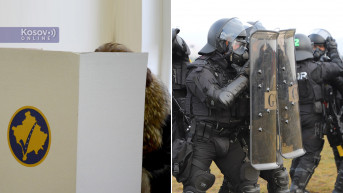
While political parties have been striving to attract as many voters as possible ahead of tomorrow's parliamentary elections, EULEX and KFOR have been conducting crowd control and riot exercises. Both international missions have increased their presence. As the saying goes, better safe than sorry. These measures, according to contributors to Kosovo Online, are good prevention given the unstable security situation in Kosovo, but they simultaneously hope for a peaceful election day.
Written by: Dusica Radeka Djordjevic
At the KFOR camp in Novo Selo, the EULEX Specialized Police Unit and the Reserve Specialized Police Unit, composed of members of the European Gendarmerie Force, conducted an exercise about ten days ago in case there was a need for “establishing order.” They also went through medical evacuation training "in situations that require a rapid response." KFOR members have also conducted several "crowd and riot control" exercises.
In Kosovo's three-tier security mechanism, the Kosovo Police is the first line of security response, EULEX acts as the second, and KFOR as the third.
At the Kosovo Police Directorate yesterday, a meeting was held regarding police engagement in implementing the operational plan on election day, attended by representatives from KFOR, EULEX, OSCE, the US Embassy, and the EU Office in Kosovo.
“Part of the discussion focused on creating a peaceful and secure atmosphere so that all citizens could freely exercise their voting rights,” the police statement said.
Deputy Director of Police for the North region, Veton Elshani, stated that an operational plan has been made for election day and generally for all of Kosovo and specifically for the north.
“Voting locations have been determined by the CEC, we are monitoring them and are ready to intervene at any moment if needed. The situation is calm," said Elshani.
According to Milos Pavkovic, an associate at the Center for European Policies in Belgrade, there are three potential scenarios that KFOR and EULEX might have considered in preparation for election day.
"As a potential challenge for the organization of elections, I see organized provocations, perhaps primarily from the Albanian side, by individuals or groups that could be in North Mitrovica or in places where the Serbian majority lives. This is something that is a real danger. Alternatively, if there are organized groups within the Serbian community calling for a boycott or preventing citizens from voting. The third potential situation is protests due to dissatisfaction with the organization of the elections or some decisions by the institutions in Pristina," Pavkovic tells Kosovo Online.
As he explains, these scenarios might primarily occur in the north, but also in the south, in places predominantly inhabited by Serbs, like Gracanica.
However, as Pavkovic assesses, KFOR has proven capable of controlling protests even in much more tense situations, recalling the incursions by the Kosovo Police into institutions in the north.
"KFOR was able to keep the crowd from entering the municipal buildings, so I believe that in this situation, they have enough personnel and are sufficiently well-trained to prevent the spread of any potential protests or unrest," says Pavkovic.
During these elections, caution has also increased because the Serbian community is participating after several years of boycotting Kosovo institutions, especially considering the tense situation and events from the past period.
According to Hisen Gecaj, a security expert, elections further complicate the security situation in Kosovo, which is why he says it is good that both NATO command and EULEX have decided to reinforce their troops on the ground.
He assesses that the situation in Kosovo, especially in the north, is quite fragile and requires such actions by these units.
"Groups that are ready to destabilize this region would always use the election period, and then there would be unrest that would be difficult to calm down. Therefore, this prevention is necessary and I think everything will proceed in the best order," Gecaj told Kosovo Online.
Citizens, he added, expect elections to always proceed peacefully, but given the current mood between the authorities and the opposition, it is possible that there could be some unrest that would disturb the citizens.
"Then this could also be used externally, by other parties who would try in some way to disrupt the order and peace that currently prevails in Kosovo," Gecaj mentioned.
Although there was some inflammatory rhetoric during the election campaign, Zoran Savic from the NGO Aktiv says that this is a common occurrence worldwide and he does not expect there to be any major security problems tomorrow.
"There should not be major challenges. I assume that along with the Kosovo Police, members of EULEX and KFOR will develop an operational plan to ensure the election day passes without incidents. The CEC has prepared an operational plan and I expect this day to proceed peacefully," Savic told Kosovo Online.



0 comments